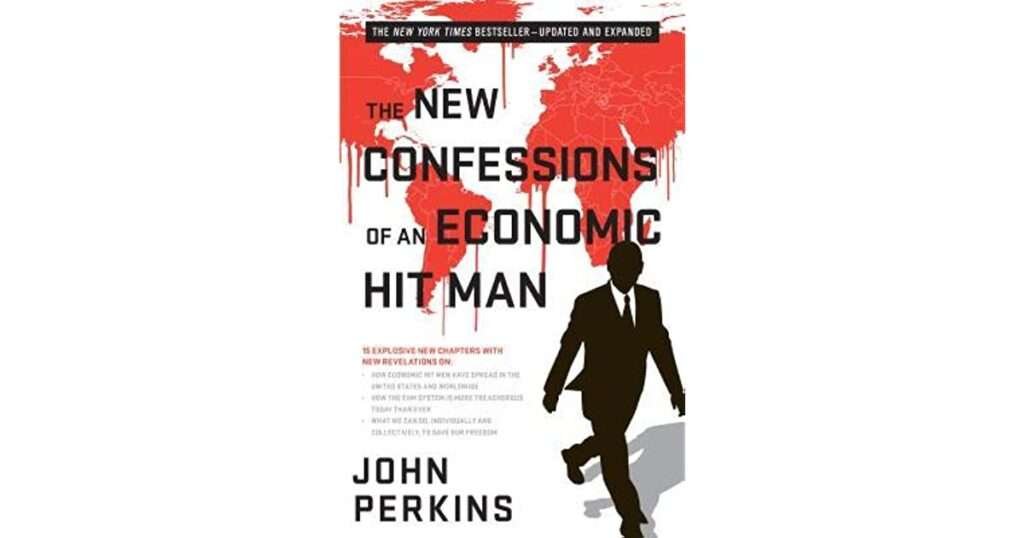
The book “The New Confessions of an Economic Hit man” written by John Perkins is a delineated treatise on the tactics that powerful countries employ covertly to control developing and underdeveloped. John Perkins is an American writer. He holds a bachelor’s degree in business administration from one of the high-ranked American institutions, Boston University. Having closely worked with World Bank, United Nations, IMF, and US treasury departments, Perkins appears to claim in the book about economic webs used by the US to maneuver economically enfeebled nations. His book mainly surrounds the paid professional economic hit men who work in different countries under United Nations organizations. Their prime tasks are to produce statistically manipulated financial reports, rig the elections, topple anti-American regimes and deal with different negotiations that profit powerful nations.
The book covers two aspects political in general and economic in particular. Perkins tells that the US uses economic debt traps, infrastructure myths, human development projects, and democracy proponents to do political engineering in different countries. To carry out these goals, the US creates corporations in the desired countries. Economic crises in any country, he believes, lead to political instability.
When South Vietnam fell under communist ideology holders, the US engaged in airing the propaganda of the threat faced by the world due to the Soviet Union and China because, with their rise, the US had to face new competitors in infrastructure, economy, and technology zones.
US via World Bank and USAID finance to establish the infrastructure of developing countries to pull them out of poverty. For this, they hire economic hit men to accomplish the tasks in these infrastructure projects in third-world countries. They, economic hit men, under the guise of different development projects extract mineral resources of said countries. In addition to this, they carry on US policies which mean overthrowing anti-US regimes, installing the government of their favorite politicians, and regulating foreign trade and affairs in the wide interest of the US in these countries.
According to Perkins, in 1953 it was the US behind the political instability in Iran. The US engineered the overthrow of the democratically elected Prime Minister Muhammad Musadegh by sponsoring street riots and violent demonstrations country-wide. Following the debacle of Musadegh’s regime, anarchy pervaded the country creating a vacuum of power thereby allowing a dictator to walk into the power corridors. Shah Mohammad Reza Pahlavi, a US-backed dictator, became the new ruler of the country and the dethroned prime minister was put under house arrest.
Mossadegh met this fate because of his policies. During his government, he nationalized all petroleum assets. This policy, to a large extent, created great hurdles for US oil companies and related corporations from generating revenue from Iranian oil. Oil-rich countries have always been on the top list of the US. Washington usually installed her companies and corporations in such countries and via these links, she boosted her economy and power sectors.
According to the writer, Washington, in order to build its hegemony, set free Panama by dismantling the militia that was controlling the region and established a puppet government there. Torrijos, a rights-fighting leader, denounced US influence in the country and without associating with any ideology started the movement for the legitimate rights of the people of Panama.
Perkins is of the view that America does not face any backlash by world forums due to her malevolent and undue influence in weakening the countries both politically and economically. Corporations around the globe induce developing countries to borrow huge amounts of money, designated to conditional investments in infrastructure, ultimately with the motive of making laden-debt countries more dependent, economically and politically upon the master of lenders.
In order to make America from a republic to a global empire, monetary organizations like International Bank for Reconstruction and Development and IMF not only allured developing countries to borrow more and more debts but created also an atmosphere of security threat in different countries. Saudi is one of those countries. Realizing the security vulnerabilities of neighboring countries like Iran, Iraq, Syria, and Israel, Saudi ended the embargo it had, along with different Arab countries, imposed on oil. American, after this step Saudi, began negotiations on procuring technical support, military weapons, and training and opportunity to bring them into the twentieth century.
United States of America, the writer contends, grossly abused the power of being a superpower country in the globe when she made an unprovoked attack on Panama City. The world witnessed the barbaric and inhuman actions of the US after world War 2. Nothing was more shameful, Perkins maintains, than the silence of world forums over this aggression of the US.
Corporations (almost American-led) turned their eye towards Iraq where they supported along with Saudi Arabia, anti-Iran proxies to counter growing Shia influence in the country. The fact is that Iraq possesses huge strategic importance in the region because its border lines are in proximity with Iran, Kuwait, Saudi Arabia, and Jordan. Furthermore, Washington’s administration was always noticed supporting dictatorships where she found her vested politico-economic interests. For instance, the US conspired against Musadegh which lead his outer to a coup d’état by Shah Pahlavi. In addition to this, the CIA played a major role in toppling Guatemala’s democratically elected President Jacob Arbenz. Via IMF, the US maintains influence. IMF gives loans to developing countries, makes political demands, and imposes conditionalities on the debtor countries thereby influencing the way they govern themselves.
The writer mentions same is the case with china in different tactics. He believes in china’s expansionism policy. He is of the view that China lends to economically faltering countries, plunders their resources, and enfeeble their leaders politically.
