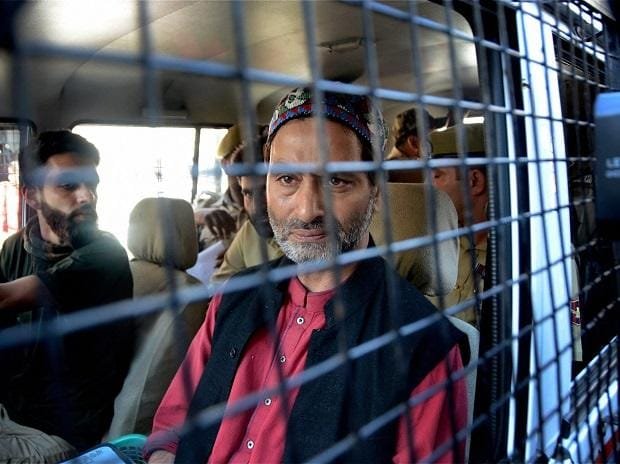
Yasin Malik, one of the three top separatist leaders of Kashmir, was convicted last week on charges of committing terrorist acts, illegally raising funds, belonging to a terrorist organization, and criminal conspiracy and sedition. He was arrested in 2019 in kept in Tihar Jail in New Delhi. During the trial, the Kashmiri separatist leader protested the charges and told the judge in court, “I am a freedom fighter, and if seeking freedom is a crime, then I am ready to accept this crime and its consequences”. The court has sentenced him to life imprisonment twice and imposed a one million Indian rupees fine. The Indian National Investigation Agency (NIA) had sought the death penalty.
Pakistan, to record its protest, summoned Indian charge d’affaires in Islamabad to the foreign office and asked the official to advise the Indian government to acquit the separatist leader of all baseless charges and arrange for his immediate release from prison. The press wing of the Pakistan Army, Inter-Services Public Relations (ISPR), through its spokesman Major General Babar Iftikar, claimed that Yasin Malik was sentenced on “fabricated charges”.
As the condemnation of the sentence continued, The Organization of Islamic Cooperation (OIC) expressed its deep concern and urged the international community to ensure that the legitimate struggle of the Kashmiris for the realization of their rights must not be equated with terrorism. India while slamming the OIC over its remarks, said, “The organization has implicitly expressed support for the terrorist activities” and urged it not to justify terrorism in any manner, saying the world seeks zero-tolerance against the menace.
Indian leading newspaper The Hindu in its editorial “Conviction and Repression: On Yasin Malik and Separatism” wrote that the conviction of Yasin Malik, the house arrest of Mirwaiz Umar Farooq, and the death of Syed Ali Shah Geelani suggests that the political face of separatism has been neutralized in Kashmir valley. Yet, it does not mean that the voices of separatism in the valley have been silenced.
The editorial adds that Jammu Kashmir Liberation Front (JKLF) leader’s conviction, even if obtained through the judicial process, will be seen in the valley as an extension of political repression unleashed since 2019 and the militant groups will portray it that way.
JKLF was one of the first armed rebel groups to come into existence in Indian-administered Kashmir. It supported an independent and united Kashmir. In March 2019, Indian authorities banned JKLF under the provisions of Section 3(1) of the Unlawful Activities (Prevention) Act (UAPA), 1967. Yasin Malik had also been charged with the killing of four Indian Air Force officers in 1990 in Srinagar but the ruling was struck down by Kashmir High Court in April last year.
In the latest trial in court, Yasin Malik told the judge that he had given up violence in 1994 and declared that he “would follow the peaceful path of Mahatma Gandhi and engage in non-violent political struggle”. The court said he could not claim to be a follower of Gandhi as he did not condemn the violence in Kashmir. The claim made by Yasin Malik has ground, as in 1994, after releasing from jail he declared a ceasefire. In 2004, the then deputy PM LK Advani met with Hurriyat leadership. In 2005, former PM Manmohan Singh held two rounds of talks with Kashmiri leadership. In February 2006, Yasin Malik himself held a one-on-one secret meeting with the then PM Manmohan Singh, in which he proposed a dialogue with militant leaders to be held in a third country.
The peace and dialogue plans have been disrupted and are now history, but after the death of Syed Ali Shah Geelani and now the life imprisonment of Yasin Malik, Indian authorities are trying to rein in the separatism from the top. Mirwaiz Umar Farooq has been under house arrest and he has now too little influence to change things on the ground.
India has used this strategy by killing rebels in the valley, the most prominent one was Burhan Wani, who was killed in 2016. The killing of top leadership was meant to still fear in the followers and keep others away from having a second thoughts about joining the movement. But this will never give the Indian armed forces a respite. Regional mainstream political parties are of the view that the life imprisonment of Yasin Malik will further compound the uncertainties in the region and will only fuel more alienation and separatist feelings.
