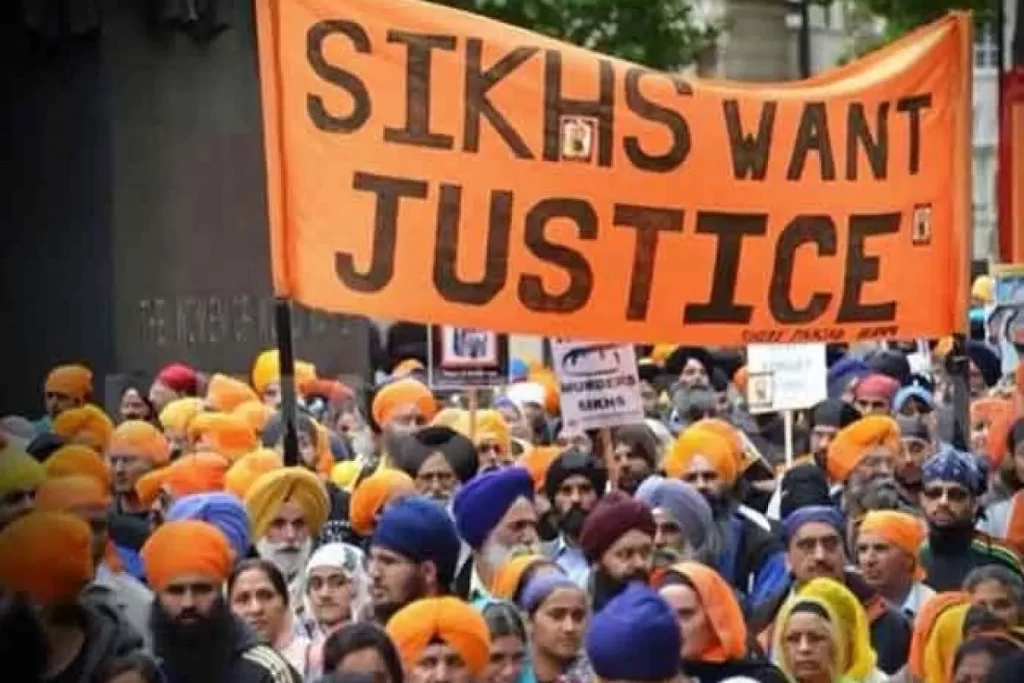
On the first week of June 1984, the Indian Army stormed the Golden Temple complex as part of its Operation Blue Star. Operation Blue Star was the codename of a military operation carried out by Indian security forces between 1 and 10 June 1984 in order to remove Damdami Taksal, Jarnail Singh Bhindranwale, and their followers from the buildings of the Golden Temple, the holiest site for Sikhs. Bhindranwale and his aides were killed in the military operation, many civilians also lost their lives.
Bhindranwale was at the forefront of the Khalistan movement that gained pace in the 1980s. Operation Blue Star turned out to be successful as the Indian Army managed to eliminate Bhindranwale along with many of his supporters holed up inside the holiest shrine of Sikhs.
Indian army’s operation outraged Sikhs around the world, Sikhs accused the troops of desecrating the faith’s holiest shrine. The Indian government claimed that 400 people were killed, including 87 soldiers but Sikh groups argued that thousands died, including a large number of pilgrims who were there for an important Sikh festival, Arjan Dev Ji. During the fighting parts of the temple were damaged and it was considered to be an attack on their religion. Operation Blue Star led to the assassination of Prime Minister Indira Gandhi, who was killed by her Sikh bodyguards in revenge.
Recently, Sikhs for Justice on the occasion of the 38th anniversary of Operation Blue Star gave a call to Indian Sikh soldiers, to stop performing their duties and defending Indian borders. The group also urged the Sikh soldiers to fully support the Khalistan referendum to liberate Punjab from the Indian occupation.
The Sikh organizations also staged massive protests and rallies in condemnation of the act Indian forces did in violating the sanctity of the Golden temple and to pay homage to Sikh heroes who fought till their last breath. On the other side, security remained beefed up in Amritsar city and in other cities of Indian Punjab expecting the protest and rallies from the Sikh community.
A video of the rally has gone viral wherein the Sikh participants are seen shouting slogans like ‘Sikhs will get freedom’, ‘Azadi is the right of Sikhs’, ‘Freedom is the demand of every Punjabi’, ‘It is the desire of every Sikh that Punjab will become Khalistan’. The participants of the rally also carried the posters of Sikh leader Jarnail Singh Bhindranwale and raised slogans in his favor as well.
Earlier on the ‘Operation Blue Star’ anniversary, Akal Takht chief Giani Harpreet Singh while addressing a public gathering outside the Golden Temple in Amritsar, said Sikhs should set up weapon training academies where people could learn to use state-of-the-art weapons in view of attempts being made by the Modi government to weaken Sikhs politically, economically and socially. Akal Takht is one of the five seats of authority for Sikhs. It is in the Darbar Sahib in Punjab’s Amritsar and his statement comes just days after Punjabi singer Sidhu Moose Wala was shot dead.
Operation Blue Star has forced Indian Sikhs to further look into the ways to get a separate homeland as Sikhs are equally facing the discrimination and hatred as other minorities including Muslims are facing in India. A referendum for a separate Sikh homeland started in London on 31st October, last year, and so far tens of thousands of Sikhs have participated in the polling held in different cities in the United Kingdom and other countries in connection with the Khalistan referendum.
The exercise has sent a strong message to India to end discrimination against Sikhs. The findings of the referendum will be shared with the UN and other international bodies to create a wider consensus regarding the separate homeland for Sikhs in India. Sikhs’ demand for a separate homeland is in complete consonance with the UN Charter and India cannot stop them from getting their birthright of freedom.
Hatred towards minorities, rising Islamophobia, societal division, and religious extremism have further intensified during the incumbent BJP government. It is that practice of intolerance and discrimination towards the Sikh community that has further intensified the Khalistan movement.
The writer is an Islamabad-based researcher with an interest in Politics, Bilateralism, and Strategic Studies.
