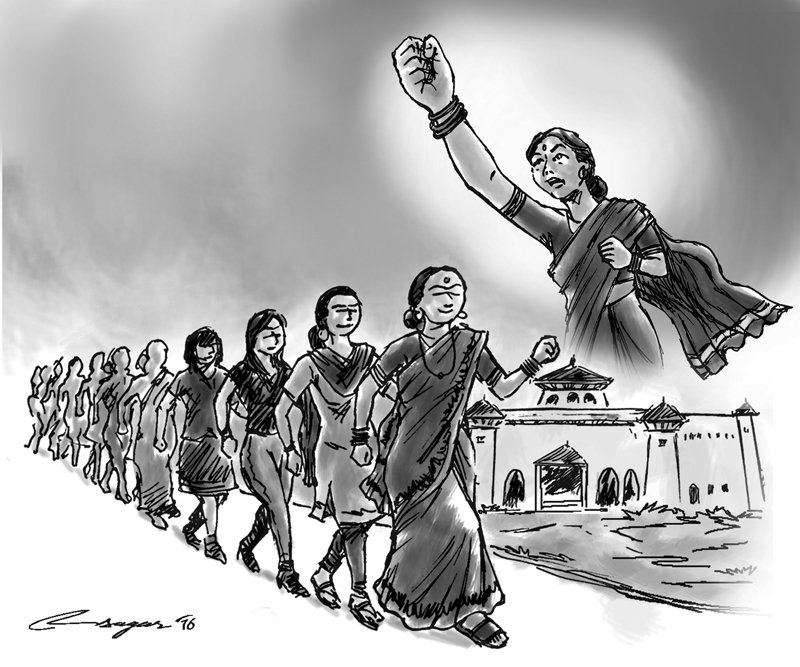
In the nineteenth century, the central moral challenge was slavery. In the twentieth century, the challenge was to battle against totalitarianism; and in the twenty-first century, the challenge is to ensure gender equality. Women hold great significance in this world as they have played an instrumental role in maintaining a social structure. At the same time, women are the key to the economic prosperity of a nation. The role women have been playing in times of crisis is widely regarded. Without women, the movements for gender equality would have failed miserably. The dark clouds of ignorance were only removed with the literacy of women as they shape the future of a generation. However, there are numerous issues faced by women that hinder the progress of this world and particularly for women: gender-based violence, gendered language, lack of political representation of women, restriction on women’s mobility and high poverty in third world countries. Therefore, women are key to the betterment of this world and prevailing challenges like gender discrimination, lack of political representation and gender-based violence need to be curtailed to make inroads toward women empowerment.
The quote “Women Hold up Half the Sky” was used by Chinese stalwart and communist party president 1949, Mao Zedong, to promote and create awareness about the importance of women in society and the workforce. This quote gained currency and was later used by eminent writers to write on this topic in more detail and highlight the role of women in society.
Women are key to the economic prosperity of any country as they represent close to half of the population of the world. The countries that have given importance to the inclusivity of women are ruling the world. For example, the United States of America has ensured fair women’s representation; and today they are economic superpowers. Similarly, Western Europe is also progressing as their governing system has a significant presence of women in power corridors.
Over the years, women have managed crises better than many men in general and particularly in covid-19. The prime minister of New Zealand Jacinda Ardern and the leader of Finland, Sana Marrin was widely regarded for their leadership roles in managing the situation of covid-19. The role of Angela Markel in Germany is highly appreciated by world leaders. Therefore, women are pivotal in resolving crises.
All the countries that are leading the charts in the democracy index are mostly the ones with a high representation of women. For example, the US, the UK, Western Europe and Scandinavian countries. On the contrary, the democracy in the third world countries did not reach its true potential as these countries have high gender disparity. For Example, Pakistan, Afghanistan and Sudan. As per the world economic forum, Western Europe leads the way in gender inclusivity.
As per the literature of sociology, women are key to the balance of society. The theory of structure functionalism states that both men and women are key to the social structure of a society. If one organ of society fails to perform, it ultimately disturbs the balance. This shows that women are equally important, hence, it is imperative that women get the same socio-economic rights as men. Also, Plato in his book, the Republic, highlighted that women are natural leaders and should get leadership positions.
More importantly, women are known as torch-bearers of society. As there is a famous saying, “You educate a man; you educate a man; you educate a woman; you educate a generation”. Similarly, as women spend more time with their children, it is highly essential that women are empowered. Without women’s empowerment, the future of a nation could become bleak. Also, as per research, women’s education plays a key role in the literary rate of any country. Countries with a low literacy rate of women are struggling; such as Pakistan, Afghanistan, Kenya and Zimbabwe.
Moreover, women are central to the peace and prosperity of this world. Women like Malala Yousafzai, Jacinda Ardern, Benazir Bhutto, Hilary Clinton and Greta Thunberg have shown the world that peace can be achieved without resorting to wars of arms and ammunition. Malala Yousafzai has been helping billions of kids in their education, especially in war-torn countries. Benazir Bhutto and Hilary Clinton fought valiantly for women’s rights ultimately ensuring peace in society. Jacinda Ardern handled the Christ arch mosque attack ad covid-19 fallout efficiently. This shows that women are more inclined towards peacemaking efforts.
As per the United Nations, women’s rights are human rights. This just shows the importance of giving women their rights that are key to reaching the true potential of this world, it means that women are given equal socio-economic rights. Also, it would fulfil the SDG-5 goal set by the United Nations for gender equality. Unfortunately, third world countries are still lagging behind on these goals of gender equality.
However, women face numerous impediments that make it difficult for them to hold up the sky. First and foremost, women are not empowered when it comes to political representation across the globe. As per the world economic forum (WEF) report on the global gender gap index, it states that women’s representation is 22 per cent of national parliaments, ministers and assemblies across the globe. Also, only 26 countries have women as their heads of state. Consequently, it would take more than 135 years for women to achieve gender equality in politics. This shows the appalling state of women in politics.
The poor literacy rate of women in general and particularly in third world countries is a huge concern. Without education, it would take years for women to achieve prosperity. The socio-economic development of women can only be secured through education as it gives awareness and skills. The literacy rate of women in Pakistan is 49 per cent as per the Economic Survey of Pakistan. Similarly, their labour force participation is 25 per cent as per the labour force survey of Pakistan. Therefore, it shows that education is pivotal in ameliorating the conditions of women.
The challenge of gender-based violence cannot be ignored. The issue of gender-based violence has further pushed the backs of women against the world, especially in patriarchal societies. As per UN women, 243 million women aged 15-49 faced some sort of gender-based violence from their intimate partners in form of rape, harassment, and physical assault. Also, it is higher in countries like Pakistan, Bangladesh and India. In Pakistan, as per Human Rights, 1000 women are killed every year on the ‘pretext’ of honour killing. This is one of the severe challenges faced by women.
Besides, poverty and hunger are also some of the most significant impediments faced by women. As per World Food Programme, 60 per cent of the hunger and poverty in this world are faced by women. The fallout of the covid-19 has added insult to injury for women because the reports of the International Labour Organization show that out of 5 people who lost their jobs, 3 are women. This would further add to the woes of women. The theoretical framework of gender studies has manifested that language itself is gendered. The eminent scholar Simone De Beauvoir in his book ‘second sex’ highlighted how women are marginalized through gendered language. For example, men are considered as strong and women as weak; men are rational and women are irrational; men will be breadwinners and women will bear children and do house chores. This reflects that the social construction of gender did not allow women to come out of the woods.
The advancement of women is further hindered by restrictions on their movement. Due to patriarchy, women are asked to stay indoors as it is against the norms and values of society for women to go to work or pursue education. This happens more in third world countries or developing countries. Without the mobility of women, it is next to impossible for them to improve their socio-economic conditions. As per Unicef, 23 million children are out of school in Pakistan and out of which 60 per cent are women or girls. Most girls cannot step out for education because of patriarchal norms and values.
Although the values of religion-state that women should have equal rights as men it is rather used to suppress women. Due to orthodox religious teaching by some scholars, women are asked to stay home and only manage children and house chores. This has given impetus to men to stamp their authority on women and further support patriarchy. All religions support equal rights for women but misinterpretation of religious context and vested interests of theocracy did not allow many women to reach their true potential.
To mitigate challenges faced by women, it is important to take the following remedial measures. Firstly, it is imperative to enhance the representation of women in power corridors. Until and unless women secure power positions in their respective countries, it would be difficult to achieve the socio-economic development of women. For example, when Benazir Bhutto came to power, she emphasised separate ministries for women, hospitals for women, and content on women’s education was included and taught. This exhibits that women can understand the problems of women better.
The role of international bodies like the UN, World Bank, IMF, and WTO should ensure fair representation of women. The bodies of IMF and European Unions are led by women and they should encourage other bodies as well. This would allow women to prove their mettle in higher positions and lead the way in their own countries as well. Moreover, the movements that are based on fighting for women’s rights should persist for the betterment of society. For example, the #metoo movement turned out to be decisive for securing women’s rights in preventing harassment, rape and sexual assault. Many countries like Pakistan, India, Finland, the US and many more passed laws on preventing online bullying and harassment, actions against rape, and murder of women.
Last but not least, gender-based violence has become a chronic problem. Therefore, it is essential to devise strong laws on this issue. Finland took a great initiative by ensuring life imprisonment for perpetrators of harassing women. Similarly, Pakistan took great measures to combat cases of rape by implementing the Anti-Rape bill 2021. These laws and reputations are necessary to curtail gender-based violence in society.
In essence, women are torch-bearers of this world and deserve equal rights as men; therefore, it is imperative that efforts should be taken to combat gender-based violence, enhance women representation in political affairs and increase health and education measures for women to avert the damage. As women represent close to half of the population, it is essential that their mobility is not restricted. The progress of women is key to managing global affairs as women are more skilled in peacekeeping measures. Also, by providing education to women, the world can combat the challenge of ignorance, intolerance and patriarchy. As Ban Ki-Moon, former secretary-general of the UN said, “achieving gender equality requires the engagement of women and men, girls and boys. It is everyone’s responsibility”.
