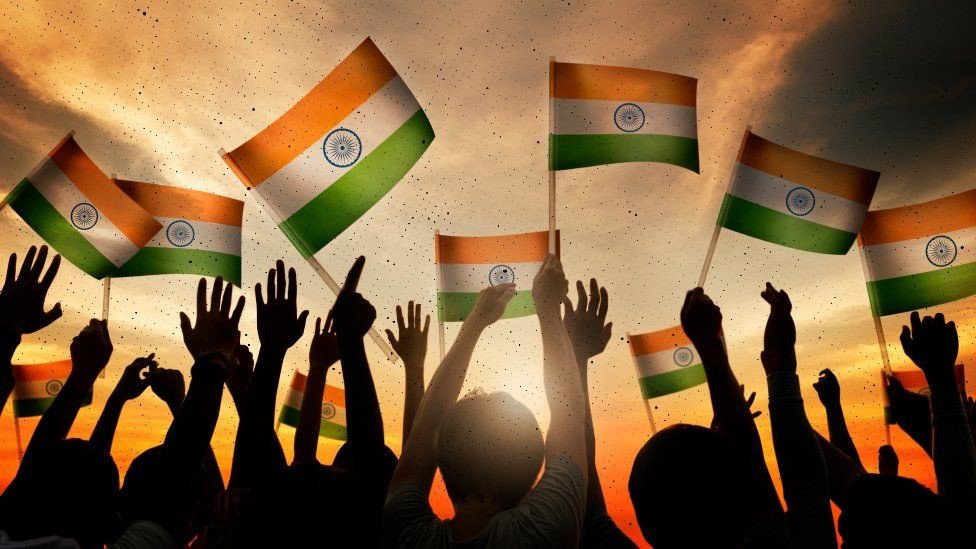
As India completes 74 years of its independence, the core liberal and democratic values seem to be eroding. The very concept of illiberal democracy can be defined in terms of “a regime which only pays attention to elections, while it violates, some core democratic principles, especially freedom of expression, ignore the constitutional limits of its power and deprive its citizens of basic rights and liberties”. It views elections as the only measure of democracy and once elected, it seeks unrestrained power, often on behalf of the majority community.
Since the very day it got independence from British rule, India declared itself a liberal democracy, a democratic state by adopting its constitution in 1950. Elections at federal and state levels have been held regularly in a competitive multiparty system. The transfer of power between governments had also been peaceful so far. On the basis of the conduct of fair elections and upholding political rights and civil liberties, the Freedom in the World 2021 report by Freedom House has designated India as Free for 20 consecutive years. The signs of democratic erosion started to appear once BJP came into power in 2014. Though Modi has to some extent progressed in controlling the corruption and strengthening reforms of the economy, his government has so far neglected a number of challenges to India’s democracy.
India had been praised internationally being a role model for upholding human rights and freedom of expression but its experience with democracy and liberalism is far from perfection. India, home to a complex network of different ideologies, religions, and ethnic groups has historically segmented being a nation. With the rise of right-wing nationalist populism, Indian democracy has been seriously challenged. This has entailed the elected leaders eroding social norms, suppressing the freedom of expression, and undermining the very liberal ethics of a society. With the rise of the BJP and Modi coming into power, the perversion of Indian democracy and its descent into authoritarianism has however become more prominent. The active mobilization of anti-Muslim and anti-minority sentiment, rejection of the core democratic principle that all citizens are equal, sectarian tensions, the rise of Hindutva ideology, mob attacks, violence against Muslims, and bending of India’s judicial system to the wishes of politicians, are all the elements which are very much working against the very definition of India as a liberal democracy or the general concept of liberal democracy.
The emerging trend in the deteriorating democratic system of India has now become part of global discourse. There is a number of events where India as an illiberal democratic state has been represented. For Example, Financial Times in 2020 held an event on the festival of ideas were more than 100 of the world’s brightest minds gathered and discussed the major global issues. India was named during the event as the world’s largest “illiberal democracy”. The label came after Freedom House downgraded India’s status in its 2021 report from “free country” to “partly free” due to rising violence and discriminatory policies against minorities specifically Muslims.
Moreover, a Sweden-based institute V-Dem has said that India is no longer an ‘electoral democracy, classifying the country as an ‘electoral autocracy’ instead, noting that much of the decline in democratic freedoms occurred after the BJP’s victory in 2014.
Yogi Adityanath, the Chief Minister of Uttar Pradesh and member of the BJP, days after the release of the Freedom House report, declared secularism “the biggest threat to India’s tradition of getting recognition on the global stage.” India’s 1st Prime Minister Jawaharlal Nehru laid the foundations of a pluralist and secular Indian nation. His “idea of India” was of a nation whose citizenship laws would institutionalize unity in diversity and institutions would defend democracy. But unfortunately, under Modi’s rule, Nehru’s idea received a deep blow when the controversial Citizenship Amendment Act (CAA) was passed in Dec 2019 and made religion the basis of citizenship in open contradiction to the constitution.
Institutional autonomy is also under constant threat in India.
The media has become a major tool in the hands of Modi’s government and is being used by the BJP fanatics for advancing and promoting their Hindu nationalist agenda. Recently, CBC News spoke to 18 Canadian Academics who say they had been harassed or threatened by those supporting Hindu nationalism. Their harassment ranged from abusive emails to death and rape threats. Likewise, recently a group of academics has quit the Australia-India Institute at Melbourne University, citing concerns for academic freedom, and alleging interference by the Indian High Commission. The academics claim there was a reluctance to publicize commentary on caste and race, and that official events had “carried the flavor of propaganda”. Another example of Disha Ravi, a young environmental activist who shared a manual protest with the farmers against the government policies, shows how brazen the government under Modi is in silencing the critical voices.
Modi’s fanaticism does not stop here. The flames of Modi’s fanaticism are expanding at the regional level too. On 23 Apr 2022, the University Grants Commission (UGC) and All India Council for Technical Education (AICTE) advised students from India and Overseas Citizens of India against pursuing higher education in Pakistan. The advisory says, “All concerned are advised not to travel to Pakistan for pursuing higher education. Any Indian national or overseas citizen of India who intends to take admission to any degree college or educational institution of Pakistan shall not be eligible for seeking employment or higher studies in India based on such educational qualifications (in any subject) acquired in Pakistan.”
India’s so-called foundational credentials as a liberal democracy are fast eroding. Instances related to democratic backsliding are not new in India. However, the danger has become very real under the Modi government. In its pursuit of Hindu majoritarianism, the Modi government is nullifying the very older concept of India as a liberal democratic nation. India’s march to illiberal democracy is proceeding apace that too with alarming implications. India, home to 204M Muslims (constitutes the largest religious minority), has miserably failed in providing them and other minority groups the confidence of living in an independent country…. a country of freewheeling debate, guaranteeing bureaucratic autonomy, and safeguarding of minorities/people rights and freedoms.
The writer is a Senior Research Officer at the Center for International Strategic Studies (CISS) Islamabad.
