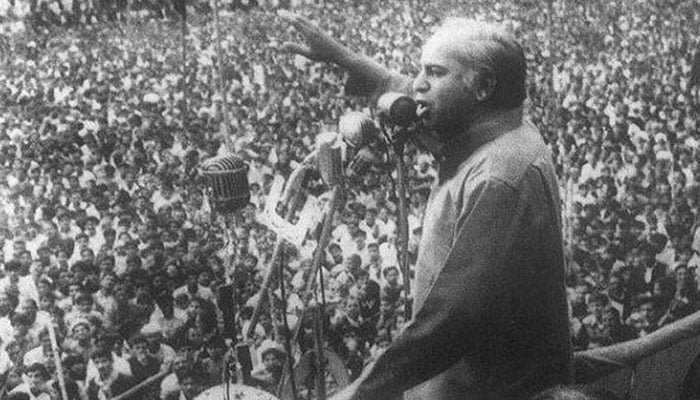
In the annals of Pakistan’s political history, few figures stand as tall as Zulfiqar Ali Bhutto (SZAB). He was a man of vision, charisma, and an unwavering commitment to the welfare of his people. However, his life was marked by turmoil, tragedy, and ultimately betrayal at the hands of those he once considered allies.
One of the darkest chapters in SZAB’s life was his unjust demise. When Shahed Zulfiqar Ali Bhutto was murdered, the ruthless leader of the time callously denied SZAB’s daughter the chance to bid her father a final farewell. Such was the callousness of this leader that he forbade many from participating in SZAB’s funeral. Contrastingly, this same leader’s funeral was attended by over a hundred thousand participants, showcasing the stark difference in public sentiment between the two figures.
Today, on the anniversary of SZAB’s death, millions gather to pay tribute to the man who was wrongfully silenced. Yet, on the anniversary of that leader’s death, even his son refuses to visit his grave—a testament to the enduring legacy of SZAB and the lack of remorse from those who persecuted him.
The events leading to SZAB’s demise are shrouded in controversy and political intrigue. The FIR filed on November 11, 1974, following the assassination of Nawab Kasuri, marked the beginning of a tumultuous period for SZAB. He was named as the main accused, setting the stage for a trial that would ultimately seal his fate. The testimony of FSF officer Masood Mahmood further compounded SZAB’s predicament, leading to his conviction amidst allegations of judicial bias.
As SZAB faced imprisonment, his supporters, known as Jiyalas, took to the streets in protest. However, their fervor was overshadowed by the conspicuous absence of PPP leaders, raising questions about their allegiance and dedication to SZAB’s cause. It was a moment of reckoning for the party he had built—a test of their commitment to the ideals he espoused.
Throughout his life, SZAB championed the cause of the downtrodden and marginalized. His political journey was not driven by personal ambition but by a fervent desire to uplift the masses. His imprisonment and eventual execution were not the result of criminality but rather a consequence of challenging the status quo and advocating for radical change.
In the face of adversity, SZAB remained resolute, refusing to succumb to the pressures of his oppressors. Even in death, his legacy endures, inspiring countless individuals to fight for justice and equality. The betrayal he suffered serves as a stark reminder of the perils of power and the fragility of political alliances.
Shaheed Bhutto‘s prescient statement—”I will resonate so much that I will be heard for centuries”—rings true today more than ever. His legacy transcends the boundaries of time and space, transcending the limitations of mortality to inspire and empower future generations. In a world rife with uncertainty and turmoil, Bhutto’s message of hope and resilience endures as a guiding light, illuminating the path towards a more just and equitable society.
As we reflect on SZAB’s life and legacy, let us not forget the sacrifices he made and the principles he stood for. His memory lives on in the hearts of millions, a beacon of hope in a world fraught with injustice and oppression. May his vision of a progressive and prosperous Pakistan continue to guide us in our collective pursuit of a better tomorrow.
