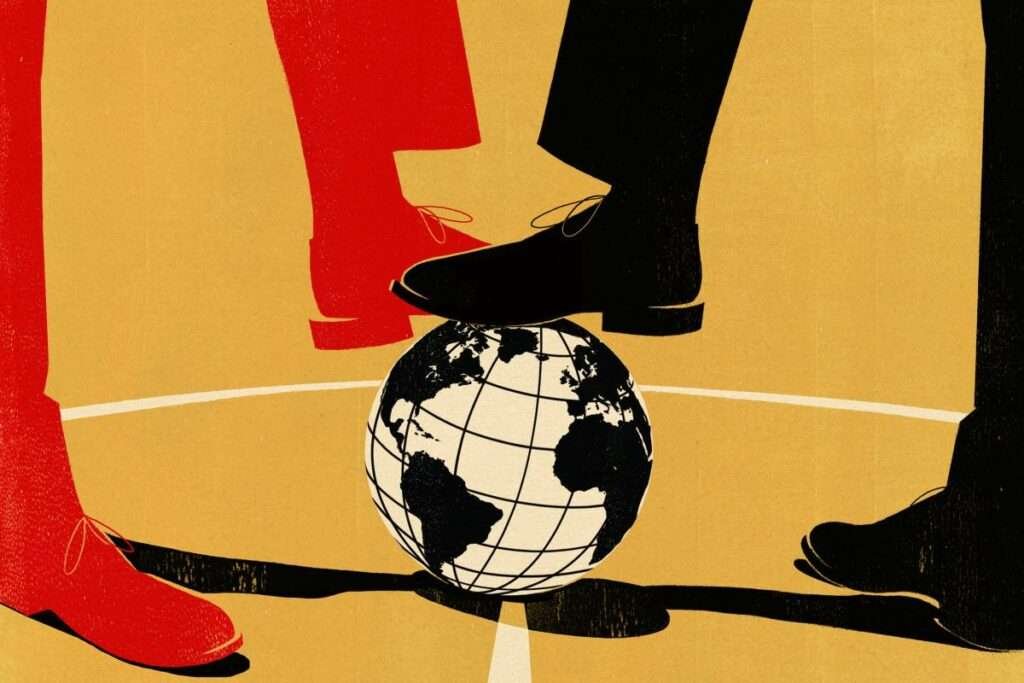
With the United States’ strength eroding, other actors, particularly China and Russia, are attempting to supplant the United States long-established un-polarity. The international order is shifting from unipolarity to multipolarity, and so Pakistan must adapt to the global arena. Though Pakistan has been a US ally for many decades, from fighting a war against the Soviet Union to the war on terror, and has benefited from their economic and military support, with the emergence of new powers and the dwindling US power, it may be the ideal time to shape a new foreign policy and reconsider its stance in the global politics. Being governed by the US and Western bloc, which is losing power and cohesion ever since the Russia-Ukraine war broke out, and maintaining the status quo is not in Pakistan’s long-term interests.
Looking back at Pakistan’s history of shaping its foreign relations, one of the key reasons for Pakistan joining the US block in the late 1940s and early 1950s was the Soviets’ backing for Afghanistan’s claim to the NWFP (North west frontier province). Pakistan then signed various agreements with the US to fulfill its core aim of security, most notably joining SEATO and CENTO. Initially, Pakistan enjoyed its economic and military assistance and eventually became a part of the cold war alliances. However, Pakistan did not receive as much backing from the US as anticipated in the 1960s. Pakistan was compelled to adjust its alignment strategy, and it took a more pluralistic stance in the 1970s, breaking the ice with the Soviet Union during the Bhutto era.
Following the Soviet invasion of Afghanistan, Pakistan reestablished ties with the US and fought alongside them from 1980 to 1990. During this period, ties with the United States improved, and Pakistan received significant funding from Arab and Western countries. With the dissolution of the Soviet Union, ties between the United States and Pakistan deteriorated once again in the 1990s, and Pakistan was subjected to sanctions over its nuclear program. Wake of 9/11, Pakistan embraced the US narrative of the global war on terror, allowing operations against the Taliban in Afghanistan to take place on its soil. In exchange, the US removed sanctions against Pakistan and assisted in obtaining economic aid from the IMF (International monetary fund), World Bank, and ADB (Asian Development Bank).
The abrupt withdrawal of the United States from Afghanistan, as well as the shifting dynamics of international order, had complicated matters for Pakistan. Pakistan is currently in a tough foreign policy scenario, attempting to balance relations with both the US and the Taliban, while both claiming that Pakistan is backing the opposite group. The US wants Pakistan to exploit its leverage with the Taliban to establish a globally recognized government. On the other hand, the Taliban wants Pakistan to gain worldwide recognition without surrendering its fundamental foundation.
Along with this, Pakistan has a new difficulty in balancing its relations with the United States and China. China, as a revisionist state, seeks to limit the US’s influence in South Asia and is pursuing a multipolar system alongside Russia, whereas the US is determined to retain the status quo. Along with this, China wants Russia to participate in CPEC and to be a strategic ally. Pakistan is also attempting to get India to the negotiating table and resolve all issues peacefully, which appears unachievable, especially after Modi’s government came to power in 2014. In addition, Pakistan has always sought to repair relations between Iran and Saudi Arabia, with one Pakistan sharing a border, and culture, among other things. The other is Pakistan’s most reliable ally and financial supporter.
Pakistan must break free from dichotomous thinking and cease prioritizing the interests of outsiders over national interests. Pakistan must prioritize its interests before other rivals.
A revised approach is required for the changing environment. As a neighbor with a vast border, Pakistan is immediately affected by the unstable situation in Afghanistan hence Pakistan needs an appropriate slant to deal with the Taliban. Pakistan must first put pressure on the Taliban to take appropriate action against any groups inflicting harm to the country. Furthermore, Pakistan must ensure that any terrorist outfit that exists in Afghanistan and constitutes a threat to world security should be dealt with accordingly. Also, Pakistan should offer aid in establishing contact with the West. Pakistan must ensure that its overall interests are preserved in Afghanistan through its foreign policy.
The already tense security situation in South Asia is exacerbated by the US-China competition.
To oppose China, the US is aggressively investing in India and assisting in the development of an advanced military, creating a security conundrum for Pakistan and increasing Pakistan’s reliance on China. Optimistic Pakistani policymakers are attempting to function as a bridge between them, but their actions are making it more difficult for Pakistan to play its constructive role. Pakistan, on the other hand, is obliged to choose a side and engage in binary thinking. However, Pakistan should not put all of its eggs in the Chinese basket and be forced to submit to its will. Pakistan must also retain its relationship with the US and collaborate with it on topics of mutual interest.
Furthermore, Pakistan’s policy in interacting with Russia must be revised. The United States’ enhanced backing for India has given Pakistan with a chance to strengthen its relations with Russia. Russia is a staunch revisionist and strategic ally of China, which is Pakistan’s all-weather friend, making it simpler for Pakistan to engage Russia in areas of mutual concern. Although relations between the two countries were improving, with transactions of military equipment and military drills taking place, Russia has been isolated from the US and the West since the conflict in Ukraine. In these times of stress, Pakistan’s approach toward Russia may be the first stumbling block in future ties.
Pakistan has made a number of actions that suggest the country’s institutions have unanimously opted to pursue a working-level relationship with India rather than unnecessary antagonism. Because of the implementation of Pakistan’s first-ever National Security Policy (2022-2026), which establishes a direction for Pakistan to promote commerce and interconnectivity in interstate relations, this goal is projected to outlive personnel changes in the civilian and security spheres. This is the general direction and motive underlying signals of the country reaching out to India.
Pakistan professes neutrality in the Iran-Saudi war. Maintaining this approach, however, has become challenging in light of the rising Iran-Saudi rivalry. Pakistan seeks to remain neutral in the Iranian-Saudi rivalry, although this is difficult given the country’s extensive and diversified relations with Saudi Arabia. Pakistan can act as a go-between between Saudi Arabia and Iran, which may be the only option to protect its interests while also decreasing tensions between them. Pakistan cannot turn its back on Saudi Arabia, nor can it go up against Iran. Pakistan’s sole option is to strike a balance with both of them and adopt measures in the interest of long-term mutual interests.
As a whole, the dynamics of international politics are changing at a rapid speed, and new actors with powerful economies, giant militaries, and staggering technology are emerging, Pakistan must carefully thread its foreign policy. Pakistan’s attitude will have an impact on all of them, to varying degrees, since Pakistan’s geographical location is at the core of evolving global politics, and everyone is interested in Pakistan. Following in the footsteps of the West may not benefit Pakistan’s interests in the long run. In today’s world, Pakistan cannot continue with its binary view that being one’s ally means being someone else’s adversary. Although Pakistan can do little to change the world order, it may limit its negative consequences, gain from competing actors, and play a positive role in global affairs.
The writer is a student of Strategic Studies at National Defense University, Islamabad. He tweets at @MMamooti.
