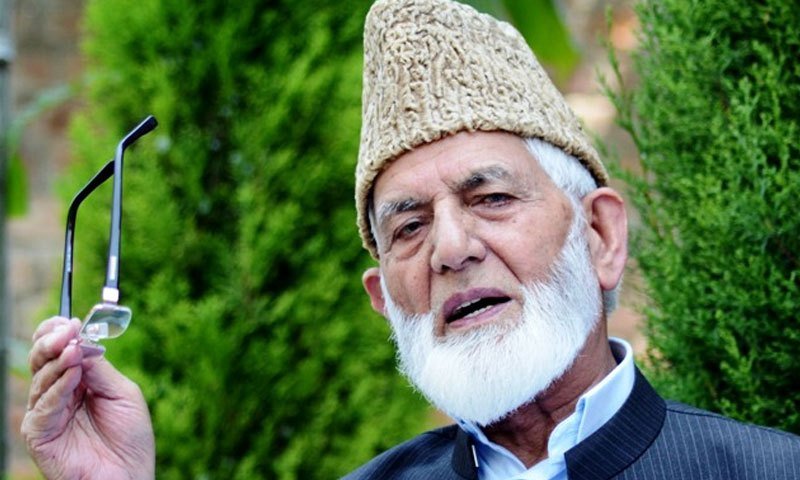
Syed Ali Geelani is a key figure in Kashmir’s “War of Liberation.” Geelani was born and raised in northern Kashmir’s Bandipora district in September 1929, and his life is filled with incitement, fascination, and inspiration. Over the years, his unwavering support for the Kashmir Liberation Movement has earned him the title of “The Leader of the Resistance” in Kashmir.
Syed Ali Geelani embraced martyrdom on September 1, 2021, in Indian police custody at his home in Srinagar, where he had been held in house detention for over a decade. What India is doing in Indian illegally occupied Jammu and Kashmir under Modi has attested to the unrivaled ability to tower Kashmiri personality, Syed Ali Gilani, to foresee anti-Kashmir measures years before they are now unfolding in the territory.
Syed Ali Geelani’s foresight was demonstrated once more when the incumbent BJP-led Indian government announced on 5 August 2019 that it would include Indian citizens ordinarily residing in IIOJK in voter lists, three years after its unilateral moves to annex IIOJK in complete disregard of UNSC Resolutions and bilateral agreements between India and Pakistan. The moves are intended to weaken the territory’s disputed status and change its Muslim majority character.
Syed Ali Geelani had correctly pointed out earlier that India’s demographic engineering measures included land grabs and the establishment of colonies for Indian soldiers and Kashmiri Pandits, issuing new domicile rules, delimitation of Assembly constituencies, and voting rights for non-resident Kashmiris in elections.
Some of the anti-Kashmiri measures implemented by the Modi regime speak volumes about Syed Ali Geelani’s foresight;
On the legal front, India eroded Jammu and Kashmir’s special status by repealing Article 370 and establishing two union territories to be governed directly by New Delhi. The marginalization of Kashmir’s Muslim majority population, land-grab policies, resource exploitation, rampant aggression, killings, arbitrary arrests, extra-judicial executions, forced disappearances, and systematic genocide of Kashmiri youth by Indian troops are clear manifestations of the racist regime’s apocalyptic vision and attitude toward Kashmir.
India’s unilateral moves in Kashmir have not only posed serious challenges to a final settlement of the Kashmir dispute but have also heightened tensions between the two nuclear states, threatening regional peace and security. They praised the late Kashmiri leader, Syed Ali Geelani, for correctly predicting that India planned to bring 500,000 Indian laborers from Bihar, Rajasthan, and other Indian states to Kashmir to permanently settle them.
Furthermore, Syed Ali Geelani stated that Indian soldiers would be granted Kashmiri citizenship, that 300,000 to 500,000 displaced persons would be settled in Kashmir, and that Kashmiri Hindus (Pandits) would be settled in separate zones. In many of his revolutionary and visionary speeches, Geelani predicted what the future held for Kashmir. He previously stated that if the demographics in Kashmir, such as in Jammu, shift in favor of Hindus, India may agree to a plebiscite in the territory.
Quaid-e-Kashmir Syed Ali Geelani, like Quaid-e-Azam Muhammad Ali Jinnah, had also concluded from previous events that Hindus would never accept Muslims as a separate entity in India or as the majority population in IIOJK. Gilani was well aware that the Hindutva forces responsible for the massacre of Muslims in Jammu and Kashmir might do the same in the Kashmir valley if India is ruled by the RSS and its sister organizations. It is because the record of the large-scale killing of the Muslim population during the Sub-Continent partition in 1947, primarily in the Jammu region of the State, is well documented. Thousands of Muslims were either killed or forced to flee the Jammu region in November 1947.
To alter the demographic makeup of Jammu and Kashmir, the Indian government proposed 2016 the establishment of Sainik (soldier) colonies in various parts of the Kashmir valley, which was interpreted as the RSS agenda of settling outsiders in Jammu and Kashmir. The ruling BJP hinted in July 2019 that it might revive its plan to resettle 200,000 to 300,000 Kashmiri Pandits in the Kashmir valley. It was stated that these Pandits would be settled in specially built segregated Hindu enclaves.
According to the report, 5,764 families or 47,215 people migrated from Pakistan (but not Azad Jammu and Kashmir) and settled in Jammu, Kathua, and Rajouri districts. They are Hindus and are known as West Pakistan Refugees (WPRs). The Indian parliamentary standing committee on home affairs recommended in 2015 that refugees be granted the status of permanent residents with the right to vote in state assembly elections, which they did not previously have. The main concern of Kashmir’s political establishment is that these settlements will change Kashmir’s status as a Muslim majority state. The Indian government was unable to implement this plan due to opposition from local Kashmiris. However, following the repeal of Article 370 on 5 August 2019, WPRs can now buy land and apply for jobs in IIOJK, as well as vote and run in elections in the occupied territory.
The views expressed in this article are the author’s own and do not necessarily reflect The Asian Mirror’s editorial policy.
