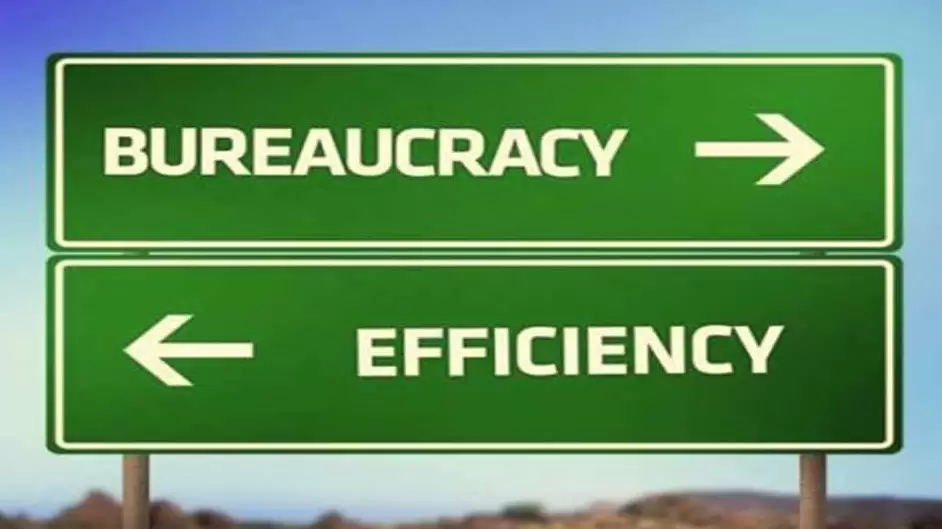
Every incoming government considers massive reshuffling of the bureaucrats as one of its primary concerns because it best serves their political interests, establishing a spoiled system. It is an absolute fact that bureaucracy is essential to the administration of any government. While bureaucrats are supposed to be personally free and only subject to authority in their official capacities but monopolistic nature of the system has incredibly reduced the professionalism and effectiveness of public service. Pakistan’s bureaucracy was supposed to be apolitical but unfortunately, it has always been vehemently political. Soon after Jinnah’s death, their desire for power undermined the country’s aspirations for democracy.
Broadly speaking, bureaucracy, like the state, provides a way for the dominant class to exercise its dominance over the other social classes. The interests of the state’s dominant and elite class are strongly tied to those of the bureaucracy. As a result, authority is concentrated in a small number of oligarchic hands, which eliminates the possibility of internal democracy.
Along with the emergence of capitalism, communication technologies, democratic institutions, rationalism, population issues, and complex administrative issues, the rise in bureaucracy could be seen but in Pakistan, political interference or influence has resulted in dysfunctional outcomes that were unanticipated and appeared to be detrimental to the achievement of democratic goals. For bureaucracy since the beginning, pursuing the goals was ineffective though the bureaucracy of Pakistan has developed and grown, becoming a sizable and amorphous bunch.
The bureaucratic structure is status quo oriented and thus resists change whether it is in the USA, UK, India, or Pakistan. In the case of Pakistan, civil service reforms are repeatedly criticized and do not consent since they are more likely to challenge the bureaucracy and elite politicians’ strong position therefore, it rarely undertakes policies, plans, programs, and initiatives that are designed with a positive mindset because once deficient systems are in established, it can be exceedingly challenging to remove them, despite how ineffective or unfair the existing quo is, strong interests always emerge to retain it. The recent elections attracted the attention of Punjab’s bureaucracy. It was evident that those affiliated with PMLN would lose their seats if the shift occurred again since when PMLN returned with its bureaucrats, they replaced the PTI bureaucrats so it is an undeniable fact that bureaucracy has embraced politics.
During the first decade of Pakistan, the rehabilitation of migrants, the creation of infrastructure for development, and the establishment of institutions for governance were the main concerns that the government of Pakistan focused on. While the political leaders struggled to reach an agreement on a framework for creating a political system, the officers of Audit and Accounts, Railways, and Indian Political Service (IPS) controlled the national economic and political decision-making processes during this time. In this period of our history, the CSP decided to engage in politics in a non-direct manner. In the process, they strengthened their team and developed a reputation as public officials who were devoted, effective, and generally honest.
Huntington in 1968 acknowledged and praised the bureaucracy of Pakistan by saying;
“The best tribute paid to the competence of civil servants is the fact that Pakistan did not collapse in the first 90 days” At that time the most serious administrative problem faced by Pakistan was an acute shortage of managerial talent but still, the bureaucracy of Pakistan served extraordinarily.
Gradually, the poor civil services of Pakistan were seen as a weak institution due to tug of war between elite politicians, political intrusion, overly centralized and excessively rule-bound structure, and an unbalanced skill mix that also hindered effective implementation of the policies formulated by the International Financial Institutions. Most of the policies in Pakistan are from elites to elites therefore, the public interest vanishes, and trust could not be retained easily.
It is a known fact that Pakistan’s governance and policies are implemented through the “Steel Frame” turned into the house of cards- its bureaucracy. Wilder in 2009 argued that; Over the past six decades, the so-called steel frame of the civil service that Pakistan inherited from colonial India has become decidedly rusty” due to its acclaimed path-dependent nature subjected to legacy effects. It only took around 70 years to get from the “fascinating” to the “ludicrous” bureaucratic structure of Pakistan. From 1958 until 1971, the civil bureaucracy joined forces with the military to maintain a tight grip on the nation’s resources and remained a significant power broker but an illegitimate one. Unfortunately, all the reforms devised resulted in making the bureaucracy abrasive rather than making it receptive and autonomous ultimately, leading to maladministration. All the civil reforms in Pakistan lead to the shock waves of “deforms” leaving the majority of civil servants feeling demotivated, demoralized, and despairing and replacing the rule of law and service delivery with apathy, indecision, and chaos.
Civil service laws are as old as the civil secretariat building. Furthermore, procedures are so entangled with modifications and replacements that even most of these officials lack understanding. Without knowing the background of these same rules and laws, they created this complex web of regulations and laws that they continually try to alter with no desired outcomes. Political, civil, military, or judicial interference has been a curse on this nation that has grown organically with time, undermining the professionalism and efficacy of public service and civil servants have continued to fall short in carrying out their supervisory duties in the best interests of the general public.
Indubitably, our bureaucratic model is outdated, having a backward-looking perspective causing hurdles for those who look for forward-looking methods. It is obsessed with traditional rules and laws, engendering an inability to cope with changing conditions due to the oligarchic and monopolistic nature of the political system. Officials are socialized in such a manner, under constant and unending pressure that does not help them in serving the upcoming challenges.
The future of democracy and the convergence of democratic processes in any nation depends not only on political parties but also on civil servants, who must be able to win the public’s trust and confidence by conducting the day-to-day operations of the state in a professional, ethical, and nation-serving manner. Strong and efficient institutions which demand adherence to simple, transparent, fair norms and values can prevent extra-constitutional forces. Prominent politicians, lawmakers and, the various government agencies would have to consult on this subject that must firstly become standardized, systematic and, organized because “in a society where status is determined by lineage, the achievement is downplayed”.
