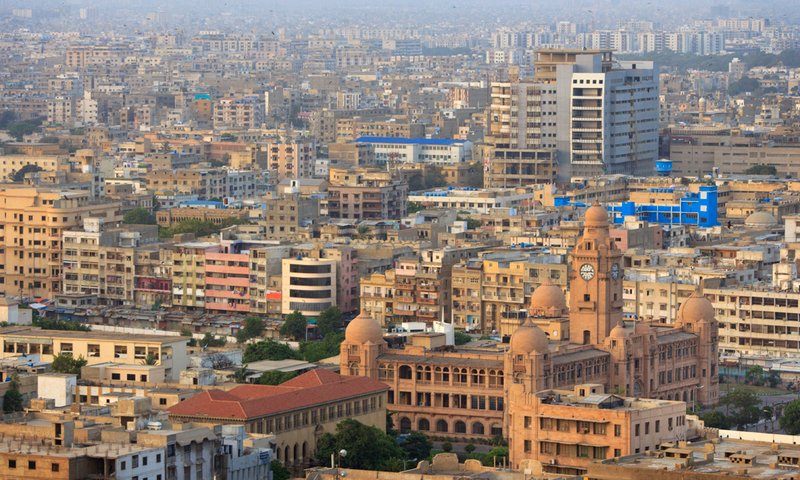
The 20 million people of Karachi, the biggest and the most diverse city in Pakistan have been facing various problems for a long time. Crime, water scarcity, and power shortages are some of the major issues and the whole city seems to be trapped under the detrimental impacts of such life-threatening problems. Not only have these issues engulfed Pakistan’s economic hub, but they have also pulled the helpless people of Karachi into a quandary.
Through this newspaper, I would like to draw the attention of the central government and PTI’s strong opposition in Sindh, towards the six major issues of Karachi that need to be dealt with on a priority basis.
First, the city has suffered a lot with regard to a severe water crisis. However, if it is not managed, it could lead to violence in Karachi’s worst-hit areas. Thus, the issue demands immediate attention from the ruling government. Secondly, the deteriorating public transport in the most populous city of Pakistan has also added fuel to the fire. The metro and green bus projects are still yet to be completed. As a result, traffic jams have gotten even worse. People would not have faced this issue had there been a good and decent public transport system.
Thirdly, illegal settlements and land grabbing must be eradicated from Karachi. Land mafias with political support continue to be a threat. The authorities concerned should root such mafias out from the soil of the city of light. Fourthly, at the university level, the education standard of Karachi has suffered due to a lack of resources and the inefficiency of the Higher Education Commission (HEC). Providing adequate funds and proper attention to the HEC can be a viable solution to promote the standard of education in this megacity.
Fifthly, Karachi, despite generating 60 percent of the federal revenue, hardly gets 10 percent of the federal resources. The joint efforts of the federal and provincial governments can take Karachi out of crime, power shortages, and unemployment. In this regard, Pakistan’s biggest and largest city needs federal resources that are more than 10 percent.
Finally, pollution, poor urban planning, and the absence of an adequate garbage and waste disposal system have turned Karachi into the world’s filthiest city. The authorities concerned must strengthen the Karachi Water and Sewerage Board (KWSB) to address these issues. The government must also launch a public awareness campaign about pollution.
To sum it up, the issues are very serious. The people have suffered a lot from such deadly problems. However, with proper will and determination, the PTI-led government can address these issues. Karachi, the city of light, can become an international trade and finance center once more
Economy OF Karachi
As of 2008, the city’s gross domestic product (GDP) by purchasing power parity (PPP) was estimated at $78 billion with a projected average growth rate of 5.5 percent. Karachi contributes the bulk of Sindh’s gross domestic product and accounts for approximately 20% of the total GDP of Pakistan. The city has a large informal economy which is not typically reflected in GDP estimates. The informal economy may constitute up to 36% of Pakistan’s total economy, versus 22% of India’s economy, and 13% of the Chinese economy. The informal sector employs up to 70% of the city’s workforce. As of 2014, Karachi had an estimated GDP (PPP) of $114 billion. In 2018 The Global Metro Monitor Report ranked Karachi’s economy as the best performing metropolitan economy in Pakistan.
