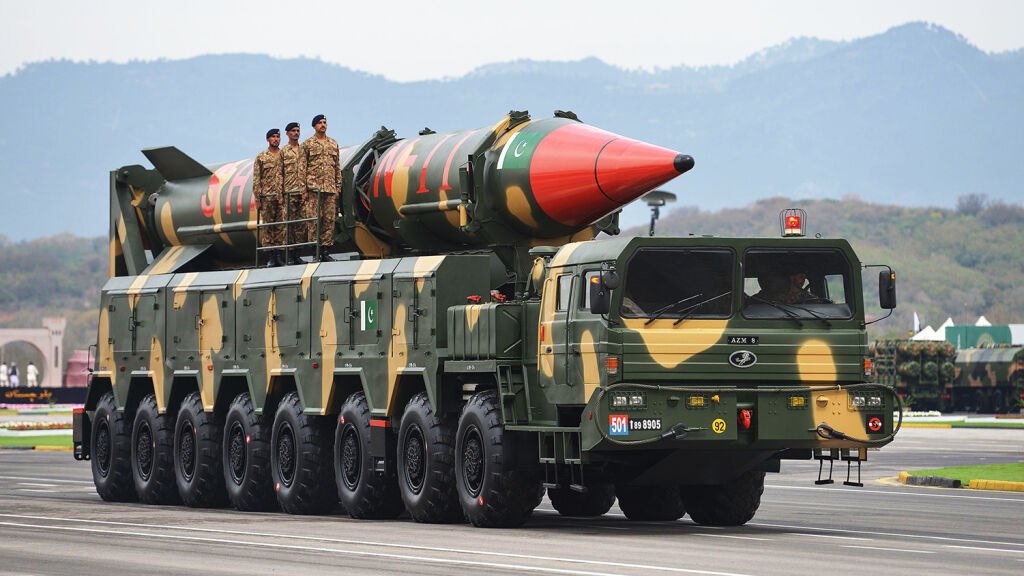
With the arrival of nuclear weapons in the 20th century, the cost of war has been elevated. That is why today most countries are inclined toward avoiding wars at any cost. In the contemporary world, states seek to enhance their capacities and capabilities to deter adversaries rather than to fight wars. In the same manner, Pakistan and India are adversaries since their independence. After attaining nuclear first-strike capabilities in 1998, both countries were interested in the nuclear triad. Second strike capability is one of the key elements in a state’s security in the current nuclear age. Second Strike Capability ensures the peak in deterrence and a no-first-use policy (NFU). Its possession confers a state’s ability to deter its enemies from initiating a nuclear war by decapitation strike, in the same way, the nuclear triad ensures second-strike capability. Pakistan’s second-strike capability allows Pakistan to deter India’s nuclear policy to a greater extent, but it has some limitations in numerous ways which need to be addressed.
Pakistan achieved its second-strike capability in 2017 after successfully testing a submarine-launched cruise missile (SLCM), Babar-III in Agosta-90-B known as Khalid class submarine with which Pakistan ultimately completed its triad. Babur-III is the modified form of Babar-II, a ground-launched cruise missile (GLCM). Pakistan successfully tested Babur-III to counter India with “Credible minimum deterrence”. In the air domain, Pakistan has acquired the Hataf-8 or Ra’ad 2 missiles (ALCM), but it has a range of 600 km. These can be fired up from Mirage 3, but recently Pakistan has acquired the J10 C from China, which can carry conventional and nuclear warheads. India had already tested its submarine-launched ballistic missile (SLBM), Sagarika K-15, and Sagarika K-4 in INS-Arihant before the acquisition of the nuclear-armed submarine (SSK) by Pakistan.
To evaluate Pakistan’s second-strike capability, a few discourses must be considered. For comparing India’s submersible ship ballistic missile nuclear (SSBN) with Pakistan’s (SSK) conventional diesel-electric submarine, the first distinction is the fuel that is used in these submarines. SSBN has a clear advantage because it is a nuclear-powered submarine while SSK is a diesel-electric-powered submarine. SSK can be detected by radars, but the probability to detect SSBN is less because of its high speed.
Another paramount characteristic of submarines that determines their capability is the duration for which they can remain under the sea. SSBNs can remain inside the sea for a long time without coming outside for months, mostly they stay submerged for about 90 days. In contrast, SSKs can stay for less time than SSBNs, they must come to the sea surface to get oxygen for fuel combustion. SSKs also possess batteries that need to be charged for about 30 minutes in 24 hours, so these submarines are more likely to be detected by the radars than SSBNs. But Pakistan has acquired the AIP system (Air Independent Propulsion) in some of its submarines which increases the stealth and duration of these submarines to be submerged in water for a longer period and it is effective for countries like Pakistan to attain such technologies because it cannot afford SSBNs. Moreover, the credibility of nuclear missile-capable submarines also depends upon the type of weapons that they carry. SSBNs can carry submarine-launched ballistic missiles (SLBMs) while SSKs can carry submarine-launched cruise missiles (SLCMs). Also, SSBNs are less noisy and produce fewer vibrations in the water than SSKs.
As SSBNs possess the SLBM capability so, they can approach at longer distances for their targets while SSKs have SLCM capability which has a lower range of approaching their target. India’s Sagarika K-15 has a range of 700 to 800 km and Sagarika K-4 has a range of 3000 to 3500 km, while on the other hand, Pakistan’s Babur-III (SLCM) has a range of 450 km. But one of the advantages to Agosta-90-B is that their SLCM has a flight at an extremely low altitude which cannot be intercepted easily by the radars due to their maneuvering at low altitude. Additionally, SSKs are less expensive to maintain than nuclear-powered SSBNs, as Pakistan’s economy in the current situation is incapable of allocating a handsome budget for SSBN purchase and their maintenance.
As Pakistan’s second-strike capability was achieved after India, it is evident that Pakistan’s nuclear arsenals are purely India-centric. Similarly, Pakistan is consistently comparing its conventional and nuclear arsenals with India. Pakistan has also made major upgrades in its conventional and nuclear missile-capable submarines, as in collaboration with Turkey in 2018, where Babar-III missiles were tested from Agosta-90B.
Furthermore, the presence of an effective command and control mechanism also plays a key role in deterrence. Effective command and control mechanism is important in transforming the second-strike capability to be deployed at the right time, in the right place, and any miscalculation can lead to a catastrophe not only in the South Asian region but in the entire world. Pakistan’s current SLCMs cannot target the most important counter-force target which is the command-and-control mechanism because of the short range of the cruise missiles and the ambiguity of positioning the Command-and-Control system, only it can target the counter-value targets which is the population in the coastal areas of India. Hence, Pakistan’s deterrence threat rests on targeting and giving damage to the coastal areas of India with its diesel-powered nuclear missiles capable submarine.
Additionally, the development of nuclear-powered submarines also requires a huge investment to take a country’s sea-based nuclear deterrence to “assured” rather than “credible” only. Thus, equipping nuclear cruise missile capable submarines (Agosta-90B/SSKs) in Pakistan’s navy may not be able to deter India’s INS-Arihant/SSBNs which can carry long-range nuclear ballistic missile technology.
Concisely, Pakistan, and India both are constantly and consistently developing arms and are nuclearizing the South Asian region; thus, increasing the asymmetry. These two key players of the South Asian region are persistently in a nuclear technology competition. The pursuance of second-strike capability by Pakistan is for defensive means because of the hegemonic designs of the historical bashed rival India; however, it needs to be more advanced; quantitively and quantitatively because in the contemporary world Pakistan needs to acquire SSBNs to deter its ideological adversary due to its growing military capabilities.
