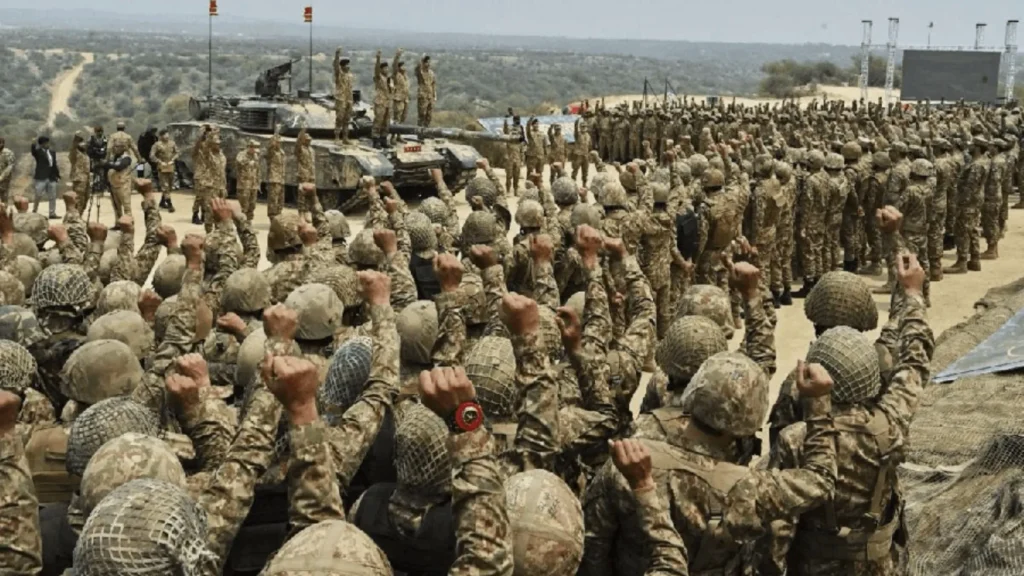
Pakistan sharply increased its arms imports between 2021 and 2025, recording a 66 percent rise compared with the 2016–20 period, with China supplying four-fifths of its military hardware, according to a new report by the Stockholm International Peace Research Institute (SIPRI).
The report highlights a deepening defence partnership between Pakistan and China, noting that Beijing’s share of Pakistan’s arms imports rose to 80 percent, up from 73 percent in the previous five-year cycle. Analysts say the trend reflects Pakistan’s growing reliance on Chinese fighter jets, naval platforms, air defence systems, and missile technology.
South Asia Arms Race Intensifies
In South Asia, India continued to import large volumes of weapons, driven by security concerns related to China and persistent tensions with Pakistan, which remains one of the largest recipients of Chinese arms.
SIPRI senior researcher Siemon Wezeman said that imported weapons were used during a 2025 clash between India and Pakistan, underlining how arms flows are directly influencing regional conflict dynamics.
Also read: China Removes Top PLA Generals in Biggest Military Purge Ahead of Two Sessions 2026
Despite a four percent decline in overall imports, India retained its position as the world’s second-largest arms importer. The report noted a significant shift in India’s procurement strategy, with New Delhi increasingly diversifying away from Russia toward Western suppliers.
Russia’s share of India’s arms imports dropped to 40 percent in 2021–25, down from 51 percent in 2016–20 and nearly half of its 70 percent share in 2011–15, reflecting India’s push to reduce dependence on Moscow.
Asia-Pacific Still a Major Arms Market
Across Asia and Oceania, countries accounted for 31 percent of global arms imports, although the region experienced a 20 percent decline compared with the previous five-year period. The drop was largely driven by steep reductions in imports by China (-72 percent), South Korea (-54 percent), and Australia (-39 percent).
Even so, four countries from the region — India, Pakistan, Japan, and Australia — ranked among the top 10 arms importers worldwide, underscoring the region’s continued strategic and military importance.
Europe and Middle East Drive Global Arms Surge
Globally, major arms transfers increased by 9.2 percent between 2016–20 and 2021–25. According to Mathew George, the rise was primarily driven by Europe and the Middle East, despite declines in some other regions.
Europe emerged as the largest regional arms importer, accounting for 33 percent of global imports. SIPRI attributed a staggering 210 percent increase in European imports to the war in Ukraine and heightened concerns over Russia. Ukraine alone received 9.7 percent of all major arms transfers worldwide during the period.
Also read: China’s Hebei Juhang Energy Eyes Setting Up Major Solar Panel Plant in Pakistan
In contrast, arms imports by Middle Eastern countries fell by 13 percent, though the region still included three of the world’s top 10 importers: Saudi Arabia (6.8 percent of global imports), Qatar (6.4 percent), and Kuwait (2.8 percent). The United States supplied more than half of all weapons imported by the Middle East.
Israel and Gaza War Weapons Supply
Israel ranked as the 14th-largest arms importer, with imports rising 12 percent. SIPRI noted that Israel continued to receive major weapons systems, including combat aircraft and guided bombs, throughout the Gaza conflict.
The United States supplied 68 percent of Israel’s arms, followed by Germany at 31 percent.
US Dominates Global Arms Exports
The United States remained the world’s largest arms exporter, increasing exports by 27 percent and expanding its share of global arms transfers to 42 percent, up from 36 percent in the previous period. For the first time in two decades, Europe received more US arms (38 percent) than the Middle East (33 percent).
Saudi Arabia remained Washington’s largest single customer, accounting for 12 percent of total US arms exports.
France Rises as Russia’s Exports Collapse
France retained its position as the second-largest arms exporter, boosting exports by 21 percent to 63 countries. Its biggest clients were India (24 percent), Egypt (11 percent), and Greece (10 percent).
In stark contrast, Russia saw its arms exports plunge by 64 percent, cutting its global market share from 21 percent to just 6.8 percent. Russia supplied weapons to 30 countries, with nearly three-quarters going to India, China, and Belarus.
Also read: Nvidia can now ship chips to China
Meanwhile, Germany overtook China as the fourth-largest arms exporter, accounting for 5.7 percent of global exports, while Italy recorded a dramatic 157 percent surge, becoming the sixth-largest supplier worldwide.
A Rapidly Shifting Global Arms Landscape
The latest SIPRI findings underline how geopolitical rivalries, regional wars, and shifting alliances are rapidly reshaping the global arms trade, with Pakistan’s growing reliance on Chinese weapons and Europe’s unprecedented surge in imports standing out as defining trends of the current era.
