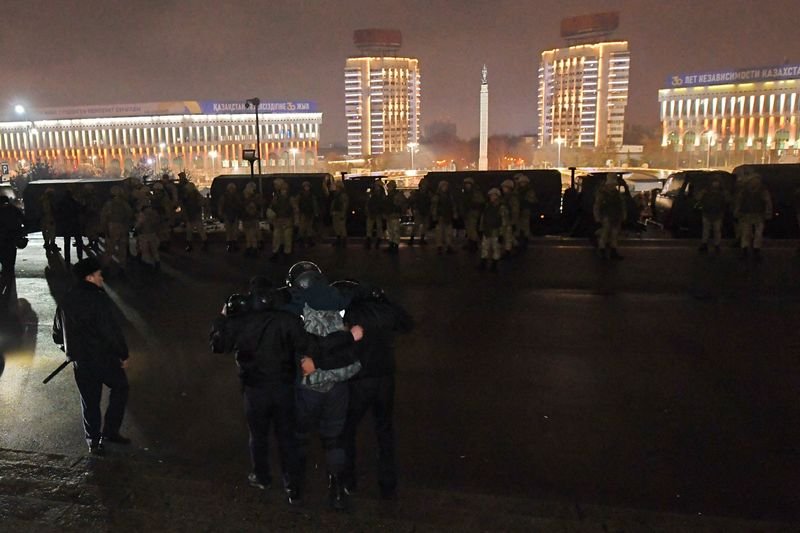
Kazakhstan’s President Kassym-Jomart Tokayev has requested assistance from a Russian-led security bloc after failing to stop days of demonstrations in the ex-Soviet country, which have resulted in the burning of official buildings and the deaths of eight security officers.
Protests against a New Year’s gasoline price rise have shaken the Central Asian country since the beginning of the year, with protestors battling with police and storming government buildings on Wednesday.
“I appealed to the chiefs of CSTO (Collective Security Treaty Organisation) states today to assist Kazakhstan in combating this terrorist danger,” Tokayev said on state television early Thursday.
He went on to say, “In fact, this is no longer a danger.” “It is weakening the state’s integrity.”
The CSTO security alliance, which includes five additional former Soviet governments, is led by Moscow.
Tokayev, who had previously declared a statewide state of emergency, said that terrorist cells are “now rampaging” across the country, claiming that they had “got considerable training overseas.”
“They are grabbing buildings and infrastructure, but most critically, they are seizing locations where small guns are kept,” he added, adding that they had also taken five planes at Almaty’s airport.
“A stubborn struggle is presently taking place near Almaty with the air forces of the defence ministry,” Tokayev alleged.
The airport had been cleared of demonstrators and was operating smoothly, according to the deputy mayor.
The turmoil claimed the lives of eight police officers and national guard soldiers, as well as injuring more than 300 others, according to the Kazakh Ministry of Internal Affairs. There were no civilian casualty statistics provided.
According to press sources, demonstrators in Almaty invaded the presidential palace and the mayor’s office on Wednesday, setting both on fire.
Before departing, police are said to have shot on several demonstrators at a home in Almaty. In recent days, they have battled with protestors many times, using water cannon in the frigid conditions, as well as tear gas and concussion grenades.
Tokayev has promised to take tough steps to quiet the unrest, declaring a two-week state of emergency for the entire nation, extending one that had been established for Nur-Sultan and Almaty, which enforced a nightly curfew and limited transportation into and around metropolitan regions.
On Wednesday, the administration resigned in reaction to the turmoil. Late Wednesday, Kazakh news sites became inaccessible, and the worldwide watchdog organisation Netblocks claimed that the nation was undergoing a widespread internet blackout, but internet connectivity was restored in Almaty by early Thursday, according to the Russian news outlet Tass.
Although the protests began over a near-doubling of prices for a type of liquefied petroleum gas widely used as vehicle fuel, their size and rapid spread suggested they were a reflection of wider discontent in the country, which has been ruled by the same party since independence from the Soviet Union in 1991.
Kazakhstan, the world’s ninth-largest country, has borders with Russia to the north and China to the east, and has vast oil reserves, making it strategically and economically significant.
Despite these reserves and mineral richness, there is widespread dissatisfaction with poor living conditions in various sections of the country. Many Kazakhs are also irritated by the ruling party’s domination in parliament, which controls more than 80% of the seats.
