The Russian soldiers are in the northern city to train Malian forces, according to an army official.
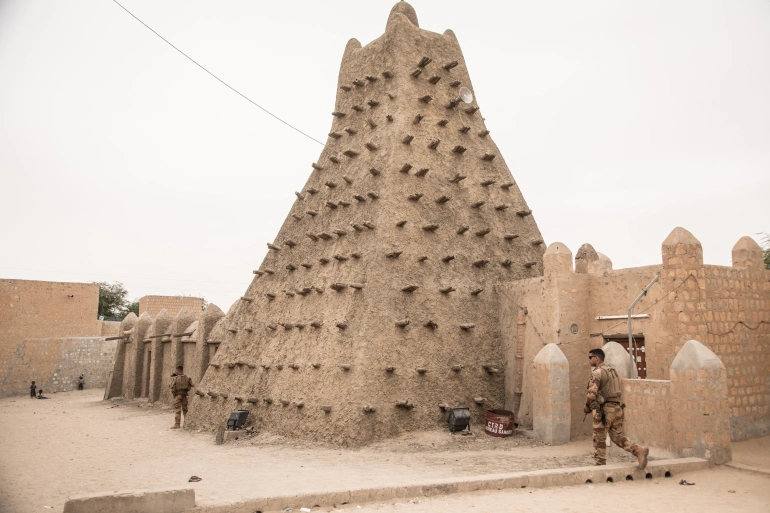
A few hours before the handover ceremony of the Barkhane military facility to the Malian army in Timbuktu on December 14, 2021, French soldiers patrol Timbuktu for the final time.
Russian soldiers have arrived in Timbuktu, Mali’s northern metropolis, to train Malian forces at a base evacuated by French troops last month amid chronic insecurity in a country where significant swaths of land remain out of the government’s authority, according to the country’s army spokeswoman.
The Malian government said late last year that “Russian trainers” had arrived in the nation, but neither Bamako nor Moscow have revealed many specifics about the deployment, such as the number of soldiers participating or the Russian forces’ exact objective.
On December 23, a group of Western countries led by former colonial power France sharply criticised what they said was the deployment of Russian mercenaries working for the controversial Wagner Group. France intervened militarily in 2013 to help push back advancing armed groups that threatened to seize the entire country of Mali.
Mali’s administration has rejected this, claiming that Russian forces are present according to a bilateral arrangement.
“They [the Russians] had new acquisitions of planes and weapons for us,” a Mali army spokesperson told Reuters on Thursday. “Training us on site is much less expensive than sending us over there… “What’s the big deal?”
He did not specify the number of Russians dispatched to Timbuktu.
Residents told Reuters that they had spotted uniformed Russian personnel driving around town, but they couldn’t say how many there were.
The entrance of Russian military in Mali follows deployments to many other African hotspots, observers believe, as part of Moscow’s bid to reclaim influence on the continent after a long absence following the collapse of the Soviet Union in 1991.
Mali has been engulfed in a conflict that began as a separatist movement in the country’s north in 2012, but has since degraded into a slew of armed factions vying for power in the country’s central and northern regions.
Fighting has spread to neighbouring countries like as Burkina Faso and Niger, and the region’s deteriorating security situation has triggered a severe humanitarian crisis.
The French troops’ evacuation from Timbuktu, which they helped reclaim from al-Qaeda rebels in 2013, is part of a larger drawdown of a 5,000-strong task force in West Africa’s Sahel region. The French government announced that it will target its military resources on countering rebel actions as well as developing and training local troops.
Colonel Assimi Goita, who was sworn in as Mali’s interim president after two coups in less than a year, made the choice amid rising political unrest in the country. The military-dominated government previously stated that elections would be held by the end of February 2022, but has since recommended a six-month to five-year transition period.
The recent rumours about the Wagner deployment have strained already strained connections between the French government and the coup plotters. The intensifying violence has also coincided with a surge in anti-French sentiment among Malians, who accuse Paris of failing to contain the violence and pursuing a hidden agenda.
The French military has already closed sites at Kidal and Tessalit further north, but it is still present in Gao, close to a dangerous border region where operations have been concentrated in recent years.
