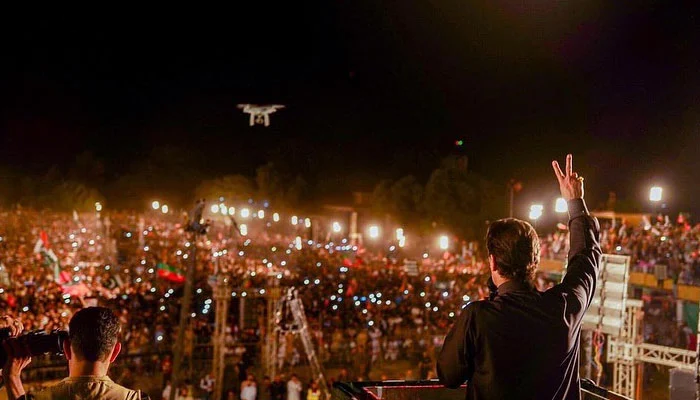
“Without revolutionary theory there can be no revolutionary movement,” said a great Russian statesman and founder of the USSR Valdemar Lenin. I wonder how relatable this quote is to understand the current political kerfuffle in Pakistan. PTI chairman Imran Khan who has recently retained popularity and emerged in Pakistani politics as an anti-imperialist leader when he blamed the US for conspiring against his government and helping to overthrow it by a no-confidence motion, is now marching towards Islamabad with his party workers in a quest to regain the ‘lost paradise.’ The questions that a layman must ask are: why is he marching? Does he have any alternative to the current socio-politico-economic crisis? Does his party have the right candidates to represent the common people? Does he have any substitute for the IMF or World Bank? The answer is a big NO.
Earlier, before his ouster from the office, the nation must not forget how badly Imran Khan failed in running the state institutes. Apart from the poor governance in Punjab, his economic management was so pathetic that he kept on changing the Finance ministers in the hope to stabilize Pakistan’s freefalling economy, but alas, during his 3.5 years in power, the inflation rate was much higher than the previous governments. What else he could do to save his image? Like any demagogue, he used rhetoric which Plato termed ‘the art of winning the soul by speech,’ and it worked. Apart from the letter conspiracy, which may be true as it seems so, he isn’t eligible to lead the country with this incompetent team.
Then why the long march? Long marches are favorable only if a party has its roots in common people; if it has a strong economic plan, and a human-centric vision. The long march is said to be the last stage of any revolution before that party organizes its workers and does a lot of hard work on the common citizens to make them understand the grammar of politics. But in Pakistan long marches are held to put pressure on the government for one’s political survival. Does one wonder how many people in Pakistan have political growth and training? None or maybe few. Most of the party workers in Pakistan are influenced by the personality of their leader or vote by taking money. That’s why every long march in Pakistan fails badly and ends with a favorable deal with the help of the establishment.
Every year we see the same political episode with different characters in Pakistan. Not too long ago, in 2013, Tahir ul Qadri’s long march against corruption ended in a so-called agreement. So pinning hopes on these kinds of protests is useless. Likewise, these kinds of long marches not only affect the economy but at the end of the day, it’s the poor people who die on the streets when a clash occurs between the government and opposition. However, the fact of the matter is the road to stability seems nowhere. This crisis will worsen even more and further pave the way for the military to expand its sphere of influence in Pakistani politics.

2 thoughts on “Can a long march succeed without revolutionary ideology?”
It is a good blog and it explains the current political situation of Pakistan very wisely. You have intellectually explained it. 😅
Well done, Hadi bhai. ♥️