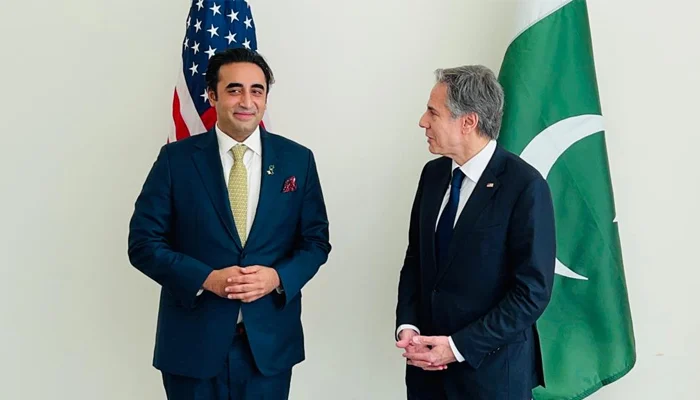
Foreign Minister Bilawal Bhutto-Zardari told US Secretary of State Antony Blinken that Pakistan values trade over aid.
Currently, FM Bilawal Bhutto is on a two-day official visit to the United States, during which he has met with UNSG Antonio Guterres and other international leaders.
Bilawal arrived in New York a day earlier and met with US Secretary of State Antony Blinken at the United Nations (UN) Headquarters. He then attended the ministerial meeting on the “Global Food Security Call to Action.”
During an exclusive interview with Geo News, Bilawal Bhutto expressed his pride in representing Pakistan at the United Nations.
“I am proud to represent my country, as Pakistan is engaging with the international community and presenting its narrative to the world,” he added.
Regarding his participation in the meeting on food security, he stated, “Food security and the water crisis are major issues in the country.”
Bilawal Bhutto disclosed the details of his meeting with US Secretary of State Antony Blinken, stating, “We emphasized Pakistan’s preference for trade over aid, and he responded positively.”
“We want to see growing ties between businessmen, entrepreneurs, and business communities of both nations,” he added.
On being asked if he could follow in the footsteps of his mother and grandfather in representing Pakistan at international forums, Bilawal responded, “I would not claim to be able to fill their shoes, as their legacy and roles are historic.”
Bilawal stated, “However, we will work diligently to represent the desires, demands, and hopes of the new generation of Pakistan around the world.”
FM Bilawal continued by stating that the new generation of Pakistan has so much potential that we can accomplish a great deal if we work diligently together.
Pakistan urges unity in addressing the problem of food security
In an address to a ministerial meeting on “global food security” at the headquarters of the United Nations, the foreign minister emphasized the importance of maintaining access to food and ending supply restrictions, export bans, hoarding, speculation, and panic buying of food and fertilizers.
He emphasized that supply chains must remain fully operational, including food processing and logistics.
In order to mobilize action to address global food insecurity, US Secretary of State Antony Blinken convened a ministerial-level meeting of 30-35 countries, including those most affected by food insecurity and those in a position to take action to strengthen global food resilience and security.
In his speech, the foreign minister also urged the United Nations to establish a special food emergency fund.
He stated that the United Nations and its relevant agencies WFP, FAO, IFAD, and UNDP should be tasked with coordinating and executing such a plan and fund for emergency food security.
“Countries in a position to increase wheat and other grain and fertilizer production must do so.”
“Support must be provided to enable food producers, particularly smallholders in developing nations, to contribute to increases in local and national food production by having adequate access to seeds, fertilizer, and capital,” he proposed.
Regarding another aspect of the emergency plan, he stated that food prices should be moderated through appropriate international, national, and market mechanisms, particularly for vulnerable developing nations.
Countries in social and financial distress must receive emergency grants and concessional financing in order to secure adequate food and related supplies.
Bilawal stated that food insecurity in developing nations has been growing steadily due to low productivity, water scarcity, land degradation, lack of agriculture infrastructure, insufficient application of new technologies, unfair trade practices, and climate change.
He added that the COVID-19 pandemic and ensuing economic crisis disrupted agricultural and food supply chains, exacerbated poverty, drove up commodity prices, and diminished the purchasing power of millions of the most vulnerable people in developing nations.
Citing an additional factor, the foreign minister stated that the ongoing war in Ukraine and the accompanying restrictions on food supply were the final straw for the poor, as food and energy prices had skyrocketed, making them unaffordable for the poorest people and countries – in Africa, Afghanistan, and elsewhere.
The foreign minister stated that it was crucial to promote sustainable systems of food consumption and production, end waste and pollution, conserve water, encourage forestation, and respect biodiversity and natural habitats.
In addition to the emergency plan of action, the foreign minister emphasized that measures must be taken to address the structural issues impeding global food security and the implementation of SDGs 1 and 2.
Among these measures, he stated, should be the rationalization of international agricultural trade, in particular the abolition of the massive agricultural subsidies provided by certain wealthier economies that distort global markets and make it impossible for farmers in developing nations to produce food at competitive prices.
In order to facilitate the production, storage, transport, and distribution of food products and agricultural inputs, Bilawal advocated for a significant increase in investments in sustainable agriculture infrastructure in developing nations.
In addition, he emphasized the efforts to increase the application of new and innovative agricultural technologies and techniques, such as digital technologies, in developing nations via access and transfer on concessionary and preferential terms.
“Mobilize sufficient concessional financing for developing countries, including through debt relief, increased ODA, reallocation of half of unused SDRs, and fulfillment of the promised $100 billion in climate finance,” he added.
