“Nuclear weapons offer us nothing but a balance of terror, and a balance of terror is still a terror” _GEORGE WALD
Nuclear weapons have brought a change in the nature of war and have converted the war from less destructive to more destructive. Nuclear wars will bring destruction to both parties and there will be no decisive wars, only the world will face complete destruction and loss of millions of lives, properties, and peace of the world. If two nuclear states wage war and one state, go for a preemptive strike then how the other state will attack if its nuclear arsenal is destroyed? For this nuclear states have developed a second-strike capability to deter and counter their adversaries for not taking the certain action otherwise they will face massive retaliation.
The second strike in a nuclear context is the ability of a nuclear state to assure its massive retaliation in case of the first strike (preemptive strike) by its adversary. Second-strike deters the enemy not to undergoing such actions otherwise they will face a massive retaliation and will face serious consequences in case of their first attempt toward nuclear war. For deterring your enemy not to waging the war Nuclear device are not necessary whether a state has to develop a capability of the nuclear triad. The nuclear triad is the capability to undertake nuclear attacks from land, air, and sea as well with proper control of having the second-strike capability.
Pakistan and India have had a rivalry since their independence and both countries have been involved in four wars after their independence. India developed nuclear in 1974 which caused a security dilemma for Pakistan. Pakistan started working on its nuclear program on serious notes and got succeeded in developing its nuclear program by conducting a nuclear test in 1998 at Chagai. This develops some space for Pakistan to deter India against its conventional military might.
To preserve second-strike capability states, have to deploy nuclear weapons where they are saved from the enemy’s first strike. The second strike can be conducted from remote areas and secret underground bases, from underwater submarines, and from Aircraft that are far and safe from attacks. Among all of them, the most convenient way for a second strike is submarines because they are underwater and are difficult to be detected.
India was interested in the nuclear triad and develop it in the early stages and attained the second-strike capability. India has developed INS Arihant and showed it in public on 26 July 2009. With the development of INS Arihant India has acquired the second-strike capability. INS Arihant is a nuclear-powered submarine equipped with ballistic nuclear missiles(SSBN) and with the development of this nuclear submarine reflects that India believes in full-spectrum deterrence. While on the other hand before the advent of INS Arihant Pakistan was refrained from the development of a nuclear triad as she believed in credible minimum deterrence. After INS Arihant Pakistan started working on a nuclear triad and developed a Baber-3 cruise missile which is a submarine-launched-based missile. After the development of Baber Pakistan declares itself capable of second-strike capability.
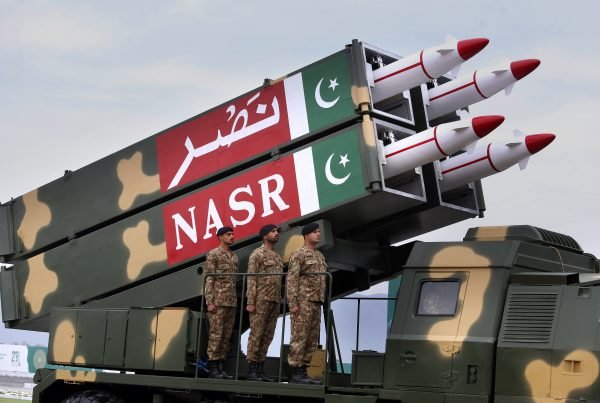
Moreover, Pakistan has stored its nuclear arsenals in the mountains of Baluchistan where they can be launched at the need of the hour. According to the US, they are unaware of Pakistan’s nuclear sites. From the Air domain, Pakistan has developed Hataf-8 which is also known as Ra’ad 2. It has the capability to carry both conventional and nuclear payloads. It has a range of 600km according to ISPR. The Ra’ad 2 will be carried out with the help of mirage 3. Thus, Pakistan has attained the nuclear triad and adopted the second strike capability to deter India not to going for a preemptive strike.
Pakistan has to work more efficiently on its second-strike capability as the development of the Baber 3 cruise missile isn’t necessarily destroying the Indian navy in case of Nuclear war. The range of the Baber cruise missile is only 450km which means it can reach and destroys coastal areas of India rather than destroy the main targets in case of the first nuclear war attempt by India. Moreover, Pakistan has diesel submarines and they have loud noise and are unable to go deeper and can be detected easily by the Indian navy, which can lead to failure in the second strike capability.
In the Air domain, Pakistan has mirage aircraft which have been serving for more than 54 years in the Pakistan Air force they are near to death because of their continuous overhauling for making them able to be in use. The Ra’ad 2 missile also lacks long-range and is unable to carry some more nuclear payload capabilities. To ensure its full-scale deterrence Pakistan has to focus on Air and sea domains for refraining its adversary to go for nuclear war.
Pakistan has to develop nuclear submarines because acquiring a conventional submarine with a cruise missile that has a shorter range cannot match the Indian nuclear submarine INS Arihant and there is still asymmetry in this domain. Moreover, only two submarines in Pakistan are in use and they will be unable to tackle India’s aggression in case of nuclear war. It is a dire need for Pakistan to develop nuclear submarines with the help of china for full-spectrum deterrence.
Recently Pakistan has got J-10C fighter jets from China to match up with the Indian Rafale fighters jet. Upgradation of J-10C is the best option for Pakistan to carry the nuclear payload in case of nuclear war and also Pakistan has to develop long-range air to surface nuclear missiles that can damage the Indian main point in case of the first attempt by India. Pakistan needs to do a lot of work to attain a nuclear triad as they have many flaws in all three domains and these flaws in the nuclear triad show that Pakistan lacks second-strike capability that can have severe damage in case of war and this also didn’t deter India to undergo for a preemptive strike.
