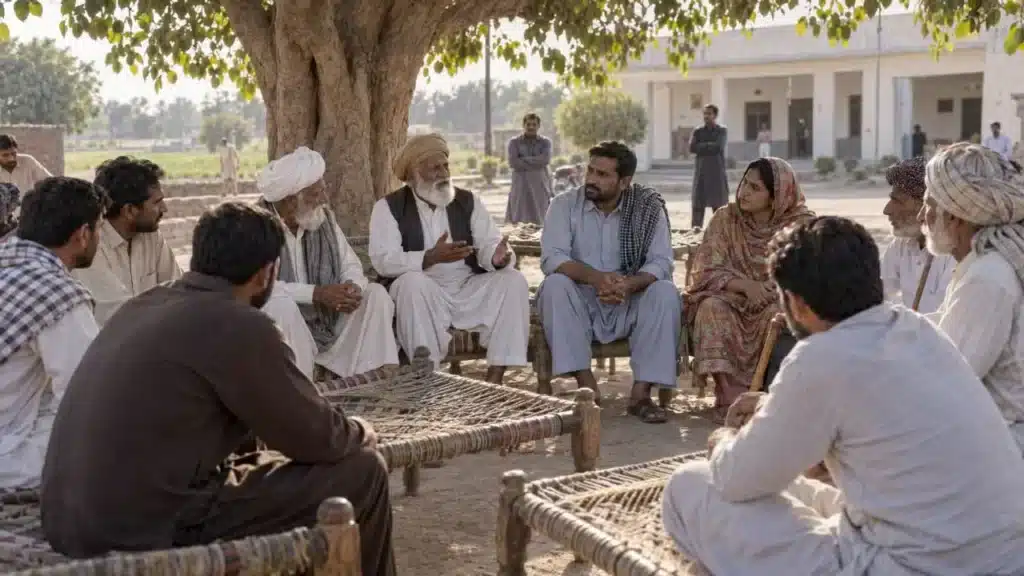
Punjab Chief Minister Maryam Nawaz Sharif has given in-principle approval to a proposed panchayat system that would allow communities to resolve minor local disputes through mediation and mutual agreement, as the provincial government seeks to improve access to justice and reduce the growing burden on courts.
Under the proposed framework, panchayat committees will be established at union council, village, locality and mauza levels. These committees will facilitate negotiations between disputing parties and help reach amicable settlements, provided all parties agree to participate.
The decision was taken during a special meeting chaired by Maryam Nawaz, where officials presented details of the proposed system and its implementation framework.
The government intends to introduce the mechanism through a proposed Punjab Panchayat Act, which will establish legal guidelines for community-based dispute resolution.
The initiative is designed to provide residents with a relatively accessible and affordable way to settle certain disagreements without immediately pursuing lengthy court proceedings.
However, participation will remain voluntary, and the proposed system will not replace the formal judicial process or restrict citizens’ right to approach courts.
The proposed committees will operate at four administrative levels, allowing residents to approach local representatives instead of immediately taking minor disagreements to court.
Deputy commissioners will appoint permanent residents of the respective areas based on their reputation, impartiality and judgment.
The proposed membership will include lambardars, teachers, retired judges, former military officers, retired civil servants and other respected community figures. Their role will be to facilitate discussions between disputing parties and help them reach mutually acceptable settlements.
The government has also proposed safeguards to prevent the system from being misused, particularly in disputes involving women and vulnerable communities.
Officials said a negative list would identify matters that panchayats would not be permitted to handle, placing clear limits on their authority.
The framework is intended to improve access to justice for women, religious minorities, low-income households and marginalised communities. Importantly, citizens will retain their right to seek judicial protection, and the jurisdiction of existing courts will remain unchanged.
Maryam Nawaz has directed relevant departments to prepare comprehensive rules, policy guidelines and regulations defining the committees’ responsibilities, powers and operational limits.
These provisions will form part of the proposed Punjab Panchayat Act, which is intended to bring traditional community-based dispute resolution within a formal legal framework.
According to Radio Pakistan’s report on the Punjab government’s announcement, the initiative is intended to revive the traditional practice of resolving local disagreements through dialogue and mutual consent while making citizens active participants in the justice system.
The chief minister said courts should not necessarily be the first option for resolving every disagreement, arguing that discussions and the experience of respected community members could help settle minor conflicts more quickly and affordably.
However, the proposal still requires detailed rules and a legal framework before the committees can begin operating. The government has not announced a formal implementation date, and the proposed system will not replace the existing judicial process.
