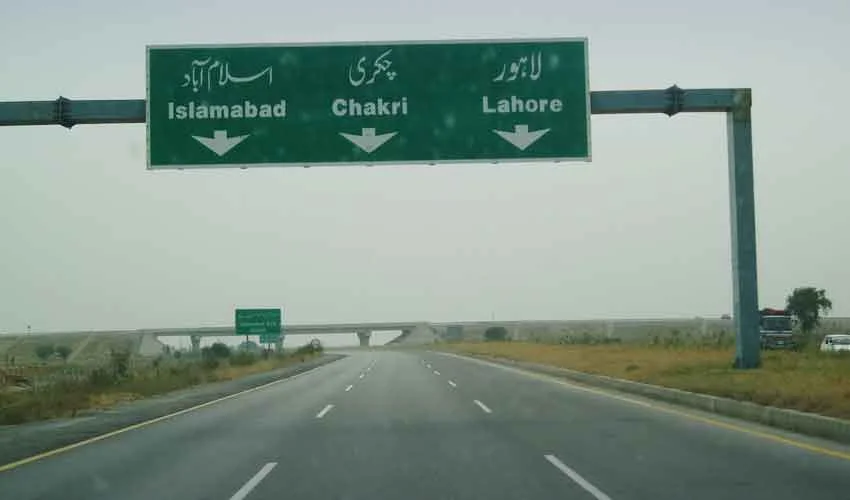
The federal government is targeting early 2027 to complete the expansion of the Faisalabad-Pindi Bhattian section of the M-4 Motorway, upgrading the existing four-lane road into a modern six-lane highway.
Federal Minister for Communications Abdul Aleem Khan announced the completion target during an inspection visit to the construction site at Kamalpur Interchange in Faisalabad. He said the government wanted to present the upgraded motorway to residents as a New Year gift.
The 53-kilometre project is designed to increase the motorway’s traffic capacity, improve connectivity and address a long-standing demand from Faisalabad residents for additional road infrastructure.
According to the government’s announcement, the expansion will add one lane in each direction, taking the existing configuration from two lanes to three lanes on either side.
Government Directs NHA to Accelerate M-4 Construction
During his visit, Aleem Khan reviewed construction activities and instructed officials to increase the deployment of machinery and workers to speed up progress.
The minister emphasised that construction should proceed according to the announced timeline without compromising engineering standards and quality requirements.
The National Highway Authority (NHA), which operates under the Ministry of Communications, is responsible for Pakistan’s national highway and motorway infrastructure. The M-4 expansion is being financed through NHA resources, according to the official government announcement.
The project involves construction organisations, including the National Logistics Cell (NLC), working on different sections of the expansion.
The government has not provided a detailed public breakdown of the remaining construction work or a percentage-based completion assessment in the announcement.
New Rest Areas and Lighting Included in Upgrade
The expansion plan also includes passenger facilities and improvements to the motorway’s surrounding infrastructure.
The government intends to establish modern rest areas along the Faisalabad-Pindi Bhattian section to provide better facilities for motorists undertaking long-distance journeys.
During the inspection, Aleem Khan directed officials to finalise the rest area designs within one week. He also instructed the relevant authorities to ensure adequate lighting throughout the motorway section.
The landscaping plan includes trees along both sides of the road, green belts in the central section and date palm trees.
These improvements are intended to make the upgraded route more convenient for passengers while improving the appearance of the motorway.
Six-Lane M-4 Motorway Expected to Improve Traffic Flow
The additional lanes are expected to increase road capacity and help manage traffic congestion between Faisalabad and Pindi Bhattian.
The communications minister said the upgraded road would improve travel conditions and help reduce the risk of accidents.
However, the actual impact on road safety will depend on several factors, including driving behaviour, traffic enforcement, road maintenance, lighting and compliance with motorway regulations.
Motorway Police personnel also play an important role in maintaining traffic discipline and responding to road emergencies.
During the visit, the minister paid tribute to Motorway Police officers who had lost their lives while performing their duties.
M-4 Motorway’s Role in Pakistan’s Road Connectivity
The M-4 is an important motorway corridor connecting Faisalabad with other major transport routes in Punjab. Its connection with the M-2 near Pindi Bhattian provides access towards Islamabad and other northern destinations.
The expansion of the Faisalabad-Pindi Bhattian section is intended to accommodate growing traffic demand and improve the movement of passengers and commercial vehicles.
For Faisalabad, a major industrial and commercial centre, improved motorway capacity could also support transportation and regional economic activity.
The government is now aiming to complete the 53-kilometre expansion by early 2027. The deadline remains a stated target, and the final delivery will depend on construction progress, infrastructure quality and the completion of planned passenger facilities.
