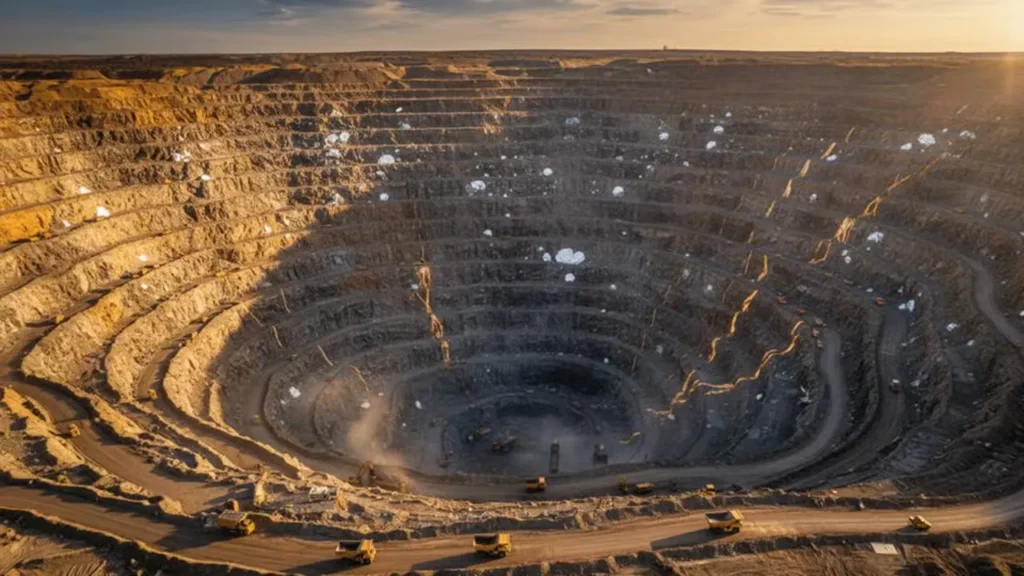
Barrick Mining began reviewing the Reko Diq project in February 2026 following an increase in security risks and incidents in Pakistan and the wider region.
In an official statement issued on April 2, 2026, the company said it would slow development activities and extend its review until mid-2027. The assessment covers security conditions, capital requirements, project financing, development scope and construction timelines.
Barrick said the project would remain under active management, although development spending would be reduced during the review period. The company also acknowledged that the revised approach could significantly affect previously announced budgets and production schedules.
Barrick Chief Executive Mark Hill subsequently indicated at the Mining Forum Americas that improvements in security conditions would be necessary before the company could commit to a full construction schedule.
The company has not formally announced 2030 as the revised production target. The potential date is based on information attributed to government and industry sources.
Investors can follow the company’s official updates through its Reko Diq project announcements.
Reko Diq Retains Its Workforce Despite Development Slowdown
Despite the reduced pace of development, project management has retained approximately 700 permanent employees and 2,000 contractual workers at the site, according to the report.
Some third-party service contracts have been allowed to expire as the company manages expenditure during the review period.
Research, administrative operations and community development programmes are continuing, indicating that the project remains operationally managed rather than abandoned.
Nearly $1 billion has reportedly been invested in the venture so far. Project stakeholders continue to regard Reko Diq as a strategically important mining development, although its future schedule will depend partly on security conditions and the outcome of Barrick’s assessment.
Barrick Chairman John L. Thornton is also expected to visit Pakistan later in November to attend the Pakistan Minerals Investment Forum 2026 in Islamabad.
Reko Diq Delay Could Increase Project Development Costs
The potential production delay has raised questions about the project’s overall investment requirements and the financial implications of an extended construction schedule.
Estimates of the additional costs vary considerably. One assessment cited in the report suggests that cost escalation could reach $8 billion to $10 billion under certain delay scenarios. Another estimate places the potential increase at approximately 10 percent, equivalent to $450 million to $900 million.
These figures represent different assessments rather than an official cost revision issued by Barrick. The company has acknowledged the possibility of higher capital requirements but has not confirmed a final revised project budget.
There have also been discussions about a possible minority investment by a consortium of Pakistani companies, although no confirmed transaction has been announced.
Separately, concerns have emerged over domestic mineral processing and value addition. Questions have been raised about the proportion of copper-gold output that could be processed within Pakistan compared with material potentially sent to overseas facilities.
Greater domestic processing could create additional opportunities for local industry, technology transfer and employment.
Ownership Structure of Pakistan’s Reko Diq Project
Reko Diq is jointly owned by Barrick Mining and Pakistani government stakeholders, with the Canadian company serving as the project operator.
The ownership structure is divided as follows:
- Barrick Mining Corporation: 50 percent
- Government of Balochistan: 25 percent
- Pakistan’s state-owned entities: 25 percent collectively
The Pakistani state-owned shareholders are Pakistan Petroleum Limited (PPL), Oil and Gas Development Company Limited (OGDCL) and Government Holdings Private Limited (GHPL).
The ownership arrangement gives both federal and provincial stakeholders a direct financial interest in the project’s long-term development.
Pakistan’s state-owned energy companies have also published information about the project’s feasibility and investment requirements. Further details are available through OGDCL’s official Reko Diq feasibility study announcement.
Reko Diq Investment Rises to Approximately $9.1 Billion
The project’s estimated capital requirements have increased significantly as development plans and investment assessments have evolved.
Under Barrick’s April 2026 update, Phase 1 capital expenditure was estimated at $5.6 billion to $6 billion, while Phase 2 was projected to require another $3.3 billion to $3.6 billion. These estimates exclude the capitalisation of financing costs.
The combined investment could therefore reach approximately $8.9 billion to $9.6 billion, placing the overall project expenditure around the $9.1 billion level.
The updated feasibility study outlines a two-phase development plan for the open-pit copper-gold mine.
Phase 1 is designed to process approximately 45 million tonnes of ore annually. Phase 2 would subsequently increase processing capacity to 90 million tonnes per year.
According to the feasibility information published by OGDCL, initial production was originally targeted for 2028, with the second phase expected to expand operations from 2034.
The updated study estimates a mine life of approximately 37 years, although further exploration and resource development could provide opportunities to extend operations.
Employment and Economic Potential at Reko Diq
Beyond its mineral production capacity, Reko Diq is expected to contribute to Pakistan’s economy through employment, export earnings, government revenues and investment in supporting infrastructure.
The project is projected to generate approximately 7,500 jobs during peak construction and support around 4,000 permanent positions once operational.
Its development could also create opportunities for Pakistani engineering companies, contractors, suppliers and businesses operating in the mining services sector.
However, the potential delay highlights the importance of addressing security risks, maintaining investor confidence and establishing a predictable investment environment for large-scale mining projects.
For Pakistan, the central challenge is to preserve the project’s long-term economic potential while resolving the operational and financial uncertainties that could push its first production beyond the original 2028 target.
