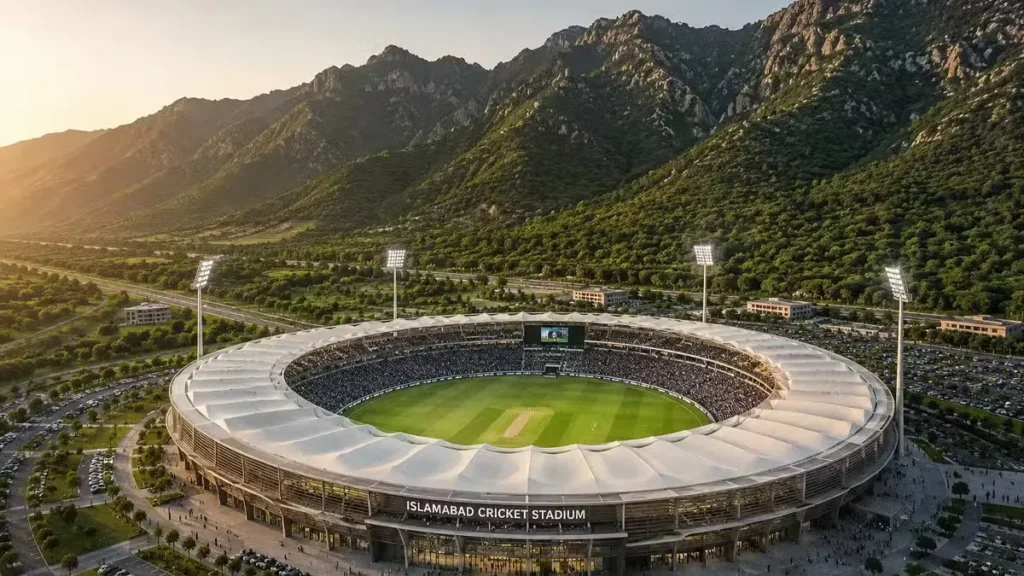
Islamabad’s proposed cricket stadium near Sector D-12 is moving closer to construction after the Capital Development Authority (CDA) and the contractor agreed on a Rs400 million rebate, clearing a major financial dispute ahead of the planned groundbreaking.
The stadium is designed to accommodate more than 35,000 spectators and will feature three tiers, rising over 25 metres at the foothills of the Margalla Hills.
The CDA has completed the approach road from Margalla Road to the site, while the main construction work is expected to begin shortly, according to officials cited by Dawn.
The project has an estimated cost of Rs11.9 billion under its approved planning framework, known as the PC-I. The Habib-ZKB-EA joint venture submitted the lowest bid at Rs8.9 billion, according to project reporting. The final financial arrangements and construction progress will determine the next steps.
CDA Resolves Contractor Dispute Over Stadium Cost
The disagreement arose after the CDA sought a rebate from the construction firm before the groundbreaking ceremony. The contractor argued that its bid had been submitted in March and that increases in fuel and other costs since then made a price reduction difficult to justify.
The two sides subsequently agreed to a Rs400 million rebate, according to Dawn. CDA Member Environment Abdullah Khurram Niazi confirmed the agreement to the newspaper and described it as a significant achievement ahead of construction.
The first phase will cover the stadium structure and approximately three kilometres of roads. The second phase will include landscaping, electrical installations and preparation of the playing field, including the cricket pitches.
The CDA had invited bids for the project through its procurement process. Details of the tender are available through the authority’s official stadium construction notice.
PCB Targets Women’s T20 World Cup 2028
The Pakistan Cricket Board (PCB) hopes to have the stadium fully operational before the ICC Women’s T20 World Cup 2028 and wants to host some of the tournament’s matches at the venue, according to PCB officials quoted by Dawn.
If completed on schedule, the facility would expand Islamabad’s capacity to host major cricket events and provide another international-standard venue in the capital region.
However, the 2028 tournament remains a target rather than a confirmed opening deadline. Construction, installation of facilities, preparation of the playing surface and any necessary approvals will affect whether the stadium is ready in time.
The project is also expected to improve the city’s sports infrastructure, although its wider benefits will depend on the facilities ultimately delivered and how the venue is operated.
Zone III Planning Rules Raise Questions
The proposed stadium site falls within Islamabad’s Zone III, where construction is generally restricted under the applicable planning framework. The CDA maintains that sports and recreational facilities are permitted in the area and that the stadium qualifies as an allowable use.
The site near D-12 was selected after the authority also considered a location near Malpur in Zone I. The earlier plan to build a cricket stadium at Shakarparian was abandoned after Supreme Court directions.
Under the new arrangement, the CDA will undertake the construction rather than leaving the development to the PCB.
The legal and environmental position requires careful consideration. In October 2026, the Islamabad High Court sought responses from the federal government, the CDA, the PCB and other authorities on an appeal challenging the proposed stadium and associated sports development. The challenge raised questions concerning land use, wildlife protection and the project’s environmental implications.
The issuance of court notices does not, by itself, mean the project has been declared unlawful or that construction has been stopped. The outcome of the proceedings and any applicable court orders remain important considerations for the project’s future.
What the Project Means for Islamabad Cricket
The stadium could provide the capital with a major venue for domestic and international cricket, reducing reliance on existing facilities elsewhere in the twin cities.
Its proposed capacity of more than 35,000 seats would allow it to accommodate large crowds, while the planned road network is intended to provide access to the site.
The final value of the project, construction timetable and completion of supporting facilities will be key factors in determining when it can host matches.
For now, the rebate agreement has removed one reported obstacle to the groundbreaking. The next milestones are the start of construction, progress on the stadium structure and resolution of any outstanding regulatory or legal issues.
The project’s readiness for the ICC Women’s T20 World Cup 2028 will ultimately depend on delivery against the construction schedule and the completion of all necessary facilities and approvals.
