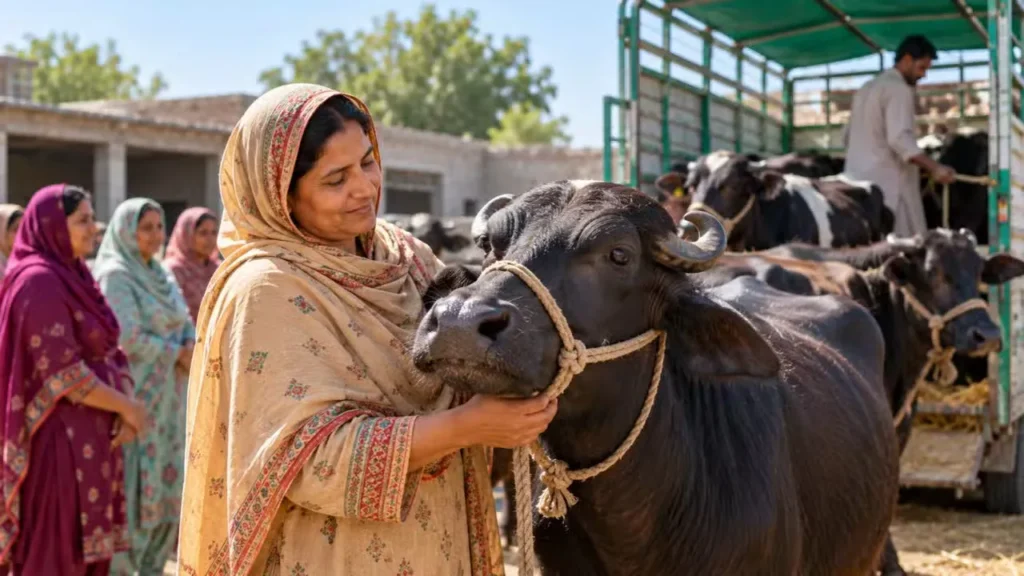
The Punjab government is preparing to distribute free cows and buffaloes to 3,380 selected rural women under Phase II of the Chief Minister’s Livestock Asset Transfer Scheme, with distribution scheduled to begin on October 20, 2026, according to the Punjab Information Technology Board (PITB).
Women who applied under the scheme can check their selection status through the official Livestock Asset Transfer Portal.
The programme targets widowed and divorced women in South Punjab and aims to help them generate income through livestock rearing and dairy-related activities.
PITB confirmed that electronic balloting for the second phase took place on October 14, 2026, using its digital system to select beneficiaries. The initiative is being implemented by the Punjab Livestock and Dairy Development Department in collaboration with PITB.
How to Check Punjab Free Livestock Scheme Results
Applicants who previously registered can check their selection status online by following these steps.
- Visit the official Livestock Asset Transfer Scheme portal.
- Enter the applicant’s Computerised National Identity Card (CNIC) number in the designated field.
- Enter the CAPTCHA code displayed on the page.
- Submit the information to check the application or selection status.
Applicants should enter their own CNIC details carefully and use the official government website rather than relying on unofficial links or social media posts.
The portal is intended for applicants seeking information about their existing applications and selection. The latest announcement does not establish a new registration period.
Who Is Eligible for the Punjab Livestock Scheme?
The scheme is designed for widowed and divorced women living in rural areas of South Punjab. According to the Punjab government’s official programme information, applicants must meet the following conditions:
- Be widowed or divorced and reside in a district of South Punjab.
- Be aged 55 or younger.
- Hold a valid CNIC.
- Have a mobile SIM registered in their own name.
- Not have received an animal through a government scheme during the previous five years.
Meeting the eligibility criteria does not guarantee selection. Applications undergo scrutiny and physical verification before livestock assets are transferred to successful beneficiaries.
Applicants who have not been selected should check their status through the official portal and contact the relevant livestock authorities for clarification rather than assuming that eligibility automatically qualifies them for an animal.
Which Districts Are Covered?
The programme covers all 13 districts of South Punjab, according to the Punjab government’s scheme information.
These districts are Bahawalnagar, Bahawalpur, Bhakkar, Dera Ghazi Khan, Khanewal, Kot Addu, Layyah, Lodhran, Multan, Muzaffargarh, Rahim Yar Khan, Rajanpur and Vehari.
The scheme is intended to support rural women who have experience in livestock management but lack the resources to establish or expand their own livestock-based livelihoods.
How the Free Livestock Scheme Supports Rural Women
The government’s initiative aims to provide eligible women with a productive asset that can support household income and economic independence.
Cows and buffaloes can offer opportunities for milk production, dairy sales and livestock rearing, depending on the animal provided and the beneficiary’s ability to care for it.
The second phase uses electronic balloting to select recipients, with PITB providing the digital system and the Livestock and Dairy Development Department overseeing the programme.
Beneficiaries should confirm the arrangements for receiving their animals directly with the relevant authorities. They should also seek guidance on animal care, feeding and veterinary support to help ensure that the livestock remains healthy and productive.
Women who applied for the scheme can now use the official portal to check their selection status and follow any instructions issued by the department for the next stage of distribution.
