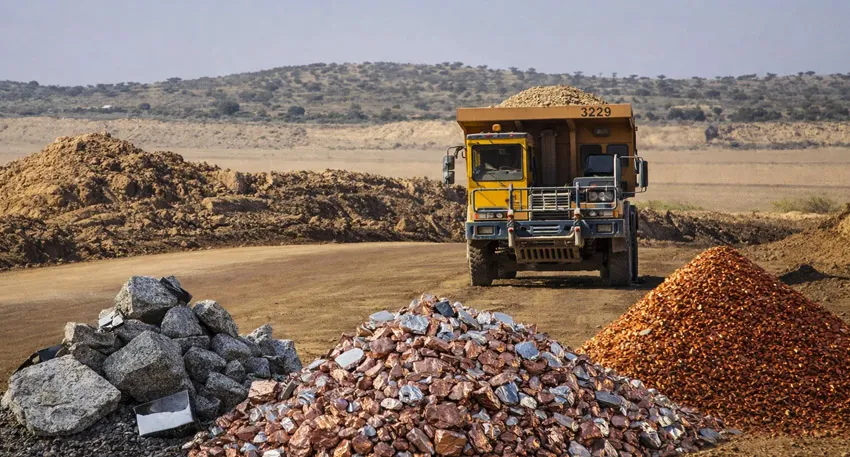
Pakistan is seeking to turn its mineral resources into a larger source of exports, industrial investment and foreign exchange as global demand for copper, gold and other critical minerals grows.
Projects such as Reko Diq, proposed critical-mineral partnerships and the upcoming Pakistan Minerals Investment Forum 2026 are central to efforts to attract international capital and develop the country’s mining industry.
The opportunity is substantial, but translating geological potential into economic gains will depend on more than the availability of minerals. Security, financing, infrastructure, regulatory certainty, environmental protection and local participation will help determine whether proposed investments become productive mines and export-orientated industries.
According to estimates attributed to the Institute of Cost and Management Accountants of Pakistan (ICMA), the country has mineral resources valued at approximately $8 trillion across an area of about 600,000 square kilometres.
Pakistan has 92 identified minerals, 52 of which are commercially exploited, according to figures cited by the institute. These estimates indicate the scale of the country’s potential, but they should not be interpreted as the market value of fully proven, economically recoverable reserves.
ICMA has also highlighted the mining sector’s limited contribution to Pakistan’s economy, historically accounting for less than 3% of gross domestic product.
It has estimated that improved governance and security could help increase annual mineral exports from around $3 billion to $8 billion. Such figures represent potential outcomes rather than guaranteed export earnings.
Reko Diq Offers Major Copper and Gold Potential
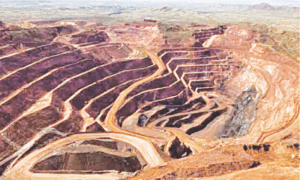
Located in Balochistan’s Chagai district, Reko Diq is one of the world’s largest undeveloped copper and gold deposits. The project is owned by a joint venture in which Barrick Mining Corporation holds a 50% stake, the Government of Balochistan holds 25%, and three federal state-owned enterprises collectively own the remaining 25%.
Barrick’s updated feasibility study, completed in 2024 and announced in February 2025, outlined a planned mine life of 37 years and total estimated capital investment of $8.83 billion across two development phases. Phase 1 was estimated to require $5.6 billion to $6 billion, excluding capitalised financing costs.
The original development plan envisaged a processing capacity of 45 million tonnes of ore annually during Phase 1, with projected annual production of approximately 240,000 tonnes of copper and 297,000 ounces of gold. A second phase was planned to increase processing capacity to 90 million tonnes annually.
However, the development outlook has since changed. In an update issued on April 2, 2026, Barrick said it would slow development activity and continue reviewing the project until mid-2027, citing escalating security risks and the need to reassess financing, capital requirements, project scope and timing.
The company warned that the previously disclosed cost estimates and schedule could change. Its earlier target for first production by the end of 2028 is therefore no longer assured.
The financing effort nevertheless demonstrates the project’s international significance. In August 2025, the Asian Development Bank approved a package comprising up to $300 million in senior loans to the project company and a $110 million partial credit guarantee covering part of Balochistan’s equity contribution. Asian Development Bank.
The central challenge is now to manage the project’s security, financing and construction risks while maintaining the confidence of investors and lenders.
Its eventual contribution to Pakistan’s economy will depend on when production begins, how much the project costs and the revenue it generates once operational.
Critical Minerals Create a Wider Investment Opportunity
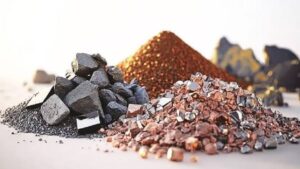
Copper is increasingly important to electricity networks, renewable energy systems, electric vehicles and other technologies that require extensive electrical infrastructure.
Demand for selected critical minerals is also being shaped by the expansion of digital infrastructure, defence technologies and efforts by major economies to diversify supply chains.
Pakistan’s geological position within the Tethyan Metallogenic Belt provides a basis for exploring copper and gold deposits. Its broader mineral potential also includes chromite, antimony, tungsten and other resources that could support industrial supply chains if commercially viable deposits are identified and developed.
But mineral availability alone does not guarantee profitable production. Investors require reliable geological data, exploration rights, transport and energy infrastructure, technically capable workforces and predictable regulations.
Processing facilities can also be important because they allow countries to capture more economic value than they would by exporting unprocessed material alone.
Pakistan has previously pursued international cooperation in the sector. On September 8, 2025, the Frontier Works Organisation and US-based US Strategic Metals signed memoranda of understanding focused on critical minerals, processing and logistics.
The proposed cooperation was presented as a framework for identifying minerals suitable for export and exploring the development of processing capacity in Pakistan. The plans included a potential investment of approximately $500 million in the first phase, according to the supplied source material.
The distinction between a memorandum of understanding and a completed investment is important. The proposed amount should not be treated as capital already deployed unless confirmed by subsequent agreements, financing disclosures or project records.
The commercial viability of the proposed facilities will depend on the minerals identified, their recoverable quantities, processing economics and access to buyers.
PMIF26 Aims to Connect Pakistan With Global Investors
The Pakistan Minerals Investment Forum is the government’s flagship platform for presenting investment opportunities and connecting policymakers with mining companies, financial institutions, technology providers and international investors.
The 2025 edition reportedly attracted around 5,000 delegates from more than 50 countries and featured 16 memoranda of understanding and agreements. Such participation can help establish contacts and identify projects, although the longer-term economic impact depends on whether those discussions lead to financing, construction and production.
The 2026 forum, originally scheduled for April 8 and 9, has been rescheduled for November 12 and 13, 2026, at the Jinnah Convention Centre in Islamabad. The revised dates are confirmed on the official PMIF26 website.
The forum is expected to address exploration, geological assessment, mining technology, investment and value addition. Technical work involving remote sensing, geophysics and geological data can help companies assess potential deposits and determine which projects merit further exploration.
For Pakistan, the forum’s value will ultimately be measured not only by attendance or the number of agreements signed, but by the projects that proceed to implementation, the investment that is actually mobilised and the capacity developed within the country.
Governance, Security and Local Benefits Will Determine Success
Developing a competitive mineral economy requires a framework that gives investors confidence while protecting the interests of local communities and the environment.
Mining projects can create employment, demand for local services, infrastructure investment and export revenue. They can also bring environmental pressures, land-use disputes and demands on water and energy resources.
Transparent licensing, environmental assessments, community consultation and credible monitoring are therefore important parts of project development.
Balochistan’s role is particularly significant because major deposits and proposed projects are located in the province.
Sustainable development will depend on how benefits are distributed, whether local workers and businesses gain meaningful opportunities, and whether environmental and social commitments are implemented throughout a project’s life.
Pakistan’s mineral resources offer a potential route to diversify exports and attract long-term investment. Yet the gap between estimated resource wealth and realised economic value remains substantial.
Reko Diq illustrates both sides of that opportunity: a major copper and gold deposit with international financing interest, but also significant security, cost and development risks. The wider critical-minerals agenda faces similar tests.
The next phase will require Pakistan to move beyond announcements and estimates towards commercially viable projects, transparent regulation, responsible extraction and domestic value addition. Those outcomes, rather than the size of resource estimates alone, will determine whether mineral development becomes a durable contributor to economic growth.
