Iran has claimed that its latest missile and drone strikes targeted US military sites in the Gulf. However, several of the locations identified by Tehran are military installations belonging to host countries where American personnel are stationed, rather than bases owned exclusively by the United States.
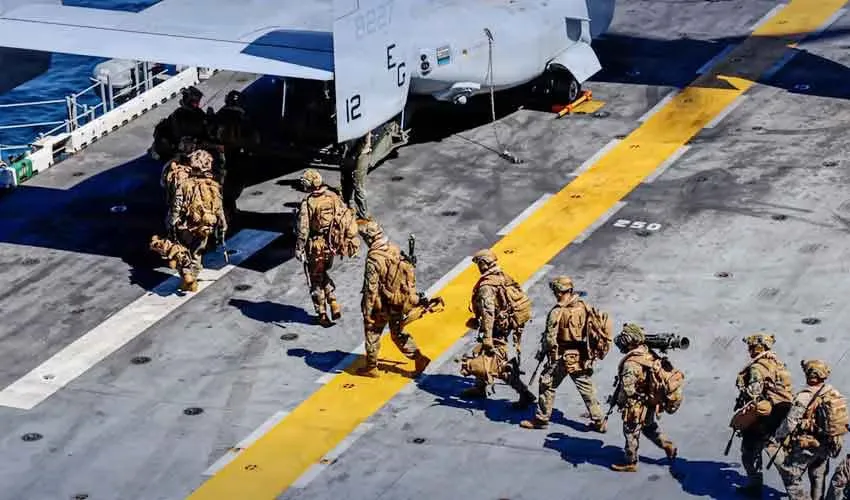
While US forces operate from numerous facilities across the Middle East, Washington also maintains several permanent or long-term military installations that play a central role in regional security, intelligence gathering, and military operations.
Here is a country-by-country overview of the most significant US military bases in the region.
Bahrain
Bahrain hosts the headquarters of the US Navy’s Fifth Fleet, located near Manama.
The Fifth Fleet oversees naval operations across the:
- Arabian Gulf
- Red Sea
- Arabian Sea
- Gulf of Oman
- Parts of the Indian Ocean
The headquarters serves as one of the most strategically important American naval facilities outside the United States.
Qatar
The Al Udeid Air Base, located southwest of Doha, is the largest US military installation in the Middle East.
The base serves as the forward headquarters of US Central Command (CENTCOM), which oversees American military operations across a vast region stretching from Egypt to Kazakhstan.
Key facts include:
- Covers approximately 24 hectares
- Houses around 10,000 US personnel
- Supports air operations, intelligence, logistics, and regional command functions
Kuwait
Kuwait hosts several major US military facilities, including:
Camp Arifjan
Camp Arifjan serves as the forward headquarters of US Army Central, coordinating Army operations across the region.
Ali Al Salem Air Base
Located about 40 kilometers from the Iraqi border, the installation supports combat aircraft and logistics missions.
Often referred to as “The Rock,” the base is known for its isolated desert location.
Camp Buehring
Originally established during the 2003 Iraq War, Camp Buehring remains an important staging area for US forces deploying to Iraq and Syria.
United Arab Emirates
Al Dhafra Air Base
Located south of Abu Dhabi, Al Dhafra Air Base is jointly operated with the UAE Air Force.
The facility has supported:
- Operations against the Islamic State
- Intelligence and surveillance missions
- Regional air operations
Jebel Ali Port
Although not an official military base, Jebel Ali Port in Dubai is the US Navy’s largest port of call in the Middle East.
The port regularly accommodates:
- Aircraft carriers
- Destroyers
- Amphibious assault ships
- Logistics vessels
Iraq
The United States continues to maintain military personnel at several Iraqi bases.
Ain al Asad Air Base
Located in Anbar Province, Ain al Asad supports Iraqi security forces and coalition missions.
The base gained international attention in 2020, when Iran launched missile strikes against it following the US killing of General Qasem Soleimani.
Erbil Air Base
Situated in Iraq’s Kurdistan Region, Erbil Air Base supports:
- Coalition training
- Intelligence sharing
- Logistics
- Counterterrorism operations
Saudi Arabia
US military personnel operate alongside Saudi forces to strengthen regional air and missile defense capabilities.
A key installation is:
Prince Sultan Air Base
Located about 60 kilometers south of Riyadh, the base supports:
- Patriot missile batteries
- Terminal High Altitude Area Defense (THAAD) systems
- US Air Force operations
According to official figures, more than 2,300 US personnel were stationed in Saudi Arabia during 2024.
Jordan
Muwaffaq al Salti Air Base
Located near Azraq, northeast of Amman, the base hosts the 332nd Air Expeditionary Wing of the US Air Forces Central.
The installation supports missions across the Levant, including:
- Air operations
- Intelligence activities
- Joint military exercises
- Regional security cooperation
Strategic importance of the regional network
The United States maintains this network of military facilities to support regional security, protect vital maritime trade routes, conduct counterterrorism operations, and coordinate with allied nations across the Middle East.
Although Iran has claimed recent attacks on several military locations, there has been no independent confirmation that permanent US-operated bases were directly hit. Officials in Washington and host countries continue to assess the reported strikes, while regional tensions remain elevated.
