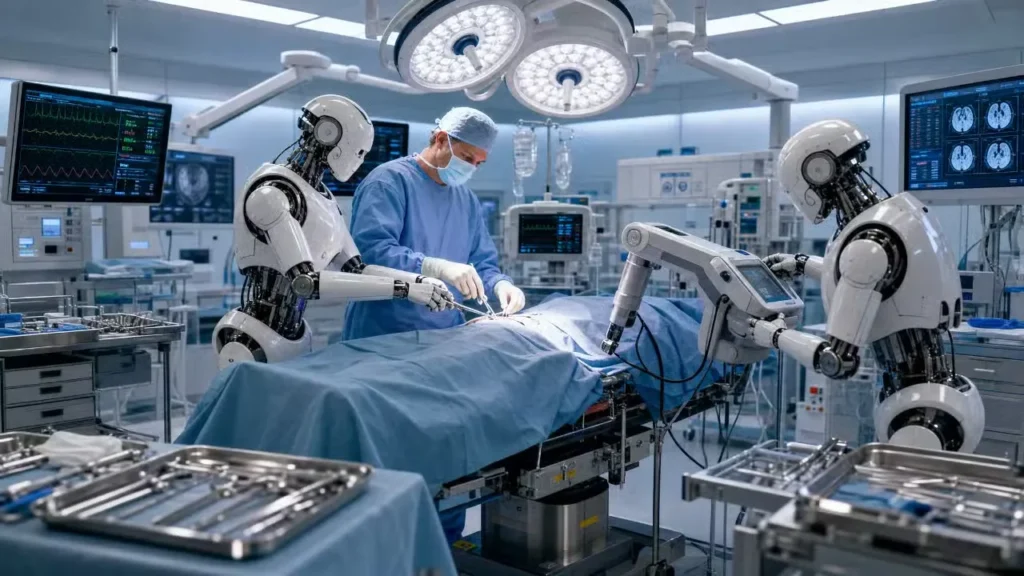
Researchers at the University of California San Diego have successfully used teleoperated humanoid robots to perform two surgeries in a preclinical trial, marking a significant advance in robotic-assisted healthcare and the future of surgical technology.
The study demonstrated that humanoid robots can work alongside surgeons in the operating room and could eventually perform procedures under remote human control, potentially improving access to surgical care worldwide.
Two successful surgeries completed
During the trial, researchers carried out two separate procedures on large non-primate mammals.
In the first operation, a humanoid robot collaborated with a human surgeon to successfully perform a gallbladder removal.
The second procedure involved two humanoid robots working together under teleoperation to complete another successful surgery without direct human participation at the operating table.
The researchers believe these results represent an important milestone in the development of advanced robotic surgical systems.
Designed to support surgeons
Unlike conventional surgical robots that are built for specific procedures, humanoid robots are designed to move freely, occupy less operating room space, and perform a broader range of clinical tasks.
The research team said the technology could initially serve as an assistant to surgeons before evolving into systems capable of carrying out complex procedures under remote supervision.
Such capabilities could help address global shortages of skilled surgeons, reduce patient waiting times, and improve access to specialized healthcare in rural, remote, and underserved communities.
Portable robots for diverse environments
The humanoid robots used in the study, nicknamed Surgie, stand approximately five feet tall and weigh about 60 pounds.
According to the researchers, their compact design makes them easier to deploy in hospitals, emergency response settings, disaster zones, and other locations where traditional surgical systems may be impractical.
More development still required
Although the trial produced promising results, the researchers acknowledged that additional improvements are needed before the technology can be used in clinical practice.
Current challenges include reducing communication latency, improving calibration accuracy, and enhancing overall system reliability during delicate surgical procedures.
Future role in healthcare
Beyond assisting with surgery, the research team believes humanoid robots could eventually support hospital staff by retrieving surgical instruments, disinfecting operating rooms, transporting medical supplies, and assisting healthcare professionals with routine clinical tasks.
As robotic technology and artificial intelligence continue to evolve, researchers say humanoid robots may become an increasingly valuable part of modern healthcare, helping medical teams deliver faster, safer, and more accessible treatment to patients around the world.
