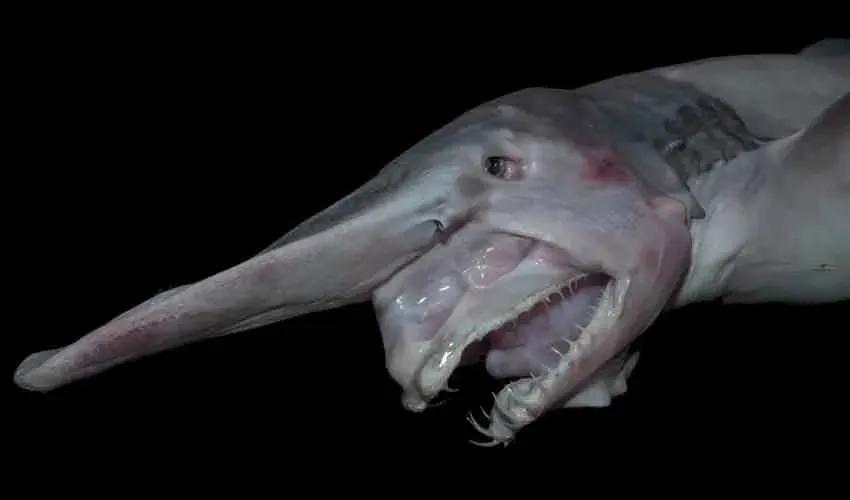
Scientists have successfully captured rare video footage of the goblin shark, one of the most elusive deep-sea predators and a species often described as a living fossil due to its ancient evolutionary history.
The findings, published in the Journal of Fish Biology, document the first confirmed recordings of the goblin shark swimming freely in its natural habitat.
Researchers say the species has remained largely unchanged for nearly 125 million years, offering a unique window into prehistoric marine life.
Filmed in Extreme Ocean Depths
The shark was first recorded in 2019 in deep waters near Jarvis Island, close to Hawaii. A second confirmed sighting was captured in 2024 in the Tonga Trench, one of the deepest parts of the Pacific Ocean. Both encounters occurred at depths exceeding 2,000 metres, or approximately 6,500 feet below the ocean surface.
Marine scientists noted that the extreme depth and pressure of the goblin shark’s habitat make direct observation exceptionally challenging, explaining why sightings of live individuals are exceedingly rare.
Unique Hunting Mechanism Observed
The footage provided valuable insights into the shark’s distinctive feeding behaviour. Researchers observed that the goblin shark typically keeps its jaws retracted, but when hunting, it can rapidly thrust them forward to snatch prey with remarkable speed.
This specialized jaw mechanism is considered one of the most unusual feeding adaptations among sharks and plays a key role in the species’ survival in the dark, food-scarce deep-sea environment.
A Distinctive and Ancient Species
Scientists describe the goblin shark as grey in colour, with an elongated snout often compared to a parrot’s beak. Its appearance has frequently been likened to characters from horror films, a reputation that has earned it the label of the world’s ugliest shark in popular culture.
Despite its fearsome look, researchers stress that the goblin shark poses no known threat to humans and remains one of the least understood shark species on the planet.
Experts say the successful recording of live goblin sharks represents a significant breakthrough in deep-sea research, underscoring how much remains unknown about life in Earth’s most inaccessible environments and highlighting the importance of continued ocean exploration.
