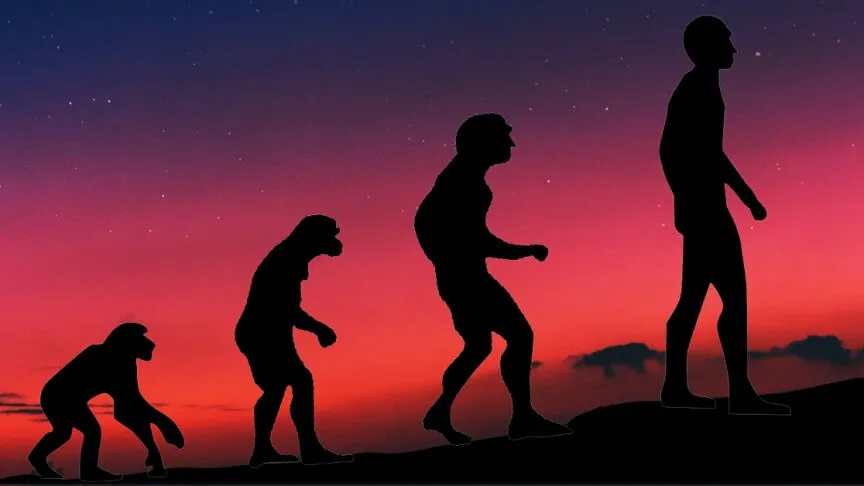
The modern Muslim intellectual faces increasing pressure to reconcile revelation with Darwinian evolution. In that effort, many have attempted to reinterpret the creation of Adam as merely another stage in biological evolution. But this reconciliation creates a deeper problem: if Adam was only an evolved creature among other creatures, then where does humanity itself truly begin?
For many modern thinkers, fossils have become a kind of scripture of their own. Geological layers, prehistoric remains, and evolutionary timelines are increasingly treated not merely as scientific observations, but as frameworks through which revelation itself must now be interpreted. This has led some Muslim writers to argue that the Qur’anic account of Adam should be understood symbolically or evolutionarily, rather than as a direct and distinct creation.
Yet the real issue is not whether biological life developed gradually on earth. The real issue is whether Adam himself belonged to that biological chain.
There is no necessary conflict in acknowledging that life began in water, or that various forms of animal life emerged gradually across vast spans of time. The Qur’an itself states that every living thing was made from water. One may even accept that biological organisms evolved and diversified over ages. This is not foreign to the Qur’anic worldview as it states: “Do the disbelievers not see that the heavens and earth were one mass, and We split them apart, and We made from water every living thing?” (Al-Anbiya, 21:30)
But none of this automatically resolves the question of man. The confusion, in my humble opinion, begins when biological resemblance is mistaken for human identity.
According to the evolutionary narrative, life progressed from simple organisms to increasingly complex forms until eventually human-like beings emerged. But resemblance alone does not define humanity. Homo sapiens may have resembled man physically, yet physical similarity is not the same as the reality of Adamic humanity described in revelation.
In the Qur’anic worldview, humanity begins not merely with an upright skeleton or a larger brain, but with Adam – a being directly created by God, endowed with consciousness, moral responsibility, speech, and divine purpose. Adam was not presented as the final product of animal evolution. He was presented as a distinct creation. The Qur’an is unambiguous: “Indeed, the example of Jesus to Allah is like that of Adam. He created him from dust; then He said to him, ‘Be,’ and he was.” (Aal Imran, 3:59)
This distinction is essential because the Qur’an treats Adam not simply as a biological organism, but as the beginning of mankind itself.
The Qur’an draws a direct comparison between Adam and Jesus: the example of Jesus before God is like that of Adam. Jesus was born without a father. Adam was created without father and mother. The point of the comparison is not biological explanation, but divine power. Both represent creation that transcends ordinary material causation.
Modern reasoning often struggles with this idea because it assumes that everything must unfold through gradual physical processes. As a result, some ask mockingly whether Adam suddenly appeared as a complete human being merely because God said “Be.” Yet the Qur’anic narrative repeatedly emphasizes that divine creation is not bound by human expectations of process or delay. The same God who creates galaxies over billions of years may also create instantly when He wills.
The problem, therefore, is not scientific difficulty alone. It is a philosophical limitation.
Science operates within the observable world. It studies mechanisms, patterns, and material processes. But revelation addresses realities that lie beyond the reach of experimentation. Fossils may reveal traces of biological life, yet they cannot explain consciousness, morality, prophecy, or the spiritual distinction that separates man from animal existence.
Science may study the body of man, but revelation explains the meaning of man.
This is why the attempt to reduce Adam entirely to evolutionary biology creates theological confusion. Once Adam becomes merely another evolved species, the Qur’anic understanding of human origin is fundamentally altered. Humanity is no longer a divinely initiated reality, but merely an advanced stage of animal development.
The Qur’anic account presents something entirely different.
Adam was created from clay, fashioned directly by divine will, and then given life by God’s command. From Adam began the human family — the first true human society. His children married among themselves because no other human tribe existed. Even the story of Qabeel learning from a crow how to bury Habeel reflects the infancy of humanity at its very beginning.
Before Adam, there may have existed other creatures resembling man outwardly. But resemblance does not erase distinction. The existence of humanoid beings does not necessarily mean the existence of humanity in the Qur’anic sense.
It is within this framework that some interpret the mysterious figures of Ya’juj and Ma’juj – Gog and Magog. They are described in the Qur’an as destructive beings living beyond a barrier erected by Dhul-Qarnayn.
The Qur’anic description portrays them as a people lacking refinement, difficult in speech and understanding, existing outside civilized human order. Such descriptions have led some to associate them with primitive humanoid remnants existing outside the moral and spiritual civilization. Specifically, these people are known to be ‘Ya’juj and Ma’juj’ due to their wild beast temperament. Though humanoid in form, they were fundamentally not of the Adamic generation; genetically, they represent Homo-sapiens remnants. This lineage sprouted once again into massive herds following a new phase of birth derived from the single pair of their species saved aboard Noah’s Ark, while the entirety of their other flocks drowned and perished altogether in the Great Flood (Quran 11:40-44). Thus, when the Qur’an describes Dhul-Qarnayn reaching a people who ‘could hardly understand speech’ (Al-Kahf 18:93), it is referring directly to these very entities who were spreading corruption across the earth – beings humanoid in form but entirely outside the moral order initiated through Adam.
Whether one accepts this interpretation or not, the central argument remains unchanged: not every human-like creature qualifies as man in the full Qur’anic sense.
The modern debate over evolution ultimately revolves around a deeper question than biology. It is a question about the definition of man itself. Is man merely an intelligent animal produced through material development, or is man a unique creation carrying moral consciousness and divine responsibility?
The Qur’anic answer is clear. Humanity begins with Adam.
None of this requires hostility toward science itself. Science remains valuable within its proper domain. It can study the physical development of life, examine fossils, and explore the mechanisms operating within nature. But science becomes philosophically overextended when it attempts to speak authoritatively on realities that belong to revelation.
Human knowledge has boundaries. There comes a point where empirical investigation reaches its limit and revelation begins.
The creation of Adam belongs to that boundary.
Fossils may narrate the history of biological life on earth, but the story of Adam begins elsewhere. It begins with divine intention, divine command, and the beginning of humanity as revelation describes it. The modern urge to dissolve Adam completely into evolutionary history may satisfy contemporary intellectual trends, but it risks erasing the very distinction that revelation sought to establish – for human science reaches its limit where revealed knowledge begins.
