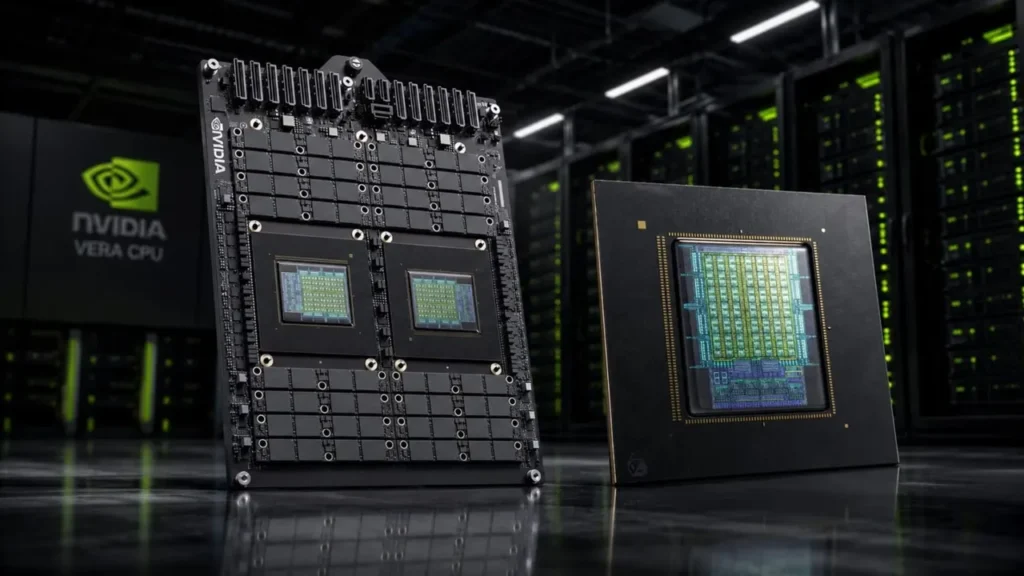
Nvidia has detailed the specifications of its new Vera CPU, a data center processor designed specifically for agentic artificial intelligence workloads, marking a major expansion of the company’s AI hardware ecosystem.
The announcement was highlighted during Nvidia Chief Executive Jensen Huang’s GTC 2026 keynote in Taipei on June 1, where the company positioned Vera as a next-generation CPU built for AI systems that autonomously execute tasks, run tools, and manage complex workflows with minimal latency.
According to Nvidia’s product documentation and reports cited by The Elec, Vera is designed to deliver up to 10 instructions per clock cycle and is claimed to achieve the highest instructions per clock (IPC) of any CPU currently available.
Nvidia also states that the processor is up to 80% faster than traditional x86-based CPUs in specific AI-focused workloads.
Built for the Era of Agentic AI
The NVIDIA Vera CPU is purpose-built for “agentic AI,” a computing model in which AI systems independently call tools, execute code, retrieve data, and orchestrate workflows.
In this architecture, CPUs play a critical role in supporting low-latency operations such as sandboxed code execution, scheduling, and data processing. Nvidia’s technical materials emphasize that modern AI agents require CPU-level responsiveness that traditional architectures were not optimized for.
An “agentic sandbox” refers to a secure execution environment where AI systems can run code (such as Python or Java), process datasets, and interact with tools without compromising system security.
Core Architecture and Specifications
Vera integrates 88 custom Olympus CPU cores, each supporting two threads, resulting in a total of 176 threads per processor. These cores are designed for control-heavy and latency-sensitive workloads commonly associated with AI orchestration systems.
Each core includes 2MB of L2 cache, while the system features 164MB of shared L3 cache, enabling faster data access across workloads. The processor operates within a configurable thermal design power (TDP) range of 250W to 450W, reflecting its high-performance data center positioning.
Nvidia also claims that Vera delivers up to 1.8 times the performance of leading x86 CPUs in agentic sandbox benchmarks, based on internal testing and reported comparisons.
High Bandwidth and Memory Performance
Unlike traditional multi-chiplet CPU designs, Vera uses a single compute die architecture. This reduces latency between cores and improves data flow efficiency across the processor.
The CPU achieves 3.4TB/s of bisectional bandwidth through Nvidia’s second-generation Scalable Coherency Fabric. Nvidia reports that this provides significantly higher per-core bandwidth and nearly double the total bandwidth of conventional x86 server CPUs.
Vera is also Nvidia’s first server CPU to adopt LPDDR5X memory, delivering up to 1.2TB/s of memory bandwidth and up to 1.5TB of memory capacity. This configuration reduces memory latency by up to 40% compared to existing enterprise CPU systems, according to company data.
Benchmark Performance and Real-World Workloads
Independent and internal benchmarks cited by The Elec show strong performance across a range of AI-oriented workloads, including code compilation, Python execution, Java processing, and database operations.
SQL workloads reportedly show performance improvements of up to three times compared to previous-generation systems. Additional tests also show strong gains in file compression, video transcoding, and system-level orchestration tasks used in AI factories.
In high-frequency data environments such as the New York Stock Exchange, Vera reportedly demonstrated performance improvements of up to six times in real-time stream processing, highlighting its suitability for low-latency, high-throughput computing environments.
Part of the Vera Rubin AI Platform
Vera will serve as the central CPU component in Nvidia’s next-generation Vera Rubin AI computing platform. The processor is designed for deployment across multiple configurations, including single-socket systems, dual-socket servers, dense liquid-cooled racks, and large-scale CPU clusters.
Nvidia also envisions rack-scale deployments supporting up to 256 CPUs and over 22,500 concurrent execution environments, targeting hyperscale AI factories and cloud providers.
Early systems have reportedly already been delivered to major technology companies and cloud operators, including Anthropic, OpenAI, Oracle Cloud Infrastructure, and SpaceX AI.
Industry Adoption and Outlook
Server manufacturers such as Dell, HPE, Lenovo, and Supermicro are expected to build systems based on Vera architecture, expanding its reach across enterprise and cloud infrastructure markets.
Nvidia is positioning Vera as a foundational CPU for the emerging era of agentic AI, where workloads are increasingly defined by autonomous decision-making systems rather than traditional human-driven computing tasks.
Jensen Huang emphasized that agentic AI will become one of the largest consumers of future computing resources, with Vera designed to meet the extreme demands of low-latency execution, high memory bandwidth, and large-scale orchestration.
As AI workloads continue to shift toward autonomy and tool-based execution, Vera represents Nvidia’s strategic move to redefine CPU design for the next generation of computing infrastructure.
