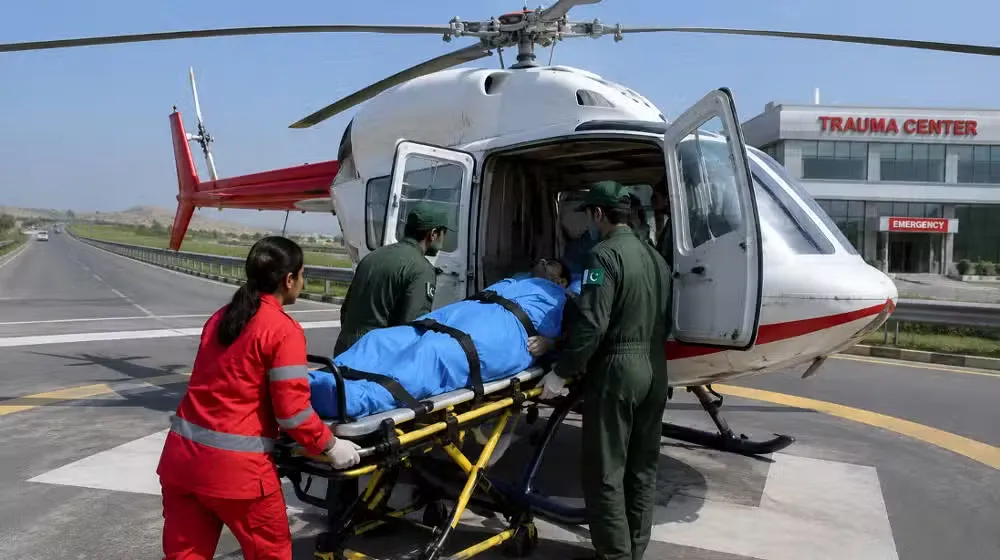
The federal government has unveiled plans to introduce a Pakistan air ambulance service alongside the development of modern trauma and emergency care centers along major motorways, marking a significant upgrade in national road safety infrastructure.
Federal Minister for Communications Abdul Aleem Khan said the initiative is being developed in collaboration with the Pakistan Air Force, aiming to strengthen emergency medical response systems across high-risk highway routes.
The announcement came during a meeting with senior officials from the Asian Infrastructure Investment Bank, including Vice President Konstantin Limitovskiy and Director General Xiaohong Wang, where ongoing and future infrastructure cooperation was discussed.
Under the proposed plan, air ambulance helicopters will be deployed to provide rapid medical evacuation services in case of road accidents and emergencies on motorways.
The government also plans to establish fully equipped trauma centers at key motorway points to reduce response time and improve survival rates in critical situations.
Officials highlighted that the project has received strong institutional backing, including interest from the Air Chief Marshal, who has reportedly taken a personal interest in accelerating the launch of helicopter-based emergency services.
During the meeting, Abdul Aleem Khan emphasized that Pakistan is prioritizing large-scale transport and infrastructure development projects, with several major schemes targeted for completion within the next two years.
Also read: Two new interchanges approved to link Ravi riverfront with major motorways
One of the key projects discussed was the Karachi–Hyderabad motorway, which the minister described as a strategic infrastructure corridor for economic growth. He also identified the Hyderabad–Sukkur motorway as a critical extension designed to enhance regional connectivity and trade movement across Sindh.
The Karachi Port-linked section of the motorway is planned as an eight-lane corridor, while the Hyderabad–Sukkur stretch is expected to be constructed as a six-lane highway, significantly improving freight and passenger transport efficiency.
The National Highway Authority is expected to play a central role in executing these projects in coordination with international financing partners, including AIIB, which has expressed interest in further collaboration.
If implemented, the air ambulance initiative combined with upgraded motorway trauma systems could represent a major shift in Pakistan’s emergency healthcare infrastructure, particularly for long-distance highway networks where delayed medical response has historically been a challenge.
About Tamoor Ahmed

Tamoor Ahmad has been covering politics since 2022.
