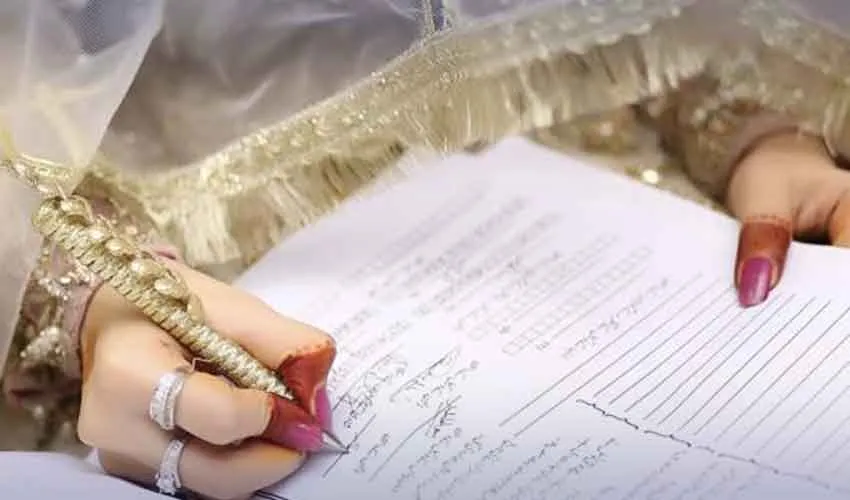
Differences between the judiciary and the federal government over proposed reforms to the Nikahnama have been resolved, paving the way for legislative clarity on marriage contracts and women’s property rights in Pakistan.
The breakthrough came during proceedings at the Lahore High Court, where the matter was described as one of public importance due to its widespread social and legal impact.
The court noted that ambiguities in the Nikahnama continue to generate disputes in family courts, often leaving women entangled in prolonged litigation over dower, dowry, and contractual rights.
Presiding over the case, Justice Jawad Hassan observed that inconsistencies between the Urdu and English versions of the Nikahnama were a major source of confusion.
Particular concern was raised over columns related to haq mehr and dowry, which judges said were frequently misunderstood or left incomplete at the time of marriage, later becoming flashpoints in legal battles.
Court observations showed that unclear language and weak documentation had contributed to an increase in family disputes. Judges stressed that women often face the brunt of this confusion, especially when seeking enforcement of financial rights after marital breakdown.
Legal experts told the court that poor drafting and translation had turned what should be a protective document into a source of uncertainty.
Also read: Clause of Prophet Muhammad’s finality added in Nikahnama
To address the issue, an eight-member committee has been tasked with reviewing relevant provisions of the Muslim Family Laws Ordinance 1961.
The committee will examine possible amendments related to matrimonial property, enforceability of contractual clauses, and standardisation of the Nikahnama across provinces.
The process is being supervised by the court under its continuing mandamus jurisdiction while leaving final lawmaking to parliament.
Initially, the Ministry of Law and Justice had expressed concern over judicial involvement in matters it said belonged to the legislative domain.
Officials argued that reforms to family law should pass through constitutional bodies, including parliament and the Council of Islamic Ideology.
However, following consultations, the ministry formed its own technical committee and joined the review process.
The committee has recommended a standardised bilingual Nikahnama to be used nationwide. It has also proposed that all translations be verified by the National Language Authority, with coordination from the Ministry of Religious Affairs and provincial administrations.
Officials believe this will ensure uniform interpretation and reduce disputes arising from vague or inconsistent wording.
Also read: Lahore High Court Rules Full Dower Including Jewellery Must Be Paid After Divorce
Members of the legal community, including Haseeb Paracha, have played a role in bridging gaps between institutions. Lawyers say the cooperative approach has helped move a long-pending reform agenda forward, particularly on issues affecting women’s financial security.
Analysts note that clearer Nikahnama provisions could significantly reduce the burden on family courts and strengthen trust in the legal system. They caution, however, that reform will only be effective if nikah registrars are trained properly and compliance is monitored at the grassroots level.
With further consultations under way, stakeholders expect a revised Nikahnama to be introduced soon, marking a significant step toward clearer, fairer, and more enforceable marriage contracts in Pakistan.
About Tamoor Ahmed

Tamoor Ahmad has been covering politics since 2022.
