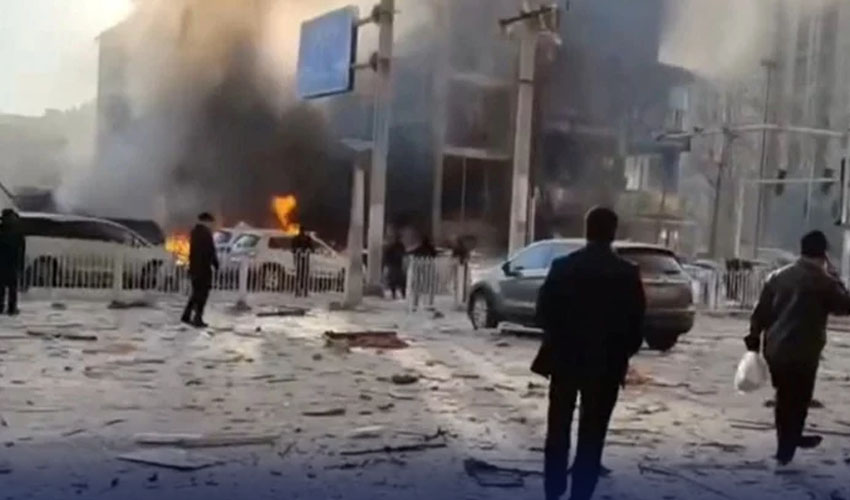
At least 21 people were killed and 61 others injured after a powerful explosion ripped through a fireworks manufacturing factory in Liuyang, located in China’s Hunan, triggering a major rescue operation and renewed concerns over industrial safety.
The blast occurred in the evening at a factory situated in a rural, mountainous area of Liuyang, according to Chinese media reports. Videos widely shared on social media showed a towering column of dark smoke rising from the site, followed by repeated explosions that echoed across nearby villages. The force of the blast was strong enough to shake buildings several kilometres away.
Drone footage released by local authorities showed that the factory building was completely destroyed. Large sections of concrete and metal were scattered across the area, while rescue workers could be seen clearing debris by hand and with heavy machinery. Several nearby buildings were damaged, with roofs blown off and windows shattered. Fire spread to adjacent structures before emergency crews managed to contain it.
Rescue operations are continuing, with more than 480 personnel deployed, including firefighters, medical teams, and disaster response units. Authorities have also dispatched technical experts to assess the site and speed up search efforts. A three kilometre controlled zone has been imposed around the affected area, and residents living nearby were evacuated as a safety measure.
Also read: China’s AVIC Chengdu Posts Record Profit After Fighter Jet Success
Police have detained several company officials as part of the investigation into the cause of the explosion. Officials have not yet disclosed whether safety violations or improper handling of materials played a role.
Chinese President Xi Jinping expressed condolences to the families of the victims and directed authorities to make all possible efforts to locate the missing and treat the injured. He also called for a thorough investigation and strict accountability, according to state media.
Liuyang is widely regarded as the heart of China’s fireworks industry. The city is estimated to produce around 60 percent of the country’s domestic fireworks supply and up to 70 percent of exports, making it a critical hub for both local employment and international trade.
The scale of production has long raised concerns about safety oversight in the sector. Fireworks manufacturing involves highly flammable chemicals and complex processes, where even minor lapses can lead to catastrophic consequences. Analysts say enforcement of safety standards often varies across regions, particularly in smaller factories operating in rural areas.
The China Fireworks Factory Explosion has also revived memories of previous industrial accidents in China. Last year, a fireworks factory blast in Hunan killed nine people. In 2023, an explosion in a residential building in Tianjin claimed three lives. Earlier this year, separate explosions at fireworks outlets in Jiangsu and Hubei left 12 and eight people dead, respectively.
On Chinese social media, the China Fireworks Factory Explosion has sparked criticism over safety enforcement and calls for stricter inspections in high-risk industries. Many users questioned how such facilities continue to operate close to residential areas.
For now, the focus remains on rescue work and medical treatment for the injured. The [KEYWORD] is expected to prompt renewed scrutiny of fireworks manufacturing practices and regulatory oversight in China.
About Tamoor Ahmed

Tamoor Ahmad has been covering politics since 2022.
