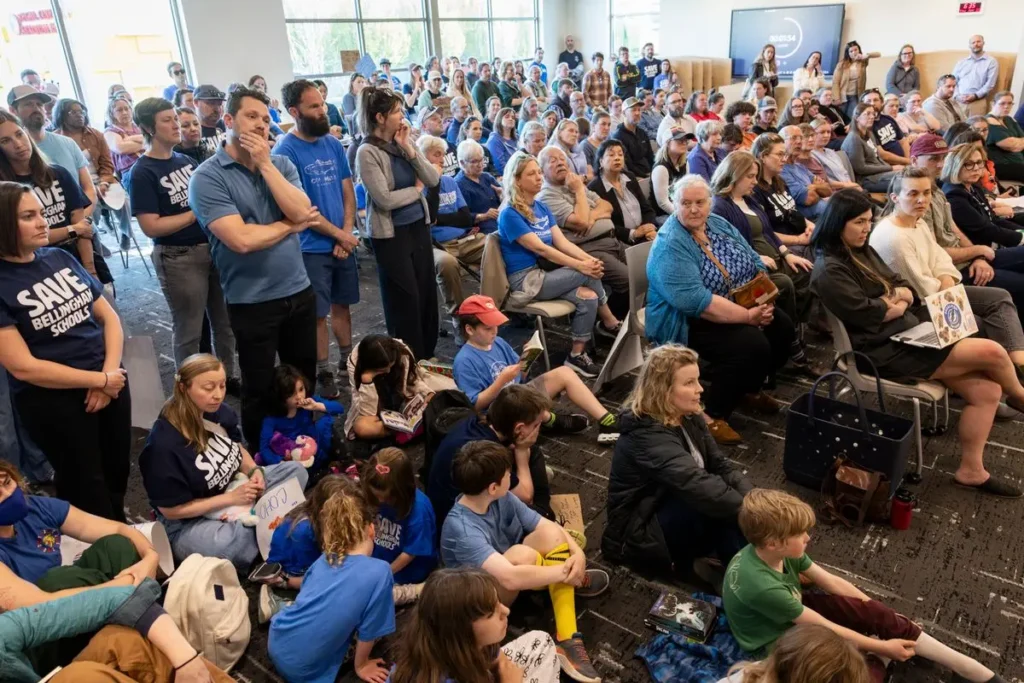
More than 100 parents and residents gathered at a Bellingham School Board meeting on Thursday, April 23, 2026, voicing strong opposition to a proposal that could lead to the closure of several elementary schools.
The district is weighing consolidation measures in response to a projected loss of around 1,000 students by 2028, alongside ongoing financial pressures.
A district task force has identified Columbia Elementary School and Carl Cozier Elementary School as potential candidates for closure or merger.
The proposal represents a dramatic shift from earlier expansion plans approved by voters just four years ago, when a $122 million bond was passed to rebuild those same schools and construct an additional elementary facility to accommodate expected growth.
The reversal has triggered widespread criticism from parents and community members, many of whom accuse the district of failing to maintain transparency and eroding public trust.
Concerns have also been raised over the use of bond funds, with approximately $6.3 million reportedly spent on architectural and design work for projects that may no longer move forward.
Also read: Punjab to Upgrade High Schools to Higher Secondary Level
During public comment, parents urged officials to honor voter-approved commitments. Ginny Roscamp, a parent of future students, emphasized accountability, arguing that the district must uphold both transparency and its responsibility to families who supported the bond measure.
Other speakers questioned the reliability of enrollment forecasts and the timing of the consolidation plan. Lauren Smith, another parent, suggested that decisions may have been made before full data was presented publicly, warning that school closures without rigorous analysis could harm students, neighborhoods, and long-term trust in the district.
Financial projections also came under scrutiny. Some community members disputed estimates that closures could save roughly $1 million annually. Parent Sachin Pai argued that when factoring in staff redistribution and transportation costs, the actual savings could be significantly lower, raising doubts about whether disruption to students and families is justified.
District leadership defended the proposal by pointing to long-term demographic trends, including declining birth rates and reduced state funding. Superintendent Greg Baker said the district is being forced to confront difficult realities shaped by factors beyond local control, including the lingering effects of the pandemic and broader education funding challenges.
While acknowledging community concerns, Baker said the district must make “the best possible decisions” under constrained circumstances. Board member Katie Rose echoed that sentiment, suggesting that state-level funding gaps are contributing to the district’s difficult position.
Despite declining enrollment—down roughly 600 students since the 2019–20 school year—some administrators argue consolidation could improve resource allocation. Wade King Elementary Principal Courtney Ross Webb noted that several schools currently have unused classroom space and suggested that redistribution could enhance educational outcomes if implemented carefully.
The Facilities Planning Task Force is expected to present final recommendations in May. No closures are scheduled before 2027, and officials say the board may still consider alternative options, including reallocating remaining bond funds or returning unused money to taxpayers.
