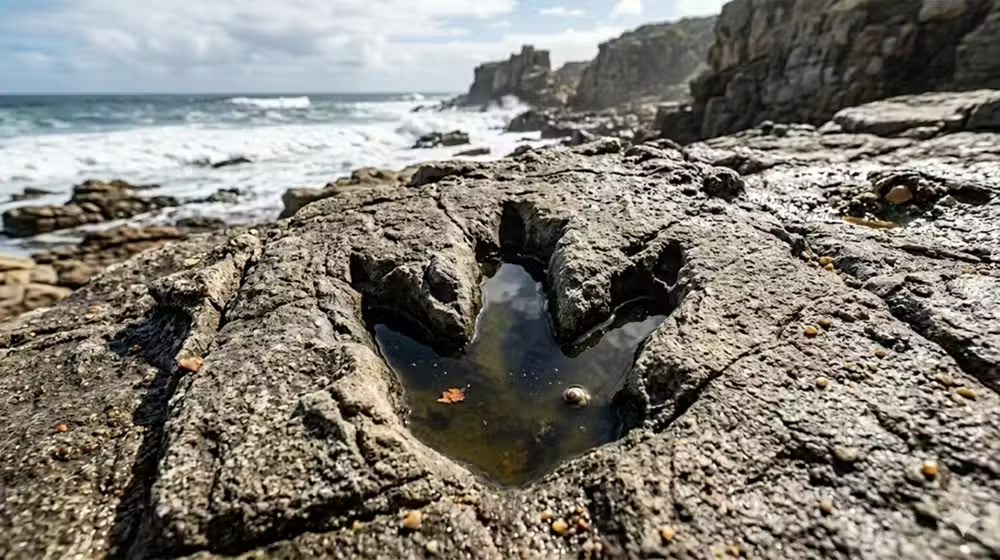
Scientists have uncovered rare dinosaur footprints along the southern coastline of South Africa, providing compelling new evidence that dinosaurs continued to inhabit the region long after massive volcanic eruptions transformed much of the landscape nearly 182 million years ago.
Southern Africa is globally renowned for its prehistoric record, particularly within the Karoo Basin, which preserves some of the world’s richest fossil deposits. However, after vast lava flows buried much of the basin during the early Jurassic Period, fossil evidence became scarce, leaving scientists with unanswered questions about what happened next.
The newly identified footprints are helping to close that gap.
Researchers first reported dinosaur tracks from the Western Cape in 2025, dating back roughly 140 million years. Continued fieldwork has now revealed more than two dozen additional footprints at a compact coastal site near Knysna, strengthening the case that dinosaurs were still thriving in the region during the early Cretaceous Period.
The tracks were found in the Brenton Formation and are estimated to be around 132 million years old. This makes them the youngest dinosaur footprints ever documented in southern Africa and among the few confirmed Cretaceous-era dinosaur traces in the country.
Although the site itself is small, the number and variety of footprints suggest that dinosaurs were not rare visitors but regular inhabitants of the area. Today, the location lies within an intertidal zone, submerged by seawater twice daily. Millions of years ago, however, scientists believe it likely consisted of river channels or low-lying coastal plains—ideal environments for large animals to leave behind tracks.
Analysis indicates that multiple dinosaur types were present, including meat-eating theropods and plant-eating species such as ornithopods, with possible evidence of large sauropods. While tracks alone cannot definitively identify species, they offer crucial insight into dinosaur diversity and movement patterns.
Much of southern Africa’s later fossil record was obscured by extensive volcanic activity, including lava flows associated with the Drakensberg Group. The discovery of footprints in both the Brenton and Robberg formations suggests that more fossil-rich sites may still lie hidden beneath coastal and sedimentary layers.
Researchers say continued exploration could uncover additional tracks, bones, and other traces of prehistoric life, potentially reshaping understanding of how dinosaurs survived and adapted in southern Africa long after dramatic environmental upheaval.
