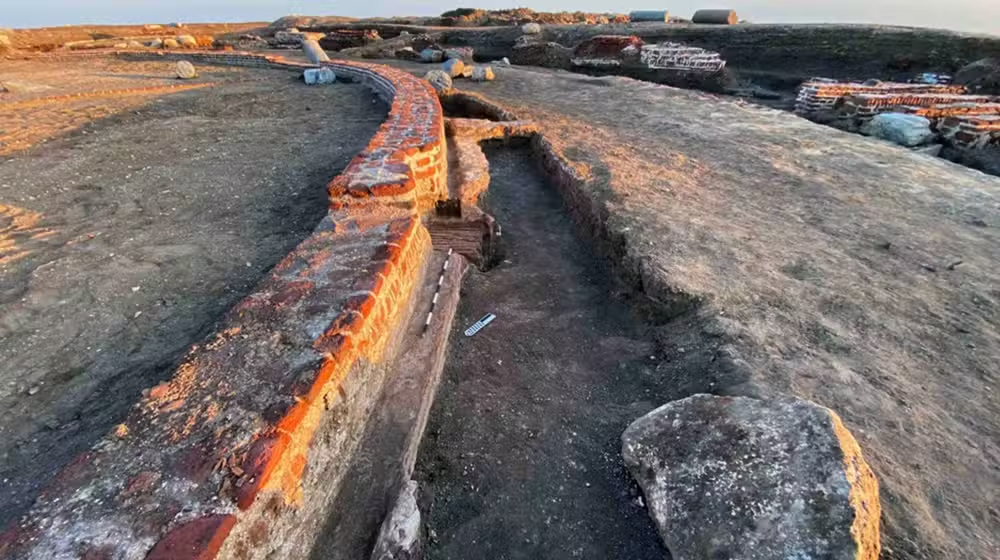
Archaeologists in Egypt have uncovered a rare circular religious structure believed to be linked with ancient water-based rituals in the historic frontier city of Pelusium, offering new insight into Greco-Roman-era religious practices in the Nile Delta.
The discovery was announced by Egypt’s Ministry of Tourism and Antiquities, which confirmed that the structure is approximately 2,200 years old and features an unusually sophisticated water system connected to the Nile.
Circular sanctuary tied to Nile water rituals
The structure was excavated at Tell el-Farama, located in Egypt’s North Sinai, an area once part of the ancient fortified city of Pelusium.
Researchers describe the building as a circular sanctuary centered around a large basin nearly 35 meters wide. The design includes water channels and reservoirs that appear to have directed Nile water into the structure, suggesting it was used for ritual purification and sacred ceremonies linked to river worship.
Archaeologists also found traces of Nile sediment inside the basin, strengthening the theory that water from the river played a symbolic and functional role in religious practices.
From misidentified structure to major religious site
The site was first partially excavated in 2019, when researchers uncovered about one-quarter of a circular red-brick structure. At the time, it was mistakenly identified as a possible administrative or civic building.
However, after full excavation revealed its complete circular layout and central basin, experts revised their interpretation and confirmed it as a religious sanctuary rather than a government structure.
Temple design linked to ancient deity worship
At the center of the structure lies a square pedestal believed to have supported a statue of a local deity associated with water and fertility. The deity, referred to as Pelusius, is thought to have symbolic ties to mud and fertile silt carried by the Nile.
The temple’s design strongly reflects ancient Egyptian belief systems where water was closely connected to life, rebirth, and divine power.
Strategic ancient city with layered history
Pelusium was historically a key gateway between Egypt and the eastern Mediterranean. Its location made it an important military fortress during pharaonic rule and later a customs and trade hub under the Roman Empire.
The same site has produced multiple significant discoveries, including a temple dedicated to Zeus uncovered in 2022, highlighting the blending of Egyptian and Greco-Roman religious traditions.
Archaeological significance of the discovery
Experts believe the circular temple was built in the second century BC and remained in use until around the sixth century AD. Its long period of use suggests that it played a sustained role in local religious life across shifting political eras.
Archaeologists say the discovery is significant because circular temple designs with integrated water systems are extremely rare in ancient Egyptian architecture, offering new evidence of how religion, environment, and engineering intersected in the region.
New insights into water-based ancient worship
The find reinforces the importance of water in ancient Egyptian spirituality, particularly in regions near the Nile Delta where seasonal flooding shaped both agriculture and belief systems.
Researchers continue to study the site to better understand how ancient communities used water not only for survival but also for complex ritual and symbolic purposes.
