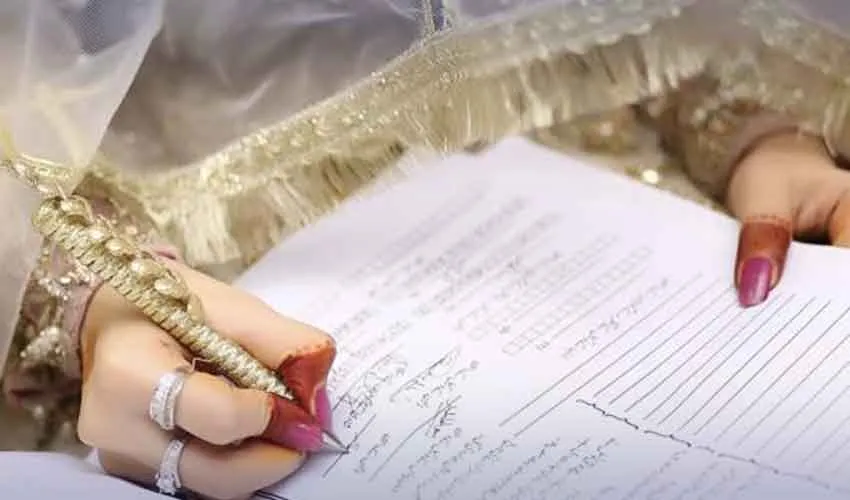
In a key judgment on family law, the Lahore High Court has ruled that a husband is legally bound to pay the full dower (haq mehr), including any jewellery or monetary items mentioned in the marriage contract, even after divorce.
The decision was issued by Justice Sajid Mahmood Sethi of the Multan Bench, who dismissed a petition challenging a Family Court ruling and upheld its earlier decision.
Court upholds Family Court decision
The court held that the Family Court’s verdict was based on complete evidence and a proper record, leaving no legal justification for interference.
It further clarified that any items listed separately in the nikahnama (marriage contract)—such as cash, gold, or silver—must each be fulfilled as part of the total dower obligation.
Jewellery or its market value must be returned
In its ruling, the court stated that if jewellery mentioned in the nikahnama is not returned after divorce, the wife is entitled to receive its market value instead.
The judgment emphasized that all listed items form part of the legally binding dower agreement, and the husband is obligated to honor the entire contract.
Case background: dispute over gold and silver
According to court records, the petitioner married in 2011 and the nikahnama included:
- Rs5,000 cash dower
- 5 tolas of silver
- 10 tolas of gold
Following the divorce, the former wife claimed that the jewellery had not been returned. The husband argued that only the cash amount constituted the dower and alleged that the jewellery entries were forged.
Also read:
- Lahore High Court Issues Contempt Notice to Punjab University VC Over Tree Cutting
- Lahore High Court Bans Commercial Use of Public Parks, Orders PHA to Restore Green Spaces
Court rejects forgery claim
The court rejected the forgery argument, noting that the petitioner failed to provide sufficient evidence to disprove the nikahnama entries.
Witnesses confirmed the authenticity of the marriage contract, and the court noted that the petitioner himself admitted signing the document. A certified copy of the nikahnama was also presented during proceedings.
Legal principle reaffirmed
The judgment reiterated that higher courts do not interfere in Family Court decisions unless they are found to be inconsistent with the law.
Since the lower court’s ruling was supported by evidence and legal reasoning, the High Court upheld the decision in full.
Significance of the ruling
Legal experts say the ruling reinforces the binding nature of the nikahnama in Pakistan’s family law system and clarifies that all listed components of dower—financial or material—carry equal legal weight.
The decision is expected to have broader implications for future disputes involving haq mehr, jewellery claims, and marriage contract enforcement.
