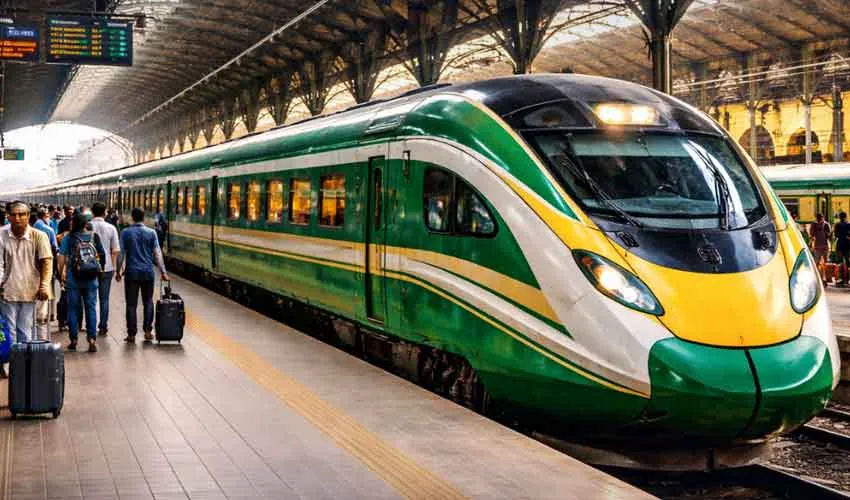
The Punjab fast train initiative is set to redefine railway travel in Pakistan as the province prepares to launch its first high-speed train, cutting travel time between major cities and laying the groundwork for long-term transport modernization.
The project was formalized through a Memorandum of Understanding (MoU) signed between the Punjab government and Pakistan Railways by Punjab Chief Minister Maryam Nawaz and Federal Railways Minister Hanif Abbasi.
Officials described the agreement as one of the most significant railway developments in decades, aimed at improving efficiency, safety, and passenger experience.
Lahore–Rawalpindi Fast Train: A Game Changer
Under the agreement, Pakistan’s first fast train will operate between Lahore and Rawalpindi, completing the journey in approximately two and a half hours—nearly half the time currently required by conventional trains or road travel during peak hours.
Also read:
- Murree Glass Train Routes and Fares Announced
- Pakistan Railways announces bullet train by 2030
- Metro stations, Orange Line train to go solar
Transport analysts say the reduced travel time could significantly benefit business travelers, students, and government officials who frequently commute between the two cities, while also easing pressure on the motorway network.
Modern Trains and Network Expansion Across Punjab
Beyond the flagship route, the plan includes modern train services on eight additional routes, designed to improve regional mobility and reduce dependence on road transport.
Key routes include:
- Shahdara–Narowal (79 km)
- Narowal–Sialkot (62 km)
These connections are expected to support industrial zones and border-adjacent districts by improving access to major markets.
New Intercity Rail Corridors to Boost Regional Integration
Several long-distance rail corridors are also part of the initiative:
- A 370-kilometer corridor linking Raiwind, Kasur, Pakpattan, and Lodhran, improving north–south connectivity.
- A 220-kilometer route connecting Sheikhupura, Jaranwala, and Shorkot.
- A 68-kilometer link from Faisalabad via Chak Jhumra and Shaheenabad.
- A 303-kilometer southern route connecting Kot Addu, Dera Ghazi Khan, and Kashmore.
Experts note that these corridors could help rebalance development by linking under-served regions with economic hubs.
Economic, Environmental, and Social Impact
Authorities estimate that around 90 million people will benefit directly or indirectly from the nine planned routes. Economists say the project could:
- Reduce fuel consumption and transport costs
- Lower carbon emissions by shifting passengers from road to rail
- Improve labor mobility and access to education and healthcare
- Support local industries and agriculture through better logistics
Rail experts also point out that faster, reliable trains could help revive public confidence in rail travel, which has declined over the years due to delays and outdated infrastructure.
What Comes Next
While no official operational timeline has been announced, officials indicated that feasibility studies, track upgrades, and rolling stock modernization will be prioritized. Funding models, including public–private partnerships, are also expected to be explored.
If implemented as planned, the Punjab fast train project could serve as a blueprint for future high-speed rail initiatives in other provinces.
