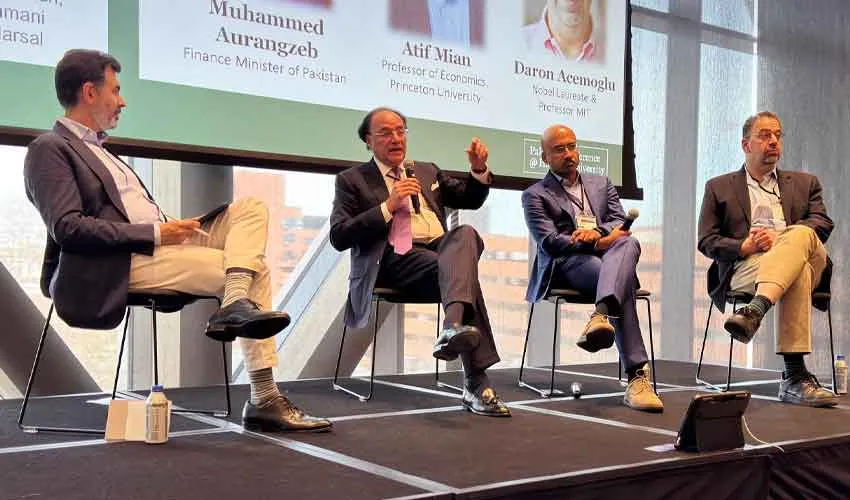
Finance Minister Muhammad Aurangzeb has said that Pakistan’s external payments position remains satisfactory, as the government continues implementing broad economic reforms focused on stability, competitiveness, and long-term growth.
Speaking at Harvard University during the Pakistan Conference 2026, the finance minister stressed that Pakistan’s core challenge is not identifying economic reforms but ensuring their timely implementation. The event brought together leading economists and policymakers for a detailed discussion on the country’s economic direction.
The high-level panel discussion, titled “Pakistan’s Economic Agenda: Stability, Reform and What Comes Next”, was moderated by former State Bank of Pakistan governor Dr. Reza Baqir and included Prof. Atif Mian of Princeton University and Nobel laureate Prof. Daron Acemoglu of MIT.
Pakistan Economy Stability and External Position
Aurangzeb emphasized that Pakistan’s external payments capacity remains stable, and the country is expected to meet upcoming financial obligations on time. He also described the recent Eurobond repayment as a “non-event,” reflecting improved debt management and market confidence.
Finance Minister Highlights Reform Priorities at Harvard Discussion on Pakistan’s Economic Agenda
Federal Minister for Finance and Revenue, Senator Muhammad Aurangzeb, participated in a high-level panel discussion at Harvard University on “Pakistan’s Economic Agenda: Stability,… pic.twitter.com/qd85moDS19
— Ministry of Finance, Government of Pakistan (@Financegovpk) April 12, 2026
He noted that even amid global uncertainty, Pakistan has managed to maintain macroeconomic stability while navigating external shocks.
Energy Security and Response to Global Supply Shocks
The finance minister described the recent Middle East tensions as one of the most significant global supply shocks in recent years.
He said Pakistan prioritized uninterrupted energy supplies across critical sectors, working through close coordination between ministries and institutions despite limited strategic reserves.
Initially, the government introduced a blanket energy subsidy to protect consumers from rising costs. However, Pakistan later shifted toward full price transmission with targeted subsidies, aligned with fiscal capacity.
Aurangzeb said Pakistan managed the situation better than many countries by avoiding major supply disruptions and maintaining law and order stability.
Remittances and Roshan Digital Account Inflows
Highlighting external inflows, Aurangzeb said Pakistan recorded strong inflows through the Roshan Digital Account (RDA), with a record monthly performance in March.
He said this reflects growing confidence among overseas Pakistanis and increasing trust in Pakistan’s economic direction. However, he cautioned that while remittances remain important, they cannot serve as a long-term growth strategy.
Instead, he emphasized the need for export-led growth and expansion in trade in services.
Tax Reform, FBR Digitisation, and IMF-Linked Reforms
Aurangzeb reiterated the government’s commitment to structural reforms, especially in taxation.
Key reforms include:
- Expanding the tax base
- Improving the tax-to-GDP ratio
- Strengthening the tax net system
- Increasing transparency in the Federal Board of Revenue (FBR) through digitisation and automation
He said the goal is to reduce human discretion and create a more data-driven and efficient tax administration system.
The minister also highlighted progress on tariff rationalization and trade liberalization in Pakistan, aimed at improving competitiveness and supporting export-oriented industries.
Energy Transition and Solar Power Growth
Aurangzeb said Pakistan’s solar energy capacity has reached around 8,000MW, marking a significant shift in the country’s renewable energy transition.
He added that renewable expansion has helped cushion Pakistan during external shocks and will remain central to the country’s long-term energy mix strategy.
Privatization, Governance, and Economic Restructuring
The finance minister confirmed progress on privatization and state enterprise reforms, noting that 28 state-owned institutions have been handed over to the Privatization Commission of Pakistan.
He also referred to broader restructuring efforts involving state-owned enterprises (SOEs) to reduce fiscal burdens and improve governance efficiency.
Aurangzeb stressed that Pakistan is moving away from permanent industrial subsidies toward a competitive, productivity-driven economy.
Long-Term Challenges: Population and Climate Change
Looking ahead, Aurangzeb identified population growth and climate change in Pakistan as the country’s most critical long-term risks.
He warned that sustainable development is not possible without addressing population pressures and improving climate resilience. He also called for stronger adaptation policies to manage climate-related shocks.
