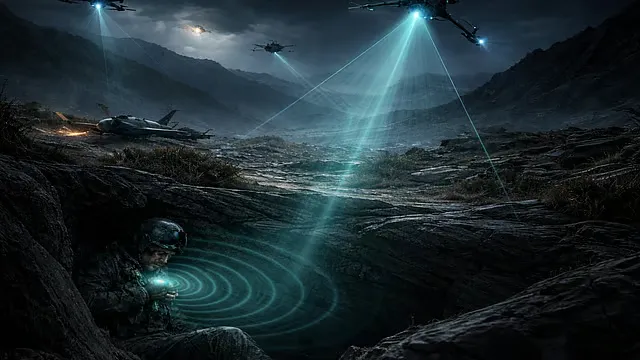
Reports have emerged that a top-secret technology developed by the United States Central Intelligence Agency (CIA), capable of detecting human heartbeats from tens of kilometers away, was used in the dramatic rescue of a US fighter pilot shot down during the war in Iran.
The successful extraction of the downed airman marks the first known operational deployment of this classified system, which combines quantum magnetometry with artificial intelligence to locate individuals through solid rock and across vast distances.
On April 7, local time, the New York Post, citing multiple sources including US officials, reported that a technology known as “Ghost Murmur” was used for the first time during the rescue operation.
The system proved instrumental in locating an F-15E Strike Eagle weapons systems officer, identified only by his call sign “Dude 44 Bravo,” who had spent 48 hours hiding in a mountain crevice while Iranian forces scoured the area with a bounty on his capture.
How Ghost Murmur Works: Quantum Magnetometry Meets Artificial Intelligence
This cutting-edge technology utilizes long-range quantum magnetometry to track the extremely faint electromagnetic signals generated by a human heartbeat. The raw data collected by the quantum sensors is then fed into artificial intelligence software, which isolates the specific soldier’s heartbeat signature from surrounding environmental noise, enabling precise tracking and location identification.
A source familiar with the program provided a detailed explanation of both the technology’s capabilities and the deliberate meaning behind its name. “There is intent behind the name,” the source told the New York Post. “‘Ghost’ refers to finding missing persons, and ‘Murmur’ is a medical term for heartbeat.”
The source elaborated on the system’s extraordinary sensitivity, comparing it to searching for a single voice in an impossibly large venue. “It’s like listening for a voice in a stadium, except the stadium is a desert spanning tens of thousands of square kilometers. As long as the right conditions are met and the heart is beating, we will find them.”
The technology represents a significant departure from traditional detection methods such as radar, infrared thermal imaging, or motion sensors, all of which require line-of-sight or are easily defeated by terrain, weather, or camouflage. Ghost Murmur instead detects the biomagnetic field produced by the electrical activity of the human heart—a signal so faint that it is typically billions of times weaker than the Earth’s natural magnetic field.
Developed by Lockheed Martin’s Skunk Works
It is reported that this technology was developed by Skunk Works, the highly secretive advanced research and development division of US defense contractor Lockheed Martin. Skunk Works is legendary for creating some of the most advanced aircraft in military history, including the SR-71 Blackbird reconnaissance aircraft, the F-117 Nighthawk stealth fighter, the F-22 Raptor air superiority fighter, and the F-35 Lightning II Joint Strike Fighter.
Lockheed Martin has not officially commented on the existence or capabilities of the Ghost Murmur technology, consistent with the company’s long-standing policy of not discussing classified programs. However, sources indicate that the system has been in development for years and has undergone testing on various military platforms, including MH-60 Black Hawk helicopters.
The Rescue Mission: 155 Aircraft Mobilized
Previously, on April 3, a US F-15E Strike Eagle fighter jet was shot down by Iranian forces, prompting the US military to carry out an extraordinarily high-risk mission to rescue the two crew members. One of the two airmen was dramatically rescued after 48 hours of evading capture behind enemy lines.
The scale of the rescue operation was massive. According to military sources, a total of 155 aircraft were mobilized in support of the mission, including:
4 bombers
64 fighter jets
48 aerial refueling tankers
13 rescue aircraft
Numerous surveillance, electronic warfare, and command-and-control platforms
Two US transport aircraft became stuck in sand during the operation and were deliberately destroyed on-site to prevent them from falling into Iranian hands. Despite these challenges and active enemy engagement, no American personnel were killed or captured during the rescue.
Why Traditional Beacons Failed
The US officer who was missing for 48 hours had taken refuge deep in the mountains, hiding in crevices and caves to evade Iranian search teams. This rugged terrain made it extremely difficult for rescue forces to determine his location using conventional methods.
The New York Post reported that even though the Combat Survivor Evader Locator (CSEL) device—a sophisticated survival beacon developed by Boeing and carried by all US aircrew—was activated, the search teams could not pinpoint his exact location.
The CSEL system is designed to transmit a distress signal that can be detected by satellites and search aircraft, but in mountainous terrain with limited line-of-sight and potential Iranian electronic warfare interference, the signal alone was insufficient for precise location.
Sources said the “decisive moment” came when the decision was made to deploy the Ghost Murmur technology. The system successfully identified the officer’s location, providing the exact coordinates needed to extract him before Iranian forces could reach him.
The Critical Vulnerability of Signal Transmission
A source provided crucial additional context about the limitations of traditional survival beacons, explaining a fundamental vulnerability that Ghost Murmur overcomes. “The missing US soldier had to come out of hiding to send a signal,” the source explained. “What mattered more than the signal itself was that he had to expose himself to send it.”
This exposure risk is a well-known problem in combat search-and-rescue operations. Activating a beacon or radio can reveal a downed airman’s position to enemy forces as easily as it reveals it to friendly forces.
In some cases, airmen choose to remain silent rather than risk capture or death. Ghost Murmur eliminates this dilemma entirely because it requires no active transmission from the target. The technology works passively, detecting the heartbeat regardless of whether the individual is actively trying to communicate.
64 Kilometers: The Detection Distance
It is not publicly known exactly how far away the heartbeat signal was detected in this specific operation. However, US President Donald Trump mentioned at a press conference on April 6, following the successful rescue, that the officer was found from “40 miles away.” Forty miles is equivalent to approximately 64 kilometers.
Trump described the achievement in dramatic terms, telling reporters, “It’s like finding a needle in a haystack. The CIA was unbelievable.” He also joked about the secrecy surrounding the technology, saying, “If Ratcliffe told you the details, I’d have to put him in prison. But I don’t want to do that—he doesn’t deserve that.”
CIA Director John Ratcliffe had previously hinted at the operation during a White House briefing, stating that the agency had confirmed that “one of America’s best and bravest was alive and concealed in a mountain crevice, invisible to the enemy but not to the CIA.”
The Ideal Environment for Detection
Another source explained that the southern Iranian desert where the pilot was hiding provided an “ideal” environment for the first operational use of Ghost Murmur. The area was described as a “clean environment” with very low electromagnetic interference, almost no competing human heartbeat signals from civilians or other military personnel, and rugged terrain that, while difficult for ground search teams, did not block the quantum sensors.
Additionally, at night, the thermal contrast between a living human body and the cool desert floor provided operators with a second layer of verification. While Ghost Murmur does not rely on heat detection, the availability of multiple confirming data streams increased confidence in the location coordinates before rescue teams were committed.
However, sources also cautioned that the technology is not a universal solution. Its effectiveness is highly dependent on environmental conditions. In dense urban environments with high electromagnetic noise from power lines, communications towers, and thousands of civilian heartbeats, the system’s ability to isolate a single target would be severely degraded.
Future Applications: F-35 Integration
It is known that the Ghost Murmur technology may be applied to F-35 fighter jets in the future. The F-35 Lightning II, also developed by Lockheed Martin, is the most advanced multirole stealth fighter in the world, equipped with an unparalleled sensor suite. Integrating heartbeat detection capabilities would add an entirely new dimension to the aircraft’s already formidable intelligence, surveillance, and reconnaissance capabilities.
Potential future applications extend beyond combat search and rescue. The technology could be used for locating hostages behind walls, finding enemy combatants hidden in bunkers or caves, conducting urban warfare operations with reduced civilian casualties, and even disaster response scenarios where victims are trapped beneath rubble.
Official Silence and Ongoing Development
Lockheed Martin has not officially commented on the Ghost Murmur technology, consistent with standard practice regarding classified Skunk Works programs. The company’s official position is to refer all questions about such technologies to the relevant government agencies.
The CIA has also declined to confirm or deny specific details of the technology or its use in the rescue operation, citing intelligence sources and methods that must remain protected.
A Paradigm Shift in Search and Rescue
The successful rescue of the downed F-15 pilot using Ghost Murmur represents a potential paradigm shift in combat search-and-rescue operations. For decades, downed airmen behind enemy lines have faced a cruel dilemma: activate survival beacons and risk revealing their position to the enemy, or remain silent and hope to be found through other means. Ghost Murmur eliminates this trade-off entirely.
While the technology has significant limitations and is not a universal solution, its successful first operational use in one of the most challenging environments on Earth—deep behind enemy lines in mountainous Iranian territory—demonstrates its immense potential. For the pilot who spent 48 hours hiding in a mountain crevice, with Iranian forces closing in and a bounty on his head, the difference between rescue and capture came down to a single heartbeat detected from 64 kilometers away.
