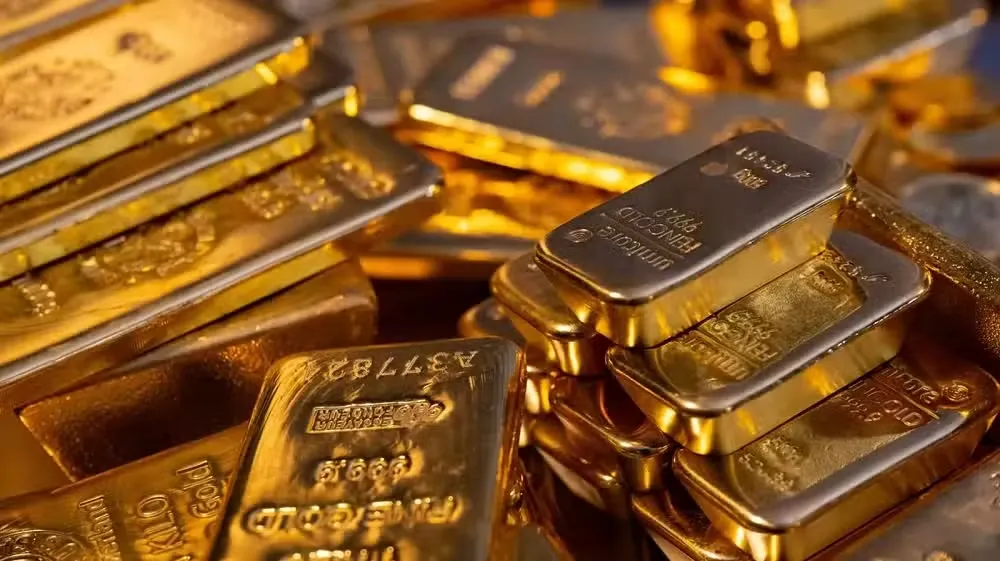
Gold prices surged to a near three-week high on Wednesday as global markets recalibrated their risk assessments following US President Donald Trump’s agreement to suspend bombing and military strikes against Iran for a two-week period.
The temporary ceasefire has eased immediate fears of energy-driven inflation, paradoxically boosting bullion as investors digest the rapidly shifting geopolitical landscape.
Spot gold was up 2.5 per cent at $4,819.25 per ounce as of 0534 GMT. Earlier in the trading session, the precious metal rose more than 3 per cent, reaching its highest level since March 19.
US gold futures for June delivery gained an even more dramatic 3.5 per cent, trading at $4,847.70 per ounce.
Ceasefire Announcement Upends Escalation Expectations
The market rally followed Trump’s announcement that Washington had agreed to a two-week pause in attacks on Iran. The US also received a 10-point proposal from Tehran, which the president described as a workable basis for further negotiations. The proposal was reportedly submitted via Pakistan, which has emerged as a key mediator in the conflict.
Trump’s conciliatory comments came after earlier warnings that Tehran must immediately reopen the Strait of Hormuz or risk US retaliation against its civilian infrastructure. The dramatic shift from threats of escalation to a negotiated truce caught many market participants off guard.
“People went into this session thinking that escalation was very likely, but the announcement of a two-week truce kind of upended that expectation and that was gold positive,” said Nicholas Frappell, global head of institutional markets at ABC Refinery.
Why Gold Rallied on Ceasefire News
The relationship between geopolitical risk and gold prices is complex. While gold is traditionally viewed as a safe-haven asset that benefits from uncertainty and conflict, the specific dynamics of the Iran-US confrontation have created an unusual market reaction.
The primary driver of gold’s rally appears to be the reassessment of inflation risks. The conflict had threatened to send energy prices soaring, with Brent crude previously spiking above $100 per barrel.
Rising energy prices fuel broader inflation, which in turn influences central bank interest rate decisions. Gold, which offers no yield, tends to underperform in a high-interest-rate environment.
The ceasefire announcement, by reducing the immediate threat of energy-driven inflation, has led markets to reassess the likelihood of aggressive interest rate hikes. This reassessment has proved beneficial for gold, which has fallen more than 8 per cent since the Iran war erupted on February 28.
Iran Confirms Negotiations in Islamabad
Iran’s Supreme Security Council confirmed that negotiations with the United States would begin on April 10 in Islamabad, following the submission of Tehran’s 10-point proposal via Pakistani intermediaries. However, the council added a note of caution, stating that the upcoming talks did not signal an end to the broader war.
This qualification suggests that Iran views the ceasefire as a tactical pause rather than a permanent resolution. The outcome of the Islamabad negotiations will likely determine whether the current détente evolves into a more comprehensive agreement or collapses back into confrontation.
Key Technical Levels for Gold and Silver
Independent metals trader Tai Wong provided technical analysis of the current market movements, identifying critical price levels for both gold and silver.
“This is a knee-jerk relief rally and it remains to be seen if Iran complies,” Wong said. “For gold, the 200-day moving average at $4,930 and then $5,000 will be key hurdles.”
The $5,000 per ounce level represents a psychologically significant milestone that gold has not yet achieved. A sustained break above this level would signal strong bullish momentum and potentially attract additional institutional buying.
For silver, Wong identified $80 to $81 per ounce as an important resistance level. “Similarly, $80-$81 is an important level for silver,” he noted.
Federal Reserve Minutes Await
Markets are now awaiting the release of minutes from the Federal Reserve’s March policy meeting, due later on Wednesday. The minutes will provide insight into the central bank’s thinking on interest rates, inflation, and economic conditions.
The Fed has been navigating a challenging environment, balancing the need to control inflation against the risk of triggering a recession. The Iran conflict and its impact on energy prices have added a significant layer of complexity to the central bank’s calculations.
Any indication in the minutes that the Fed is leaning toward rate cuts rather than hikes would likely provide additional support for gold prices. Conversely, a hawkish tone emphasizing persistent inflation risks could weigh on bullion.
Performance of Other Precious Metals
The rally in gold extended across the broader precious metals complex. Spot silver jumped 5.5 per cent to $76.91 per ounce, outperforming gold on a percentage basis. Silver’s industrial applications make it more sensitive to economic growth expectations, and the ceasefire has eased fears of a sharp global slowdown.
Platinum gained 3.9 per cent to $2,034.65 per ounce, while palladium added 4.9 per cent to reach $1,541.71. Both metals are heavily used in automotive catalytic converters, and their prices are closely tied to global manufacturing activity and auto production.
Gold’s Year-to-Date Performance
Gold started the year on a strong note, benefiting from expectations of Federal Reserve rate cuts and sustained central bank buying. However, the outbreak of the Iran war on February 28 sent the precious metal into a tailspin, with prices falling more than 8 per cent as investors fled to the US dollar and Treasury bonds.
Wednesday’s rally has partially reversed those losses, though gold remains below its pre-war levels. The $4,819 price represents a significant recovery but still trails the highs seen before the conflict erupted.
Inflation, Interest Rates, and Gold’s Dual Nature
Gold occupies a unique position in financial markets. It is simultaneously a hedge against inflation and a beneficiary of low interest rates. When inflation rises, investors traditionally buy gold to preserve purchasing power. However, when central banks raise interest rates to combat inflation, the opportunity cost of holding gold—which pays no interest or dividends—increases.
The Iran conflict created a worst-case scenario for gold: energy-driven inflation that forced the Fed to maintain or increase rates, pressuring bullion prices lower. The ceasefire reduces the likelihood of that scenario, which explains gold’s positive reaction to the truce.
The Road Ahead: Ceasefire Durability and Market Implications
The durability of the Iran-US ceasefire remains highly uncertain. The two-week pause is explicitly temporary, and the upcoming Islamabad negotiations could easily falter. Iran’s Supreme Security Council has already signaled that the talks do not represent an end to the war, suggesting that the underlying conflict remains unresolved.
For gold traders, the key variables to watch in the coming days and weeks include the progress of Islamabad negotiations, any violations of the ceasefire, the movement of crude oil prices, and the Federal Reserve’s interest rate trajectory.
Should the ceasefire hold and negotiations progress, gold could face headwinds as risk premiums unwind. However, should the truce collapse and hostilities resume, gold would likely rally sharply as investors seek safety.
