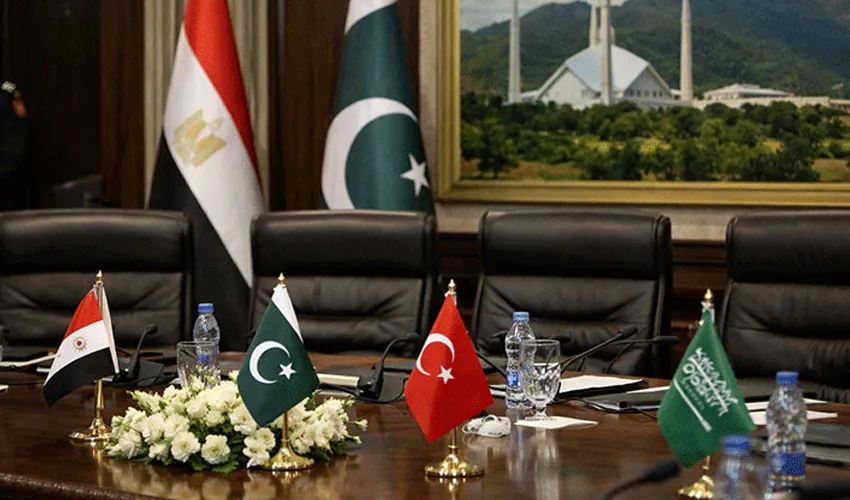
ISLAMABAD — As tensions between the United States and Iran threaten to engulf the Middle East, Pakistan has thrust itself into the center of global diplomacy, hosting a high stakes four nation summit in Islamabad aimed at de-escalation, dialogue, and regional stability.
The critical two-day consultations, bringing together the foreign ministers of Saudi Arabia, Türkiye, Egypt, and Iran, began on March 29 in Pakistan’s capital. The meetings were originally slated for Türkiye but shifted to Islamabad due to scheduling constraints. They represent a coordinated Islamic diplomatic push to prevent a wider conflagration following weeks of US-Iranian hostilities.
Breakthrough at the Strait of Hormuz
In a significant diplomatic victory, Deputy Prime Minister and Foreign Minister Senator Ishaq Dar announced that Iran has agreed to allow 20 additional Pakistani ships to transit through the strategic Strait of Hormuz, a vital chokepoint through which approximately 20 percent of the world’s oil passes.
Under the agreement, two Pakistani vessels will be permitted to cross per day. Dar hailed the development as a harbinger of peace and a tangible step toward reducing military tensions in the Gulf.
The breakthrough followed a late-night telephone conversation between Dar and Iranian Foreign Minister Abbas Araqchi, during which the two diplomats discussed the latest regional developments and confidence-building measures.
Why Pakistan A Nation Positioned as Mediator
Islamabad has quietly but aggressively positioned itself as a crucial intermediary in the ongoing US-Iran conflict. With deep historical ties to both Tehran and Washington and close relationships with Gulf monarchies, Pakistan offers a unique bridge between adversarial camps.
Recent weeks have seen intense behind-the-scenes diplomacy. Pakistan’s military leadership has engaged directly with US officials, facilitating indirect communication between Washington and Tehran. Prime Minister Shehbaz Sharif held an hour-long telephone conversation with Iranian President Masoud Pezeshkian, condemning Israeli attacks on Iran and reaffirming Pakistan’s solidarity with the Iranian people. Sharif also briefed the Iranian president on Pakistan’s diplomatic outreach to the United States, Gulf states, and other Islamic countries, underscoring Islamabad’s proactive role in promoting dialogue.
Inside the Islamabad Summit
The four-nation consultations, running March 29 through March 30, are expected to cover several urgent issues. These include reducing military and naval tensions in the Gulf region, coordinating an Islamic response to the Iran-US conflict, strengthening economic and security collaboration, and aligning positions ahead of potential United Nations and Organization of Islamic Cooperation engagements.
The foreign ministers are also scheduled to meet with Prime Minister Shehbaz Sharif for expanded talks on mutual collaboration and long-term stability.
A Delicate Balancing Act
Speaking to reporters, Senator Ishaq Dar emphasized that Pakistan is committed to resolving disputes with honesty and transparency while also maintaining necessary discretion due to the sensitive nature of ongoing negotiations.
A senior diplomatic source said Pakistan is not taking sides but rather taking a stand for peace. The source added that Islamabad has open lines to Washington, Tehran, Riyadh, and Ankara, noting that this is Pakistan’s strength.
Global Implications
The success or failure of Pakistan’s mediation effort carries weight far beyond South Asia. A wider US-Iran conflict could disrupt global energy supplies through the Strait of Hormuz, trigger proxy wars across Iraq, Syria, Lebanon, and Yemen; draw in Gulf monarchies and Israel; and reshape geopolitical alliances in the Middle East.
For now, Islamabad is betting on dialogue. With 20 Pakistani ships granted safe passage and four Muslim powers seated at the same table, Pakistan has signaled to the world that it intends to be a peacemaker, not a bystander.
