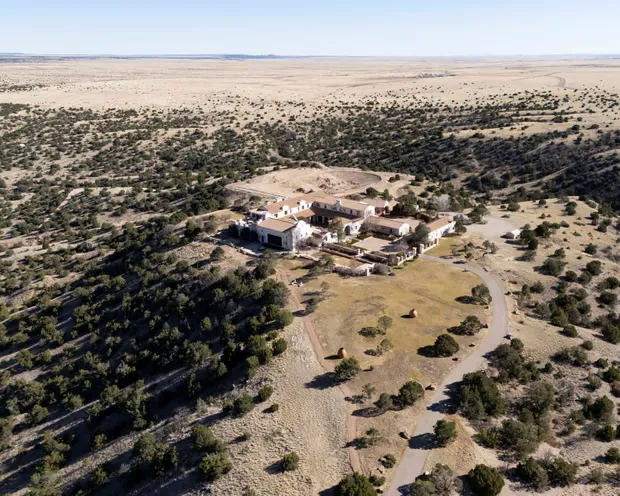
New Mexico authorities have launched a high-profile search of Zorro Ranch, the sprawling 10,000-acre property once owned by the late convicted sex offender Jeffrey Epstein, state officials confirmed Monday. The move comes as part of a renewed effort to investigate alleged sexual abuse and criminal activity tied to the secluded property.
Located outside Santa Fe, New Mexico, Zorro Ranch has been at the center of numerous allegations of sexual exploitation, yet, until now, it had received far less scrutiny than Epstein’s other estates in New York and Florida. A February investigation by the Guardian revealed that federal authorities had apparently never conducted a full search of the ranch, raising questions about gaps in the multi-state investigations into Epstein’s sex-trafficking network.
The search operation is being led by the New Mexico Department of Justice, with assistance from the state police and the Sandoval County Sheriff’s Office, under the direction of Attorney General Raúl Torrez. Officials thanked the current owners of the property for their cooperation and urged the public to avoid the area while investigators carry out their work.
This development follows the U.S. Department of Justice’s recent release of roughly three million investigative documents related to Epstein, shedding new light on his criminal activities. The New Mexico investigation had originally begun in 2019 but was placed on hold at the request of federal prosecutors in New York, who were conducting their second investigation into Epstein’s expansive sex-trafficking operation that led to his arrest in 2019.
In addition to reopening the state case, New Mexico legislators have established a “truth commission” to examine activity at Zorro Ranch, aiming to uncover the full extent of alleged crimes and provide a platform for survivor testimonies. Court records and survivor accounts describe the ranch as a site where Epstein allegedly abused teenage girls and young women for years with impunity.
Survivors have recounted a range of harrowing experiences, claiming that the remote location allowed powerful men—including a former New Mexico governor—to visit without consequence.
Epstein’s controversial and disturbing plans reportedly included using the ranch to impregnate women in an attempt to spread his DNA, highlighting the sinister scale of his ambitions. Legal experts have emphasized that investigating the property several years after Epstein’s death presents unique challenges.
“The value of any evidence that can be found now is likely minimal,” said John Day, a former prosecutor and defense attorney in New Mexico. He noted that ownership changes and alterations to the property could complicate evidence recovery. Kate Mangels, a partner at Kinsella Holley Iser Kump Steinsapir, added that while forensic evidence is unlikely to be recovered, the investigation could corroborate survivor accounts if key structural elements of the house remain intact. She explained, “If the layout of the property matches survivor recollections—such as the placement of doors or rooms—it can strengthen their testimony and provide credibility to their claims.”
The Zorro Ranch investigation also underscores the long-standing criticism that Epstein’s properties in less scrutinized areas escaped full law enforcement oversight for years, leaving survivors without closure. With the renewed state-level investigation, authorities hope to fill these gaps and ensure that justice is pursued comprehensively.
In its announcement, the New Mexico Department of Justice emphasized its commitment to transparency, survivor support, and following the evidence wherever it leads. While specific details of the search remain undisclosed, the operation signals a renewed focus on holding Epstein’s network accountable and providing validation for those who came forward with allegations years ago.
The search of Zorro Ranch represents a critical step in Epstein-related investigations, highlighting the ongoing efforts by New Mexico authorities to uncover evidence of abuse and deliver justice. It also signals a broader push to revisit properties and locations previously overlooked in Epstein’s extensive criminal operations, offering hope to survivors and accountability in a case that has spanned multiple states and legal jurisdictions.
