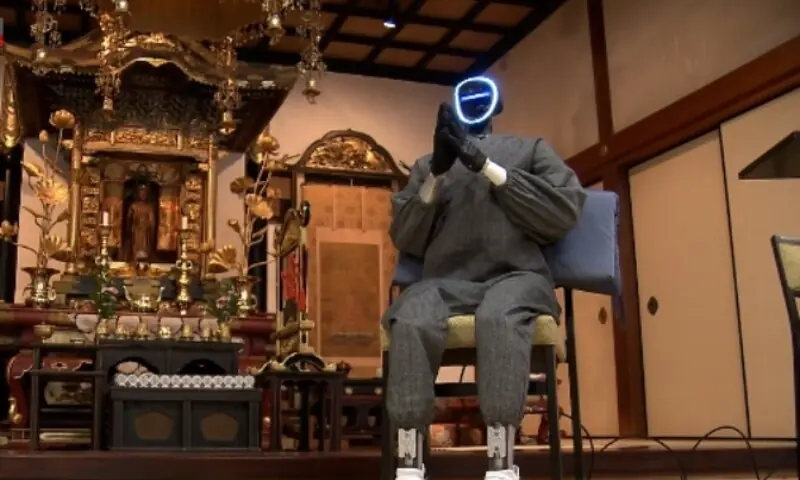
Japanese scientists at Kyoto University have unveiled a humanoid AI robot monk named Buddharoid, designed to offer spiritual guidance and potentially alleviate shortages of human monks in the future.
Trained on extensive Buddhist scriptures, Buddharoid can answer personal and sensitive questions, providing guidance for those who may feel hesitant to speak with human clergy.
Beyond voice-based conversations, the robot can offer a sense of physical presence at religious sanctuaries, performing movements similar to human monks.
Buddharoid’s Capabilities and Design
Created by Seiji Kumagai, Buddharoid combines advanced AI models from OpenAI with robotics. Kumagai installed his latest “BuddhaBotPlus” software on a Unitree G1 humanoid robot, giving it the ability to walk, gesture, and interact in lifelike ways.
During a media demonstration at a Kyoto temple, the faceless robot wore a simple grey robe, folded its gloved hands in prayer, and engaged with reporters. When a young journalist confessed to overthinking, Buddharoid offered calming advice:
“Buddhism teaches that it is important not to blindly follow one’s thoughts or rush headlong into things. One approach is to calm your mind and let go of the thought itself.”
Its soothing baritone voice mimicked the serene guidance typically offered by human monks.
AI and Robotics in Religious Practice
AI-powered religious chatbots are already widely used across major faiths, though they remain controversial. Japan has previously introduced Mindar, a non-AI android that delivers Buddhist sermons. Similarly, Germany unveiled a robot in 2017 capable of giving blessings in five languages.
Buddharoid, however, represents a new integration of AI and humanoid robotics, offering both spiritual advice and physical rituals.
Ethical Considerations and Future Prospects
Kyoto University stresses the importance of ongoing ethical discussions about the use of AI in religious contexts. With Japan facing a shrinking and ageing population, humanoid monks may assist with or even perform some rituals traditionally conducted by humans.
“In the future, AI humanoid robots are expected to be utilised in the religious field, such as assisting with or performing some of the religious rituals traditionally conducted by human priests. This is anticipated to bring about a paradigm shift in religious culture,” the university stated.
AI Humanoids and a Paradigm Shift in Spiritual Culture
Buddharoid highlights the evolving intersection of technology and spirituality, combining:
AI-driven guidance based on religious texts
Human-like gestures and movements
Potential to address monk shortages in ageing societies
Ethical and cultural considerations for religious adoption
As AI robots enter sacred spaces, they may redefine how religious teachings and rituals are delivered, offering new ways for people to engage with faith in the 21st century.
