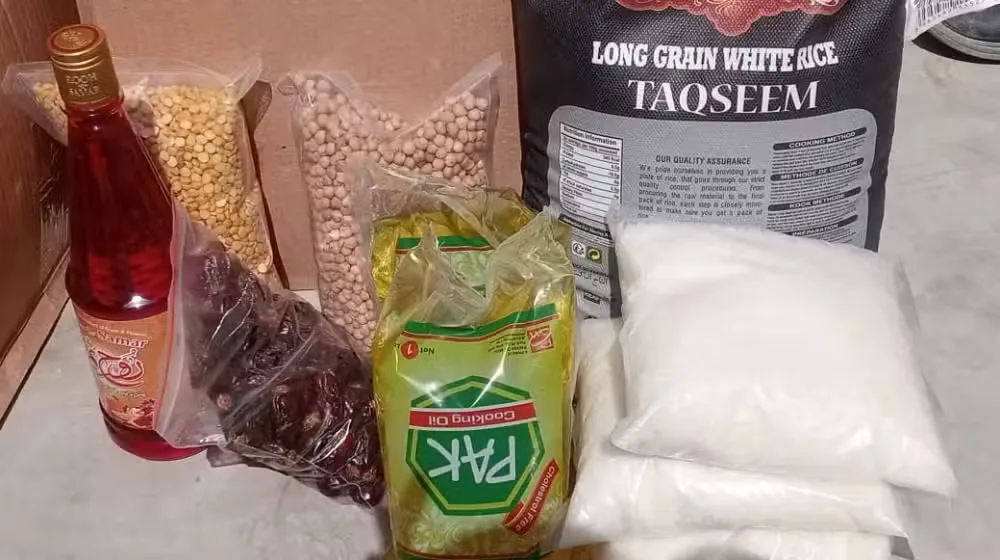
Free ration distribution for low-income families at the start of Ramadan has fallen to its lowest level in the past three years, as record inflation and rising food prices force small welfare organizations to scale back or completely suspend their relief activities.
Across major cities, many small community-based groups that traditionally distributed free Ramadan ration packs every year have either stopped operations altogether or reduced their aid by 30 to 50 percent.
Organizations that once supported between 200 and 300 families are now able to assist barely 100 households, while the size and quality of ration packs have also been significantly reduced.
While larger groups such as Jamaat-e-Islami and its affiliated welfare wings continue to play a visible role in Ramadan relief efforts, most smaller NGOs are struggling to cope with soaring costs and shrinking donations.
According to social welfare organizers, the cost of a standard Ramadan ration package has more than doubled. A pack that previously cost around Rs3,000 to Rs3,500 now costs between Rs7,000 and Rs8,000 due to sharp increases in the prices of essential food items.
Despite the surge in expenses, donations have not risen. In fact, contributions from affluent donors have declined amid broader economic pressures.
Several small NGOs that once supported up to 100 families have completely withdrawn from ration distribution this year. Even larger organizations and individual donors have been forced to reduce both the number of beneficiaries and the quantity of items included in relief packs, with staples such as pulses, cooking oil, flour, dates, and gram flour provided in much smaller amounts.
The rising cost of basic items, including juice and cooking essentials, has further strained relief efforts.
In some cases, organizations have opted to provide limited cash assistance instead of food packages. One welfare group replaced ration packs with Rs2,000 cash envelopes this Ramadan, citing high costs and concerns over the quality of subsidized government flour, which was excluded from distributions.
The decline in free ration availability has left many deserving families, particularly women, facing difficulties in securing basic food support. Residents in several localities reported that individuals and community figures who once organized annual ration drives have stopped doing so entirely this year.
As a result, a growing number of people are now turning to mosques and free dastarkhwans to break their fast during Ramadan, highlighting the deepening impact of inflation on charitable support systems and food security for vulnerable households.
