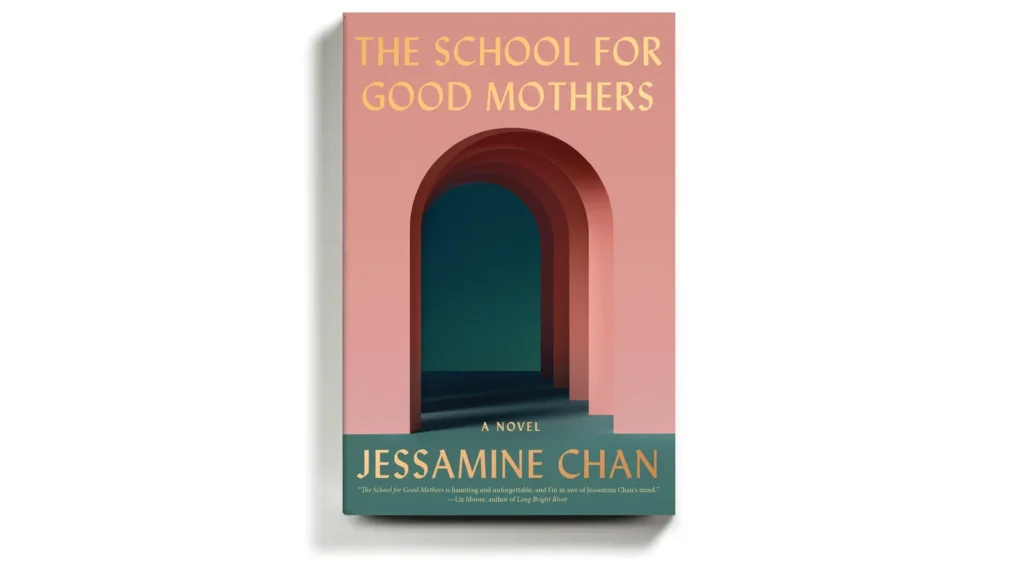
In today’s world, where every parental choice is visible and debated, Jessamine Chan’s novel The School for Good Mothers stands out as one of the most piercing reflections on motherhood in the 21st century. Chan, a Chinese-American writer based in Chicago, explores what happens when love, care, and even mistakes are no longer private — when the idea of a “good mother” becomes a rulebook written by society itself. Published in 2022, the novel follows Frida Liu, a young single mother who makes one desperate mistake: she leaves her toddler alone for a few hours, exhausted and overwhelmed. That moment of weakness turns into a lifelong punishment. The authorities declare her “unfit” and send her to a government-run reform school — a place where mothers are retrained to be perfect under constant surveillance. They are forced to perform “ideal” maternal behavior, as if motherhood could be programmed like a machine.
Through this unsettling premise, Chan builds a dystopian world that feels frighteningly close to our own. The novel’s setting may be fictional, but its emotional truth is painfully real. Mothers everywhere live under a kind of invisible watch from relatives, neighbors, and especially from social media, where every post, photo, or parenting decision can invite public judgement. Chan transforms that pressure into a literal system of control, showing how women are often punished not for being bad mothers, but for being imperfect humans.
At its core, The School for Good Mothers is not merely a story of punishment; it is a study of guilt, endurance, and love in an unforgiving world. Chan exposes how women are expected to be endlessly patient, productive, and self-sacrificing — while their smallest failures are magnified into moral crimes. Her narrative quietly asks: Who defines what “good” means and why are mothers the only ones forced to prove it every day? Chan’s writing style intensifies this emotional tension. Her language is controlled, almost restrained, mirroring how Frida must suppress her emotions to survive in the school. Yet beneath that restraint lies a deep current of tenderness and fear. Every chapter captures the ache of a mother who loves her child fiercely but is forced to prove that love through obedience and performance. Frida’s affection becomes her only rebellion — her love itself is an act of resistance. Another layer that makes Chan’s work so powerful is its connection to the culture of surveillance. In our digital age, parents—especially mothers—are constantly compared, criticized, and corrected by online audiences. Chan takes this real-world anxiety and turns it into a chillingly literal world where the government monitors every hug, every word, every tone of voice. Through this, she blurs the line between fiction and reality, making readers question whether Frida’s world is truly imaginary — or simply an exaggerated reflection of our own.
Although Chan writes from a Chinese-American background, her story speaks beyond borders. The fears and expectations she portrays resonate strongly across South Asian cultures, where motherhood is closely tied to family honor, social reputation, and community judgement. In these societies, mothers often carry the silent expectation of being perfect — balancing warmth with respectability and strength with sacrifice. Chan’s novel, therefore, becomes not just an American story but a universal one, reminding readers that the struggles of motherhood transcend geography, language, and culture.
Feminism runs quietly but firmly through the story. Chan does not protest loudly; instead, she exposes how systems — often shaped by patriarchal norms — define women’s worth and limit their freedom. The novel becomes not only about motherhood but also about female endurance: how women keep going when love, identity, and autonomy are all under watch. Despite being her debut, The School for Good Mothers establishes Jessamine Chan as one of the most daring and insightful voices in contemporary fiction. Her storytelling merges emotional honesty with social critique, urging readers to confront uncomfortable truths about judgement, gender, and love.
In the end, Chan reminds us that motherhood cannot be trained, scored, or standardized. Love is not about perfection; it is about presence. A mother’s love, with all its flaws and resilience, is what makes it profoundly human — and that humanity is what makes it good.
