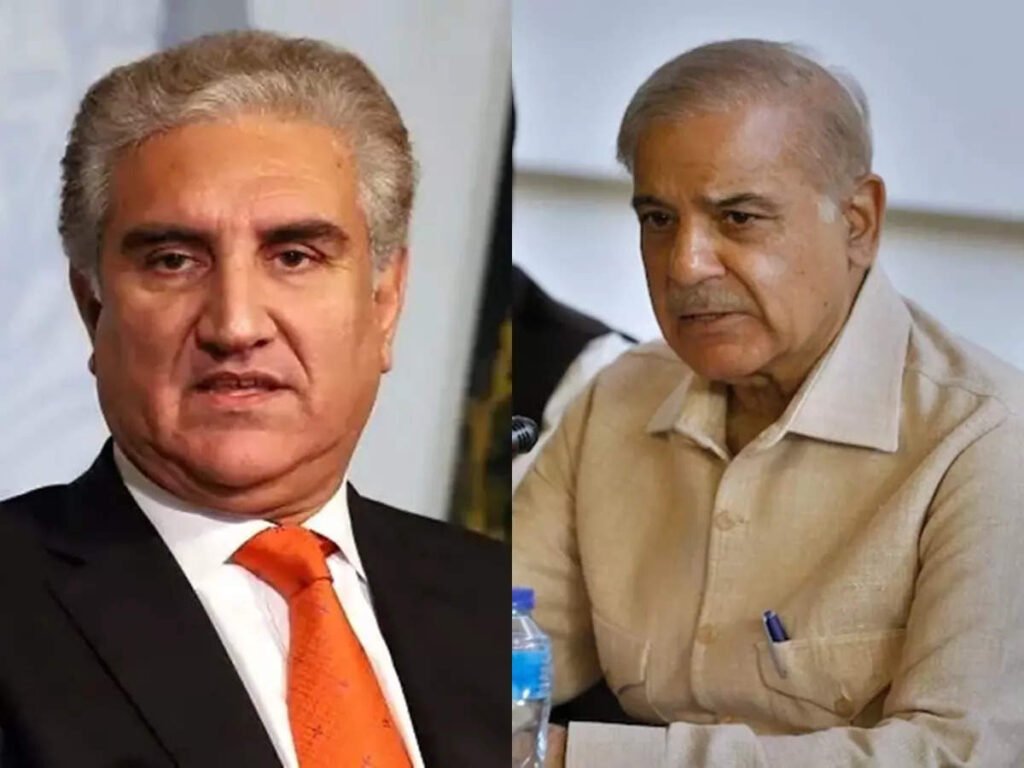
On Monday (today), the National Assembly will elect a new House leader, with Shehbaz Sharif, a former ruling party member, as the front-runner. According to the sources, the PTI has proposed Shah Mehmood Qureshi as its prime ministerial candidate.
Shehbaz Sharif, the president of the Pakistan Muslim League-Nawaz (PML-N) and the joint opposition’s candidate, personally filed his nomination papers at the National Assembly Secretariat, while Shah Mehmood Qureshi, the PTI Party candidate for Prime Minister, filed his nomination papers.
Shehbaz Sharif filed 13 nomination papers with the NA secretary’s office.
Asif Ali Zardari, Bilawal Bhutto, Khawaja Asif, Rana Tanveer, Amir Haider Hoti, Shahzain Bugti, Khursheed Shah, Naveed Qamar, Ayaz Sadiq, Saad Rafique, and others were among those who proposed and seconded PML-N president Shehbaz Sharif’s nomination papers.
The opposition leaders also met in Shehbaz Sharif’s chamber to discuss the strategy for electing a new House leader.
Amir Dogar proposed Shah Mahmood Qureshi’s nomination papers, which were seconded by Maleeka Bokhari.
Shehbaz Sharif’s nomination papers have been confirmed by the Assembly secretariat.
Shehbaz Sharif later thanked all political leaders and workers for their support in a tweet.
The Assembly session on Monday, which was scheduled to begin at 11:00 a.m., will now begin at 2:00 p.m.
The list of candidates will be released once the papers have been declared valid after a thorough examination, which will take place soon.
It’s worth noting that Prime Minister Imran Khan was removed from office by Parliament on Saturday night after a vote of no-confidence. 174 members of the Opposition voted to remove Imran Khan from his position.
President Alvi gave an update on the NA standings.
Imran Khan is no longer Prime Minister of Pakistan, according to the National Assembly Secretariat, after a no-confidence motion against him was passed with 174 votes.
According to sources, the president was informed by National Assembly Secretariat Secretary Tahir Hussain in accordance with Assembly Rule 38.
He also informed the president that the National Assembly now has a majority of the joint opposition.
The most pressing issues confronting the next president
Following Imran Khan’s dismissal, whoever succeeds him as Pakistan’s next prime minister will inherit the same problems that plagued the former international cricketer.
The economy will be a priority for the next administration, as will rising militancy and shaky relations with former allies.
Professor Jaffar Ahmed, director of the Institute of Historical and Social Research, said the incoming government will face “multiple challenges on domestic and foreign relations levels.”
The following are the major issues that the country’s 220 million people will face in the coming months:
The state of the economy
The combination of crippling debt, soaring inflation, and a weak currency have kept growth at a standstill for the past three years, with little prospect of genuine improvement.
“We don’t know where we’re going,” said Nadeemul Haque, vice-chancellor of the Pakistan Institute of Development Economics (PIDE), an Islamabad-based research institute.
“To turn the economy around, radical policy reforms are required.”
Inflation is at over 12%, foreign debt is at $130 billion (or 43% of GDP), and the rupee has fallen to 190 against the dollar, a drop of nearly a third since Khan took power.
Khan signed a $6 billion bailout package with the International Monetary Fund (IMF) in 2019, but the government failed to follow through on promises to reduce or eliminate subsidies on certain goods and improve revenue and tax collection.
“The IMF package must continue,” said Pakistan Business Council Chairman Ehsan Malik.
On the plus side, remittances from Pakistan’s vast diaspora have never been higher, despite the fact that the cash flows have put Pakistan on the radar of the Financial Action Task Force, a global anti-money laundering and anti-terrorist financing watchdog.
“This is a dangling sword that could come crashing down on the country at any moment,” Jaffar said.
An increase in militancy
In recent months, Pakistan’s Taliban, a separate movement with common roots with the militants who took power in Afghanistan last year, have increased their attacks.
They have threatened to attack government forces during Ramadan and have been blamed for a series of murderous attacks in the past.
Khan attempted to reintegrate militants into society, but talks with the Tehreek-e-Taliban Pakistan (TTP) militants failed last year, and a month-long cease-fire was broken.
The Taliban in Afghanistan have stated that the country will not be used as a base for foreign militants, but it is unclear whether they will genuinely put an end to the activities of thousands of Pakistani Islamists based there, or where they will go if they are expelled.
Experts say there are no easy solutions, even for the incoming government.
“The insurgency challenge will remain large and important for the new government,” political analyst Rafiullah Kakar predicted.
Separatists have been demanding more autonomy and a larger share of the wealth in mineral-rich Balochistan for years, and the region is riven by sectarian strife and violence.
Kakar proposed a two-pronged strategy in Balochistan, including “confidence-building measures and political reconciliation,” as well as removing the kid gloves from the Taliban “once and for all.”
International relations
Imran Khan claims that the US conspired with the opposition to remove him and that the next government will have to work hard to repair relations with Washington, which is a key arms supplier countering Russia’s trade with India.
Khan enraged the West by continuing his visit to Moscow on the day Russia invaded Ukraine, and by being one of the few world leaders to attend the opening of the Beijing Winter Olympics while others boycotted due to China’s human rights record.
Nonetheless, Army Chief General Qamar Javed Bajwa allayed some fears last weekend by saying that good relations with the US remain a top priority for Pakistan — and that the military wields enormous power regardless of which civilian administration is in power.
Tauseef Ahmed Khan, a political analyst and journalism professor, said, “The incoming government… needs to put in a lot of effort to undo the damage.”
The US State Department says it is keeping an eye on the situation in Pakistan.
In response to Pakistan’s recent political and constitutional crisis, a spokesperson for the US State Department stated that the country’s situation is being closely monitored.
The spokesperson expressed optimism that political parties will maintain their commitment to democratic values and good governance.
The US government flatly denied Prime Minister Imran Khan’s allegations that it was involved in overthrowing his government through a no-trust motion on Saturday.
Former Prime Minister Imran Khan addressed the nation on Friday, reiterating his position that he would not tolerate the establishment of a “foreign government” in Pakistan and that if this occurred, he would seek public support.
He stated that he would never accept an “imported government” and that he would leave the decision to the people.
