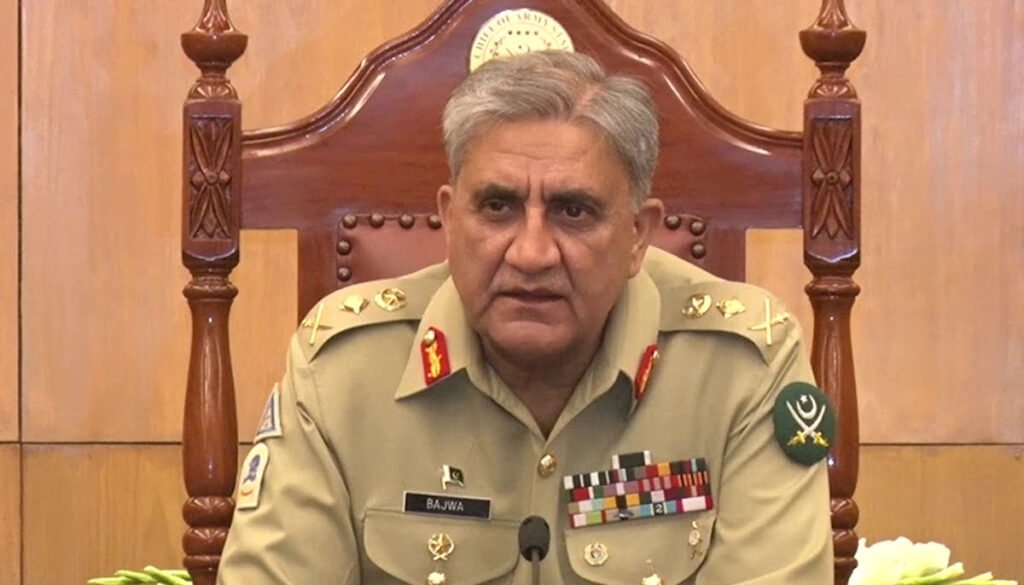
ISLAMABAD: Pakistan’s Chief of Army Staff, General Qamar Javed Bajwa, reiterated Saturday that the country wants to strengthen ties with the US, but not at the expense of bilateral relations with other countries.
The army chief stated at the Islamabad Security Dialogue that Pakistan does not believe in camp politics and that its bilateral relationships with partners do not come at the expense of relationships with other countries.
He also stated that Islamabad has a close relationship with Beijing, as evidenced by the country’s commitment to the China-Pakistan Economic Corridor (CPEC).
Meanwhile, he noted that Pakistan has a “long history of excellent and strategic relationship” with the US, which remains our largest export market.
“We seek to broaden and expand our ties with both countries while not jeopardising our relations with either,” he said.
The two-day dialogue, themed “Comprehensive Security: Reimagining International Cooperation,” brought together Pakistani and international policy experts to discuss emerging challenges in international security.
The Islamabad Security Dialogue features 17 international speakers from the United States, China, the United Kingdom, Russia, the European Union, Japan, the Philippines, and other countries.
COAS Gen Bajwa acknowledged the National Security Division’s efforts in organising the second security dialogue, saying, “I believe today more than ever we need to inculcate and promote such spaces for intellectual debate and discourse where people from around the world come together to share their ideas about the future of their country and the world at large.”
He believed that spaces like this are especially important because great minds can identify the need for global cooperation rather than confrontation.
Concerning the unprecedented challenges confronting the world, he stated that the resurgence of inter-state conflicts amid shared global challenges such as poverty, climate change, terrorism, cyber intrusion, and resource scarcity raises serious concerns for the international system.
“The collective security of the international community is based on our ability to integrate our shared goals of global prosperity into an equitable international system that can withstand external pressures.”
“As a country at a crossroads of economic and strategic challenges, Pakistan is navigating these shared challenges in our immediate region and through our partnership in the international community,” he said.
National Security Strategy
The chief of army staff went on to say that Pakistan’s first-ever National Security Policy prioritises the safety, security, dignity, and prosperity of its citizens.
“It [National Security Policy] recognises the symbiotic relationship between economic, human, and traditional security, emphasising economic security,” he said.
Gen Bajwa went on to say that the policy’s ultimate goal is to achieve prosperity for Pakistan’s citizens and that it focuses on ensuring domestic economic stability and growth, augmented by development partnerships with the international community as part of our geo-economic strategy.
COAS stated that in order to achieve this necessary peace at home and abroad, Pakistan’s security forces have made numerous sacrifices to defeat terrorism. He emphasised that Pakistan has suffered over 90,000 casualties and more than Rs150 billion in economic losses since 2001.
“Our commitment to defeating terrorism remains unwavering,” he said, adding that with the assistance of security and law enforcement agencies, the country has made remarkable gains against terrorism, resulting in a remarkable improvement in the country’s internal security situation.
COAS Gen Bajwa, on the other hand, stated that the threat of terrorism and violent extremism remains and that the fight will continue until “the last terrorist and cause of terrorism from our region is eliminated.”
“We are committed to preserving our gains against terrorism and are working with the interim Afghan government and other neighbours to ensure that terrorist organisations are no longer allowed to use one country’s territory against another,” he said.
“Our goal is a peaceful and prosperous West and South Asia,” he said, adding that Pakistan’s National Security Policy promotes national security cohesion and harmony through the principles of unity and diversity.
“By celebrating our country’s diversity, we can continue to eliminate intolerance and extremism.” “I fully recognise that it is a huge challenge, but we are committed and will not relent until we have transformed Pakistan into a moderate and forward-thinking country, as envisioned by our founding father, Quaid-e-Azam Mohammad Ali Jinnah,” he said.
Recognizing that regions, not countries, grow, the COAS stated, “We believe that peace and stability in our larger region are prerequisites for achieving shared regional prosperity and development.”
“Our doors are open for all our neighbours in this regard,” he said.
Afghanistan’s Crisis
“Decades of conflict in our immediate west have created negative externalities and spill-over effects that have negatively impacted our economy, society, and security,” he said, adding that Pakistan wants to work closely with the international community to achieve peace and stability in Afghanistan.
COAS Gen Bajwa shed light on the challenges, saying, “Unfortunately, a lack of financial flows and continued sanctions are creating a humanitarian crisis in Afghanistan.”
He stated that Pakistan has worked tirelessly in collaboration with the international community to provide humanitarian aid to the people of Afghanistan, but that “much more is required.”
“It is our collective responsibility to the people of Afghanistan to ensure the timely and adequate flow of humanitarian aid into the country; however, the world, particularly the West, is preoccupied with the humanitarian crisis unfolding in Ukraine,” he said, emphasising that we must not forget the 40 million Afghans during these difficult times.
“Failure to address the humanitarian crisis in Afghanistan will not only result in a refugee crisis but will also re-establish Afghanistan as an epicentre of terrorism where Daesh — which has a global agenda — thrives, potentially leading to more than one 9/11,” he said.
“For better or worse, the international community must keep the Afghan government’s nose above water.”
When asked about the performance of the interim Afghan government, he stated, “The current Afghan government’s performance is not satisfactory, to say the least, but we must be patient and accommodating.”
“Instead of imposing sanctions, which have never worked,” he said, “we must incentivize Afghans for their positive work and behavioural change,” emphasising that withdrawal from Afghanistan is “not an option.”
“We urge the international community to express their concerns directly to the Afghan interim government and to maintain their engagement to ensure an uninterrupted flow of humanitarian assistance to the people of Afghanistan,” he said.
He emphasised that Pakistan already hosts over four million Afghan refugees, both registered and unregistered.
South Asian peace
He described the situation on the Eastern border and the Line of Control (LOC) as “satisfactory and fairly peaceful,” adding that, thankfully, no incident has occurred along the LoC in the last year, bringing relief to people on both sides.
He did, however, state that the incident of a missile launch from India into Pakistan on March 9, 2022, is a source of “serious concern” for Islamabad.
This is the first time in history that a supersonic cruise missile from one nuclear-armed nation has landed in another; “this raises serious concerns about India’s ability to manage and operate high-end weapon systems.”
“India’s indifferent attitude in not immediately informing Pakistan about an irrelevant launch of a missile is equally concerning,” he said, hoping that the international community will recognise that this incident could have resulted in the loss of lives in Pakistan or the accidental shooting down of a passenger plane flying along the path of the cruise missile.
He reiterated Pakistan’s call for an extensive investigation into the incident, saying, “We expect India to provide evidence to ensure Pakistan and the world that their weapons are safe and secure.”
“On our part, we have once again demonstrated maturity and responsibility in our response, as we did in early 2019 when Pakistan demonstrated its role as a responsible member of the international community by returning the captured pilot of an intruding fighter aircraft,” he said.
“Pakistan continues to believe in using dialogue and diplomacy to resolve all outstanding issues, including the Kashmir dispute, and is ready to move forward on this front if India agrees to do so,” he said, reiterating the country’s stance. “With one-third of the world in the Gulf region involved in some sort of conflict and war, it is important that we keep the flames of fire away from our region.”
In this regard, he added that, in addition to the Kashmir dispute, Pakistan is deeply concerned about the Indo-China border dispute, which “we want to resolve quickly through dialogue and diplomacy.”
“I believe it is time for the region’s political leadership to rise above their emotional and perceptional biases and break the shackles of history to bring peace and prosperity to the region’s nearly three billion people,” he said, highlighting the obstinate behaviour of Indian leaders.
‘Pakistan does not believe in camp politics,’ says one observer.
“Pakistan does not believe in camp politics,” he said, adding that “our bilateral relationships with our partners do not come at the expense of our relationships with other countries.”
In terms of Pakistan-China relations, he stated that Islamabad has a close relationship with Beijing, as evidenced by the country’s commitment to the China-Pakistan Economic Corridor (CPEC).
Meanwhile, he stated that Pakistan has a “long history of excellent and strategic relationship” with the US, which remains our largest export market.
“We seek to broaden and expand our ties with both countries while not jeopardising our relations with either,” he said.
The COAS has called for a cease-fire between Russia and Ukraine.
Gen. Bajwa shared his thoughts on the Ukrainian crisis. Pakistan is deeply concerned about the Ukraine conflict, despite the fact that the two countries have had excellent defence and economic relations since their independence.
“Pakistan had cold relations with Russia for a long time for a variety of reasons; however, there have recently been some positive developments in this regard,” he said.
“Unfortunately, the Russian invasion has been very unfortunate in that thousands of people have been killed, millions have become refugees, and half of Ukraine has been destroyed,” he said, emphasising the need to address the issue “immediately.”
“Pakistan has consistently called for an immediate ceasefire […] we support immediate dialogue between all parties to find a lasting solution to the conflict,” he said, mentioning Pakistan’s humanitarian aid to Ukraine.
“The continuation or expansion of the conflict in Ukraine will not serve the interests of any party, least of all developing countries, which will continue to bear the social and economic costs of the conflict — a conflict that can easily spiral out of control,” the COAS said.
According to the army chief, the world today, at this civilisational and scientific apex, is built by those who imagined and believed in cooperation, respect, and equality rather than divisions, warmongering, and dominance.
“Pakistan today is in the unique position of having very cordial historic relations with both camps,” he said.
“By carrying out selective modernisation of equipment, the conflict gave hope to smaller countries that they could still defend their territory with smaller but agile forces against aggression by a bigger country,” he concluded.
