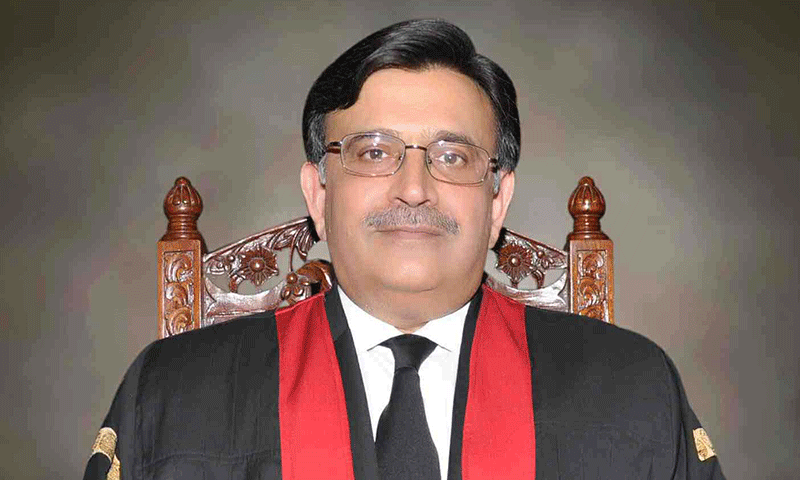
Pakistan’s Chief Justice Umar Ata Bandial stated that dissidents must face the consequences of opposing party policies because the disqualification under Article 63 ranges from 2 to 5 years.
On Monday, a five-judge bigger bench of the Supreme Court led by CJP Bandial heard the presidential reference seeking interpretation of Article 63-A of the Pakistan Constitution and the Supreme Court Bar Association’s (SCBA) petition against political demonstrations in the federal capital.
The AGP informed the court at the start of the hearing that, in addition to Article 63 (A), Article 62 (1) F will be applied against the dissident members. He contended that the dissident would be barred from serving for the rest of his life.
In this regard, Justice Ijazul Ahsan stated that deviation from party policy constituted dubious behavior. “If it is proven that loyalty was changed for monetary benefit, then disqualification will occur,” he continued.
The question before the bench, according to AGP Khalid Jawed Khan, was how the court could read something that was not contained in the constitution. He stated that he wished to provide a reference to the Supreme Court’s 2018 decision.
He stated that the apex court demanded an affidavit along with the nomination papers for the election, despite the fact that the requirement of an affidavit was not in the legislation, and that the affidavit was obtained on the court’s directives.
He went on to say that the court ruled that the nomination documents were inadequate since they lacked affidavits.
Justice Jamal Khan Mandokhel questioned AGP Jawed Khan on how the court could relate Article 63 with Article 62 (1) F, and whether the AGP thought there was a gap in Article 63. (A).
The AGP claimed that Article 63 (A) could not be read independently.
The sanctity and legality of the elections were addressed in the court judgment, according to Chief Justice Bandial.
