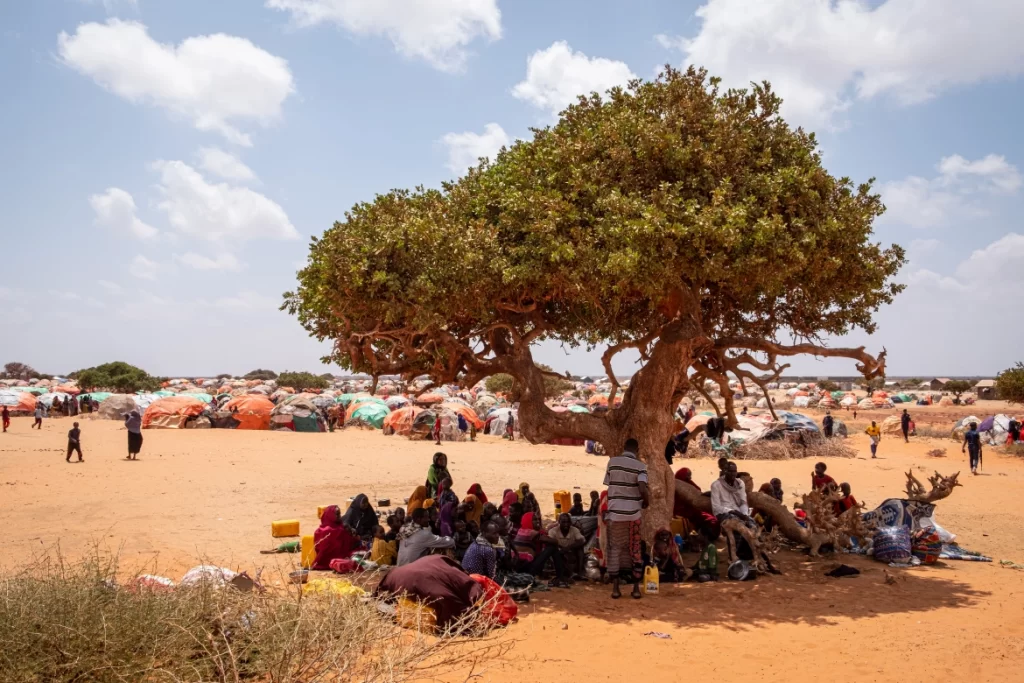
Somalia, Luglow – Millions of people in the Horn of Africa are facing severe hunger as a result of the region’s worst drought in 40 years.
Aid agencies fear that, as the situation worsens, a focus on the Ukraine crisis will overwhelm the agenda and donors at a critical time for Somalia, in particular, in East Africa.
Currently, one out of every four Somalis is hungry due to severe drought, and the United Nations (UN) estimates that 4.6 million Somalis will go hungry by May 2022.
People are flocking to camps for internally displaced persons in Somalia’s southern regions (IDPs). Dead goats, camels, sheep, cows, and donkeys litter the area, all of which died due to a lack of water.
The situation in the camps is dire. There isn’t enough food, and water trucks are only bringing in small amounts of water. Malnutrition affects a large number of children.
“Five years ago, there was enough aid from the international community,” says Mohamud Ahmed, a Somalian aid worker with Save the Children. “The response was adequate.” This time, however, that vigilance is missing. There is a significant disparity between the amount we require and the amount raised thus far.”
Only 3.2 percent ($47.1 million) of the required funding ($1.5 billion) for the UN Office for the Coordination of Humanitarian Affairs’ humanitarian response plan has been received so far, according to the UN.
If the funding shortfall persists, the UN’s World Food Programme will have to prioritise funds, according to WFP spokesman Petroc Wilton. “It’s incredibly difficult because you have to choose which areas and populations need help the most,” Wilton said.
The organisation has already been forced to transfer money from its preventive programmes in Somalia to curative aid, he said.
“The situation is extremely dire,” Wilton continues. “We are already seeing the effects of the financing gap in the camps. We simply cannot help all the people who need help. It’s going to get worse unless we can somehow bridge that funding gap.”
After a devastating locust invasion, the negative economic effects of the COVID-19 pandemic and the ongoing drought, the war in Ukraine might be the latest blow to the already worrying situation in East Africa.
Last year, 53 percent of the food that WFP received in Somalia came from Ukraine. Now that the port of Odesa, Ukraine is closed for the export of food aid, WFP is predicting food scarcity and skyrocketing prices for staples such as wheat and peas in Somalia.
