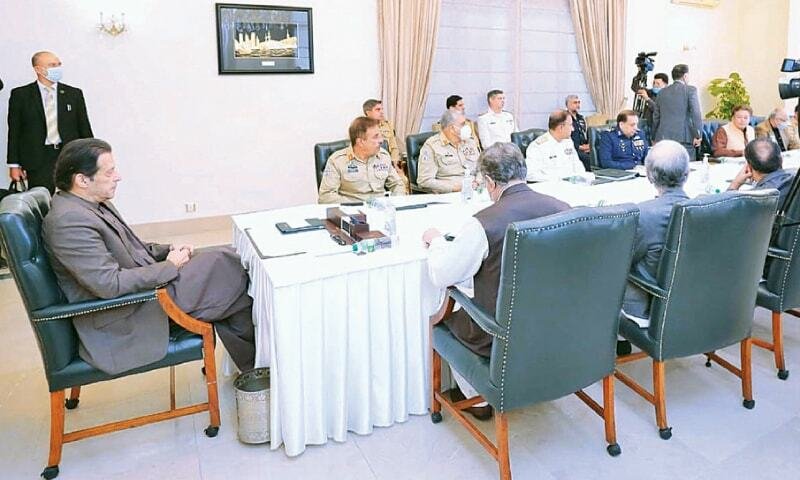
The concerned citizens of Pakistan were still reeling from the shockwaves made by the public version of the National Security Policy of Pakistan (NSP) 2022-2026, the nascent premium security document of the state, on account of the glaringly meager attention and discourse on the Islamic ideological basis of the country when they have been hurled another fireball in the form of the new ‘National Counter Violent Extremism (NCVE) Policy 2021’, disclosed by the investigative journalist Asif Chaudhry in his piece, “New anti-extremism policy to keep tabs on law enforcement ranks” Published in Dawn, January 22nd, 2022.
The NSP appallingly imprisons itself while addressing the ideological foundation of Pakistan to less than one and a half-sentence in the 62-page public version, which is reportedly just one-half of the entire document!
However, the National Counter Violent Extremism (NCVE) Policy 2021 clearly demonstrates a narrative that is essentially propositioned and predicated on Western liberal and secular ideals, with the blunt aim to promote pluralism, modernism, the ‘enlightened and modern’ version of Islam as well as painting a target on the fundamentalist and traditionalist Muslims of Pakistan without cause or definition by branding them as violent-extremist and radicals. The net outcome is a narrative and frankly a policy that shows a fundamental departure from our religious tradition and orthodoxy, which are the bedrocks of the Islamic Republic of Pakistan. It is a blatant attempt to dilute, if not revoke, the notion of a robust Islamic polity – Pakistan’ as envisioned by Jinnah, Iqbal, our constitution, and above all the Qur’an and Sunnah, by the stroke of a pen.
The use of so-called policies to ‘Counter Violent Extremism’ as a tool to develop anti-Islam plans of action is not new, either in Pakistan or the rest of the world. The post-911 world has seen a blanket ban by states on the notion of ‘political Islam’, without cause, as well as coining the grossly ambiguous phrases ‘extremism’, ‘violent extremism’ and ‘radicalization’, which are applied arbitrarily to target any and all that do not adhere to the ideology of secularism, liberalism, modernism, and ‘modernist Islam’. Pervez Musharraf tried it in the guise of ‘Enlightened Moderation’ (EM) (Ref: http://escholar.umt.edu.pk:8080/jspui/bitstream/123456789/2737/1/Summary.pdf), the UK is still perusing it under the label of ‘Preventing Violent Extremism’ (or simple the ‘Prevent’ program) since 2009, the US has failed after bombing half of the Muslim world in its so-called ‘war on terror’, yet the secular, liberal and modernist elements of the world are bent on falsely maligning and castigating the Muslims in general and the fundamentalist and traditionist ones in particular as a threat to the society, county or the entire world – as violent-extremists and radicals. Their narrative is fundamentally fallacious!
The five key objectives and as many target areas that have been mentioned in the National Counter Violent Extremism (NCVE) Policy 2021 proposed by the federal government, demonstrate, in all honesty, that the NCVE is but an extension of the EM agenda itself.
Even a cursory study of the ‘key features of the new national-level policy, geared towards ‘winning hearts and minds’, developed by the Interior Ministry and the National Counter Terrorism Authority (NACTA) (the agency responsible for putting the document together), the NCVE policy is framed in accordance with the dictates of the blemished National Action Plan (NAP), developed in August 2021, and indicates a remarkable resemblance to the conclusions drawn in the RAND report of 2004 titled: “Civil Democratic Islam: Partners, Resources, and Strategies” by Cheryl Benard (Ref: https://www.rand.org/pubs/monograph_reports/MR1716.html) and the “Prevent” program (Ref: https://www.lbhf.gov.uk/crime/prevent-strategy-overview-and-contact-details/) being exercised in the UK. Most of the vernacular jargon and modes of applications have clearly been borrowed from those two sources.
The concerned citizens of Pakistan have always condemned terrorist tendencies and acts such as the attack on the Army Public School in Peshawar and the lynching of a Sri Lankan national in Sialkot, and frankly they are becoming exhausted of apologizing for acts that they neither committed nor condoned. However, using such incidents as a pretext to invoke a police-state, that will fundamentally be regressive in nature and use every possible trick in the book to demonize and stigmatize practicing traditionist and orthodox Muslims is, surely, fiendish to say the least.
The NCVE policy clearly spells out roles, activities, and even key performance indicators for each activity, meaning thereby that for all practical intents and purposes, despite the vernacular jiggery-pokery, educational institutions and law enforcement apparatus – two agencies at the opposite poles of the spectrum – would be united in means and outcomes, viz., using brute force without fear of reprisal, without cause against the ‘target’.
Policies like the NCVE have the inevitable tendency to be abused. For instance, The Muslim Council of Britain in a report titled “Concerns on Prevent” lists a plethora of examples of excesses against Muslims in the UK (which in the case of Pakistan would be against traditionalist and orthodox Muslims): (Ref: https://www.mcb.org.uk/wp-content/uploads/2015/10/20150803-Case-studies-about-Prevent.pdf)
Similar conclusions regarding the dubious nature and stigmatizing outcomes of policies and strategies such as the NCVE Policy have been drawn by Therese O’Toole, Nasar Meer, Daniel Nilsson, DeHanas, Stephen H Jones, and Tariq Modood in the paper, “Governing through Prevent? Regulation and Contested Practice in State-Muslim Engagement”. (Ref: https://research.birmingham.ac.uk/en/publications/governing-through-prevent-regulation-and-contested-practice-in-st)
Finally, a more nuanced discourse on the key objectives and target areas of National Counter Violent Extremism (NCVE) Policy 2021 would inevitably lead to the following questions:
1. Is the NCVE Policy not essentially predicated on the Western philosophical ideology of liberalism, secularism, and modernism, with no safeguards guaranteed regarding the Islamic rights of the citizens of Pakistan provided by the constitution under articles 2(A), 31, and 227 to name a few?
2. Is the NCVE Policy not meant to adopt a narrative and the ensuing policy that traditional religious education is nurseries of violence and terrorism? Does any empirical data back that rhetoric of stigmatizing certain Muslims, without cause?
3. Does the NCVE Policy not propose that the education system (pedagogy) of all kinds of learning institutions be tuned to suit a modernist version of Islam on the one hand, while labeling all institutions, including traditional and orthodox madrasas that provide learning according to the universally accepted fundamentals of Islam agreed upon for more than fourteen centuries in the spheres of private life as well as public and collective life (political, economic and social spheres), as ‘violent-extremists’, ‘radicals’ and potentially even ‘terrorists’?
4. Does the NCVE Policy not fundamentally question the percept of the history and the important contemporary place of traditional madrasas in todays’ world, without cause?
5. Is the NCVE Policy not aimed at completely repositioning the mission of the Single National Curriculum (SNC) from “One system of Education for all, in terms of curriculum, medium of instruction and a common platform of assessment so that all children have a fair and equal opportunity to receive a high-quality education.” to inundating the misguided notion of ‘winning the hearts and minds of the children and young people’ with abject hatred towards traditional Islam, fundamentals of the Deen and orthodoxy?
6. Is the NCVE Policy not aimed at demolishing important positions of Islam on matters such as objective morality, apostasy, blasphemy, shariah laws, hudud and taziraat, political, economic, and social worldviews?
7. Is the NCVE Policy not founded on a departure from the central role of Qur’an, Sunnah, Seerah, Islaaf, Islamic tradition, and shariah towards unqualified, yet unproven, the superior rank of the modern western systems and philosophies of statecraft, national security and education.
8. Is the NCVE Policy not intended at introducing an Orwellian security apparatus that would look down at those related in any way or form to Madrasas, Mosques and other places of worship, and orthodox religious groups, communities, and parties as enemies to be ‘dealt with at any cost, without cause?
9. Does the NCVE policy not highlight the need for a uniform CVE law — on the pattern of the Anti-Terrorism Act (ATA) 1997 — by giving absolute powers to the Special Branch and prosecutorial responsibility to Counter Terrorism Departments (CTDs), inevitability leading to a Gestapo-syndrome in law enforcement?
10. By establishing CVE units in the Special Branch and giving prosecutorial responsibility to Counter Terrorism Departments (CTDs) to maintain checks and balances within police ranks, does the NCVE policy not attempt to hijack the normal course taken by the criminal justice system in the country, to serve its own agenda?
11. According to sources, the National Counter Violent Extremism (NCVE) Policy 2021 has been finalized following consultations with federal and provincial authorities, law enforcement, lawyers, and minority representatives… Do only the privileged liberals, seculars, and modernists now have a monopoly over defining the direction of the country? Do other sections of the society, including religious leaders and parties, not have the entitlement to be included in consultations entailing matters of national interest and security? Are they not ‘equals’ to everyone else in terms of being socially-contracted members of the nation?
12. Is this the Pakistan that we have become?
It has been reported that the federal government has dispatched the latest draft of the proposed NCVE policy to the provinces before submitting it to the PM Secretariat for final approval. It is high time for the PM to, for once, walk the talk on “Riyasat-e-Madinah’ and stop the National Counter Violent Extremism (NCVE) Policy 2021 from coming into force.
