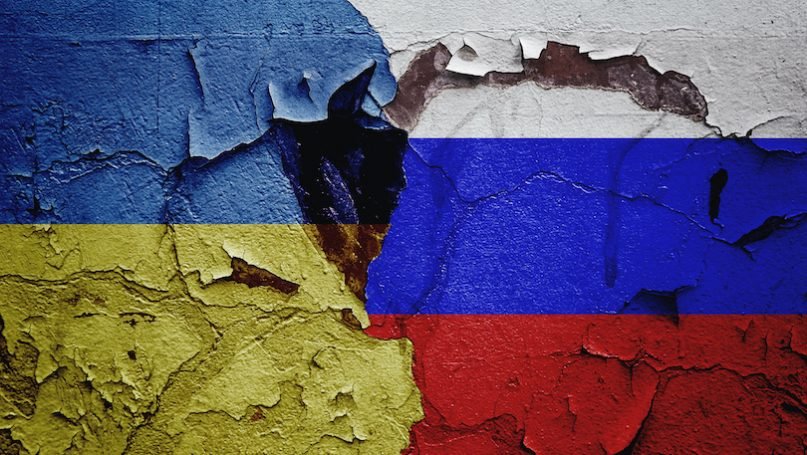
Ukraine-Russia crisis that started in February 2022, has progressed with utmost speed. The world is looking at the unfolding of the deadly war-like situation due to the Russian invasion, started on the grounds of genocide against territories in the Luhansk and Donetsk, oblasts of Ukraine, and the latter’s resistance against the former. Many national and international commentators have predicted it as the onset of another fatal World War. In the backdrop of such testing times, to protect its territorial integrity and political independence, Ukraine has knocked the doors of the International Court of Justice. The International Court of Justice (ICJ) is the principal judicial organ of the United Nations. It was established by the United Nations Charter in June 1945 and began its activities in April 1946. The Court has a twofold role that is first, to settle legal disputes, in accordance with international law, through judgments which have binding force and are without appeal for the parties concerned, submitted to it by States; and, second, to give advisory opinions on legal questions referred to it by duly authorized United Nations organs and agencies of the system. Ukraine has now approached the ICJ for making Russia suspend its military operations. The country has requested the International Court for passing provisional measures against the invading state. However, this action of Ukraine has raised many questions under international law as to the jurisdiction of ICJ that are required to be addressed.
Firstly, the question arises whether ICJ has the jurisdiction to deal with a matter when only one party has instituted proceedings before it while the other party has not directly submitted as the Russian Federation did not participate in the whole hearings of the case. The question comes forth because under Article 59 of ICJ statute the court’s decision is only binding on the state parties who have consented to its jurisdiction. However, the answer to this question has been provided by the same statute under Article 36(1). The said Article lucidly enunciates “The jurisdiction of the Court comprises all cases which the parties refer to it and all matters specially provided for in the Charter of the United Nations or in treaties and conventions in force.” This means that the court can assume jurisdiction when a matter has been referred to it by the UN Charter or when a treaty of any kind provides so to which the disputing parties are a member. In the present scenario, the court has jurisdiction because Ukraine and Russia both are members of Prevention and Punishment of the Crime Against Genocide (1948). The Convention lays down under Article IX “Disputes between the Contracting Parties relating to the interpretation, application or fulfillment of the present Convention, including those relating to the responsibility of a State for genocide or for any of the other acts enumerated in article III, shall be submitted to the International Court of Justice at the request of any of the parties to the dispute.” Meaning thereby, the international court has jurisdiction even when Ukraine has solely approached it.
Now, another matter that confronts is whether the ICJ can decide to give the requested provisional measures by Ukraine. Provisional measures, as per Article 41 of the ICJ statute, come within the discretionary powers of the court. The court can give such measures when the circumstances at hand warrant such actions as their objective is to protect the respective rights of either party. The same has also been held in Cameroon v. Nigeria, Provisional Measures, Order of 15 March 1996, ICJ Reports, 1996 “The Court, when considering a request for the indication of provisional measures, must be concerned to preserve…. the rights which may subsequently be adjudged by the Court to belong either to the Applicant or the Respondent.” Similarly, in the Fisheries Jurisdiction Case, the Court emphasized that article 41 presupposes ‘that irreparable prejudice should not be caused to rights which are the subject of dispute in judicial proceedings.’ In the given situation the provisional measures demanded by Ukraine include immediate suspension of The Russian Federation invasion, suspension of military operations by organizations influenced or controlled by the Russian Federation, the state ensures that no more actions will be taken to complicate the dispute and submission of report by Russia to the court regarding compliance to the prior measures. All these provisional measures when carefully evaluated indistinctly put forth that are aimed at preserving the territorial and political rights of Ukraine against any prejudice till the final decision of the court, therefore, they are within the ambit of jurisdiction of the ICJ.
Furthermore, the question regarding the binding force of the court’s provisional measures also comes to the fore. Even if the court rules in favor of Ukraine and permits the provisional measures against the Russian Federation do they have the capacity to make the state comply with them. For this purpose, the ruling of the court in the La Grande case (Germany v. the United States) March 3, 1999, can be appraised in which it was held that the provisional measures of ICJ are binding on states and they have to comply with them at all costs. The court said this in the words provisional measures under Article 41 “was not a mere exhortation” but “created a legal obligation for the United States”. Thus, the provisional measures if applied by the ICJ against the Russian Federation will create a binding effect on the state. The court is currently deliberating on the issue at hand and will give its decision in a couple of days, nonetheless whatever decision the court will give in no way will be outside its jurisdiction.
